 listicle
10 Motocross Fitness Exercises for Kids
Table of Contents
- Why Motocross Fitness Exercises Matter for Young Riders
- Core Strength and Stability for Bike Control
- Youth Motocross Training Drills for Balance and Coordination
- How to Improve Stamina for Dirt Bike Riding
- Upper Body and Grip Strength for Throttle Control
- Building a Safe Training Plan for Young Riders
- Off-Bike Training vs. On-Bike Practice
- Conclusion
Last Updated: August 20, 2026
Why Motocross Fitness Exercises Matter for Young Riders
Physical conditioning separates riders who finish strong from those who fade halfway through a moto. Young motocross riders need core stability to control a machine twice their body weight, cardiovascular endurance to sustain intensity across multiple races, and grip strength and balance that only comes from deliberate training. This guide covers 10 motocross fitness exercises for kids that build the foundation every young rider needs.
At Nelmgerian MX, we understand that off-bike training isn't optional, it's the difference between a kid who loves riding and a kid who can actually compete. Kids who train intentionally ride smoother, recover faster between races, and stay safer because their bodies can handle the demands their ambition creates.
Core Strength and Stability for Bike Control
A strong core keeps you centered on the bike, absorbs impacts through rough terrain, and stabilizes your upper body while your legs manage throttle and body positioning. Young riders with weak cores fight the bike instead of working with it, tire faster, and develop poor habits that become harder to break later.
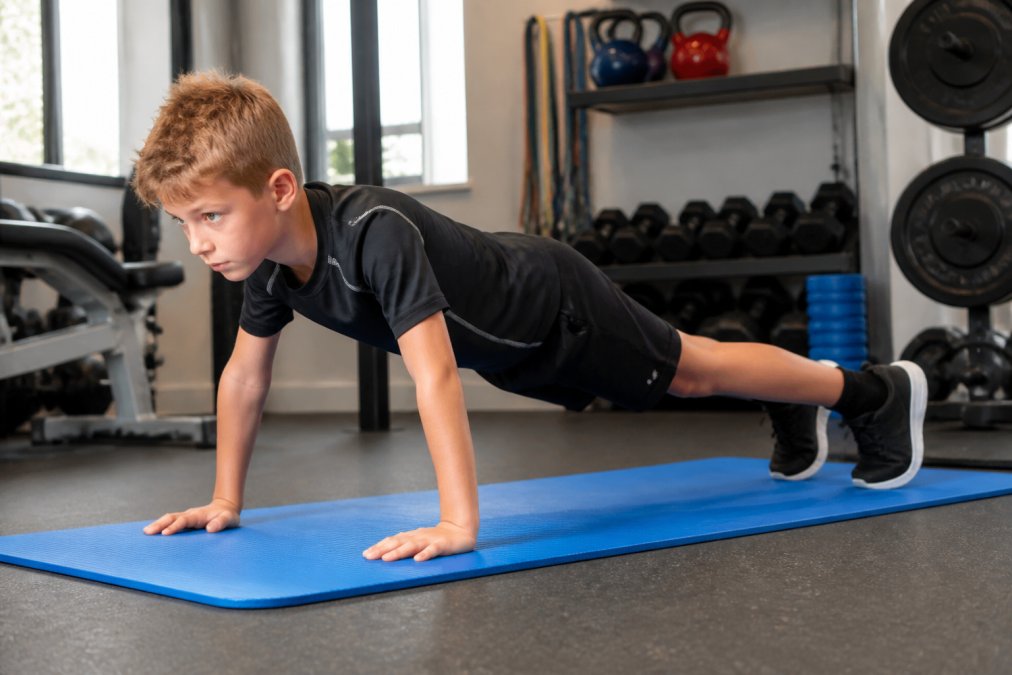
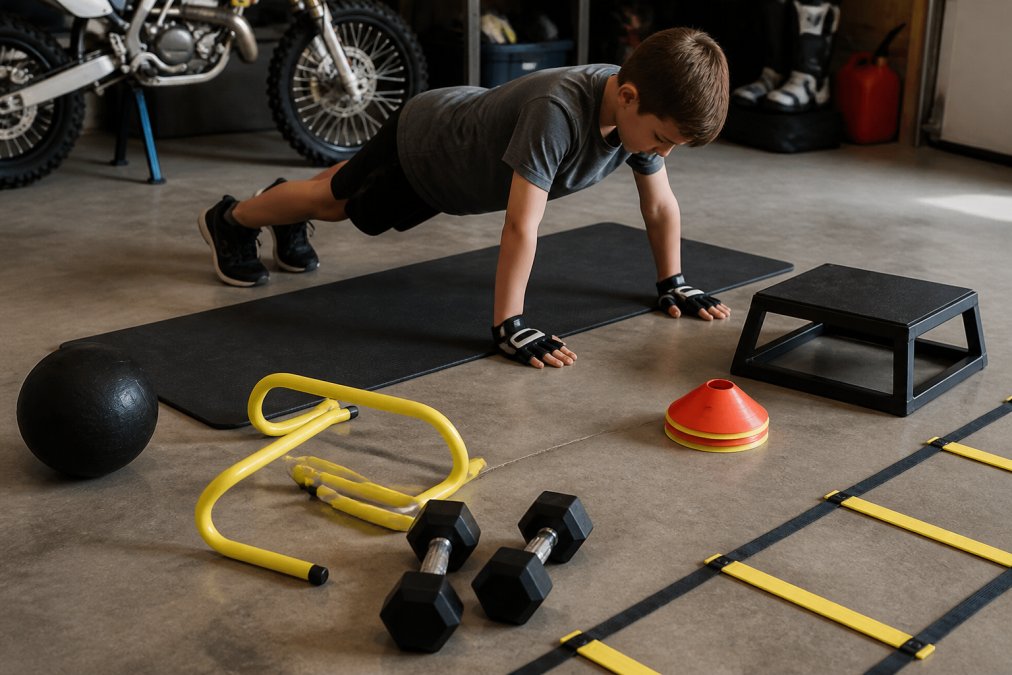
Exercise 1: Plank Hold
The plank is the foundation of core strength, teaching kids to maintain neutral spine alignment and build isometric endurance, exactly what they need when gripping the bike through a rhythm section.
How to perform it:
- Start in a push-up position with forearms on the ground, elbows directly under shoulders
- Keep your body in a straight line from head to heels, no sagging hips
- Engage your core by pulling your belly button toward your spine
- Hold for 20-30 seconds to start, building to 60 seconds as strength improves
- Rest 30 seconds and repeat for 3 sets
Why it works: Planks build anti-rotation stability. When a kid fights to stay centered on the bike through a berm, this is the exact strength they're using.
Exercise 2: Bird Dog
The bird dog teaches cross-body coordination and spinal stability while maintaining balance.
How to perform it:
- Start on hands and knees, with hands directly under shoulders and knees under hips
- Extend your right arm forward and left leg backward simultaneously, creating a straight line
- Hold for 2 seconds, keeping your hips level
- Return to starting position and repeat on the opposite side
- Perform 10 reps per side for 3 sets
Why it works: Motocross requires constant micro-adjustments to maintain balance. The bird dog trains opposite limb coordination while maintaining a stable center.
Exercise 3: Dead Bug
The dead bug builds core strength while keeping the spine neutral, critical for injury prevention in growing kids.
How to perform it:
- Lie on your back with arms extended straight up toward the ceiling
- Lift your legs so knees are bent at 90 degrees, shins parallel to the floor
- Slowly lower your right arm overhead while straightening your left leg, hovering both just above the floor
- Return to starting position and repeat on the opposite side
- Perform 10 reps per side for 3 sets
Why it works: The dead bug trains core stability in a supine position, preventing lower back strain. Young riders often have weak lower backs relative to their upper body strength, and this exercise corrects that imbalance.
Youth Motocross Training Drills for Balance and Coordination
Balance and coordination separate smooth riders from jerky ones. A kid with excellent balance adjusts their body position mid-corner without losing speed. These drills build proprioceptive awareness, your body's sense of where it is in space, that makes riding look effortless.
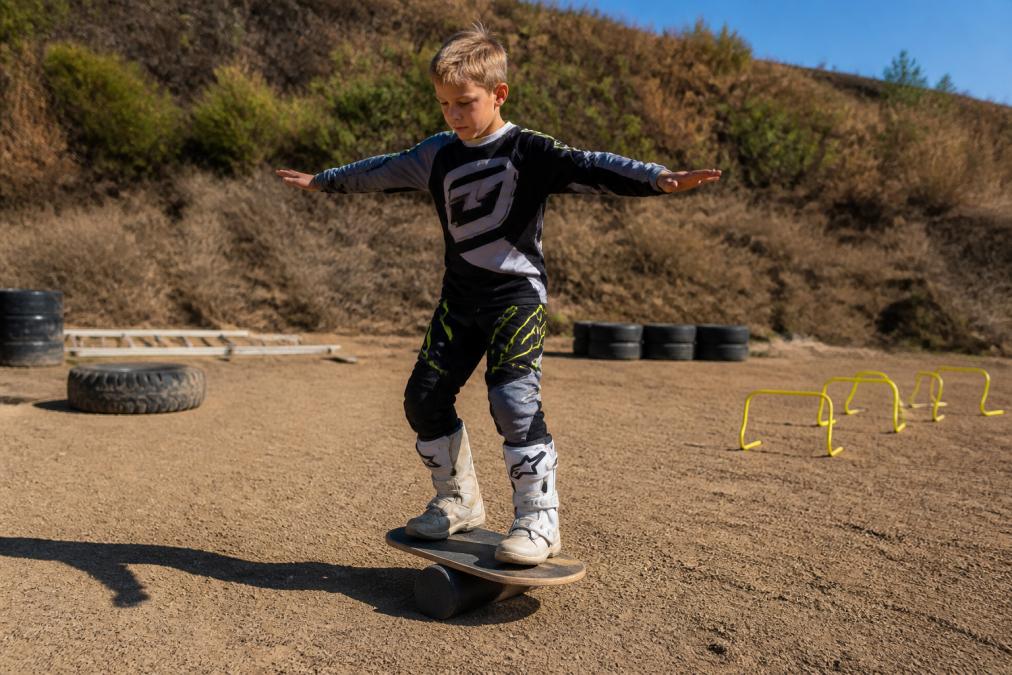
Exercise 4: Balance Board Work
A balance board forces your stabilizer muscles to work overtime, training the exact muscles kids use to stay centered on the bike.
How to perform it:
- Stand on the balance board with feet shoulder-width apart
- Keep your arms out for balance initially
- Try to keep the board level without letting the edges touch the ground
- Start with 30-second intervals, building to 2 minutes as balance improves
- Progress by closing your eyes or catching a ball while balancing
Why it works: Balance boards create an unstable surface that forces constant micro-corrections, training reaction time and proprioception in ways flat-ground training cannot.
Exercise 5: Lateral Slide Training
Lateral movement is crucial for motocross. Riders shift their weight side-to-side constantly, especially through berms and rhythm sections.
How to perform it:
- Stand with feet shoulder-width apart, knees slightly bent
- Slide your right foot to the right while keeping your left foot planted
- Follow by sliding your left foot to meet it
- Continue sliding laterally for 20 feet, then return
- Perform 3 sets of 5 slides each direction
Why it works: Motocross riders move side-to-side constantly. Training lateral movement patterns translates directly to better body positioning on the bike.
Exercise 6: Single-Leg Stance
Single-leg balance forces each leg to develop independent stability, eliminating the ability to use both sides equally.
How to perform it:
- Stand on one leg, keeping the other knee bent with that foot off the ground
- Keep your arms out for balance
- Hold for 30 seconds, then switch legs
- Perform 3 sets per leg
- Progress by closing your eyes or standing on a soft surface like a pillow
Why it works: When a rider is deep in a corner, they're essentially balancing on one leg while the bike does the work. Single-leg stance trains this exact position.
How to Improve Stamina for Dirt Bike Riding
Cardiovascular endurance separates a strong first lap from a strong final lap. Young riders with poor stamina make mistakes in the last third of a moto, missing lines and losing focus. Building aerobic capacity ensures they finish every race as sharp as they started.
Exercise 7: Jump Rope for Cardiovascular Endurance
Jump rope is one of the most efficient tools for building cardiovascular fitness and coordination.
How to perform it:
- Start with 30-second intervals of jumping at a steady pace
- Rest for 30 seconds
- Repeat for 5-10 rounds depending on age and fitness level
- As fitness improves, increase work intervals to 60 seconds or add speed intervals where kids jump as fast as possible for 20 seconds
Why it works: Jump rope builds both aerobic capacity and coordination. The rhythm required translates to the rhythm awareness motocross demands.
Exercise 8: Circuit Training Intervals
Circuit training combines strength and cardio work in short bursts, mimicking the intensity demands of motocross racing.
How to perform it:
- Set up 4-5 stations: plank hold, jump rope, burpees, mountain climbers, and lateral slides
- Perform each exercise for 40 seconds at maximum effort
- Rest for 20 seconds between stations
- Complete 3 rounds with 1-2 minutes rest between rounds
- Adjust work/rest ratios based on age and fitness level
Why it works: Motocross isn't steady-state cardio. It's intense bursts of effort followed by brief recovery. Circuit training replicates this exact pattern.
Upper Body and Grip Strength for Throttle Control
Grip strength and upper body endurance are often overlooked in young rider training. A kid with weak forearms can't maintain throttle control when fatigued. A kid with weak shoulders can't absorb impacts or maintain proper body position through rough terrain.
Exercise 9: Resistance Band Rows
Resistance bands provide variable resistance that's safer for young riders than heavy weights. Rows build back strength and improve posture, critical for maintaining proper riding position.
How to perform it:
- Anchor a resistance band at chest height
- Stand facing the anchor point with the band in both hands, arms extended
- Pull the band toward your chest, squeezing your shoulder blades together
- Hold for 1 second, then slowly return to starting position
- Perform 12-15 reps for 3 sets
Why it works: Rows strengthen the back muscles that stabilize your upper body on the bike. Stronger back muscles mean better posture and less fatigue during longer races.
Exercise 10: Farmer's Carry
The farmer's carry builds grip strength and core stability simultaneously.
How to perform it:
- Hold a dumbbell or kettlebell in each hand at your sides
- Walk forward for 40 meters while maintaining upright posture
- Rest for 60 seconds
- Repeat for 3 sets
Why it works: Farmer's carries build functional grip strength that translates directly to throttle control while engaging your core to maintain posture under load.
Building a Safe Training Plan for Young Riders
Progressive overload, recovery, and injury prevention are non-negotiable when training young athletes. Growth plates don't fully ossify until the late teens, which means young riders are at higher risk for certain injuries if training isn't structured carefully.
Progressive Overload and Age-Appropriate Intensity
Progressive overload means gradually increasing the demands placed on the body. Without it, kids plateau. With it, they improve steadily.
How to implement progressive overload:
- Increase reps before increasing weight
- Increase duration before intensity
- Decrease rest periods between sets
- Add new variations once basics are mastered
Age-appropriate intensity guidelines:
- Ages 5-7: Focus on movement quality and fun. Use bodyweight only. Aim for 2-3 training sessions per week.
- Ages 7-9: Add light resistance bands and balance work. Increase to 3-4 sessions per week. Keep sessions under 30 minutes.
- Ages 9+: Introduce heavier resistance and more complex movements. Can handle 4-5 sessions per week. Sessions can extend to 45 minutes.
Warm-Up and Cool-Down Routines
Every training session should start with a warm-up and end with a cool-down. These reduce injury risk and improve recovery.
5-minute warm-up routine:
- 2 minutes of light cardio (jumping jacks, jogging in place, or jump rope at easy pace)
- 10 arm circles each direction
- 10 leg swings forward/back per leg
- 10 leg swings side-to-side per leg
- 5 bodyweight squats
- 5 inchworms
5-minute cool-down routine:
- 2 minutes of walking to bring heart rate down
- 30-second quad stretch per leg
- 30-second hamstring stretch per leg
- 30-second chest stretch
- 30-second shoulder stretch each side
- Child's pose hold for 30 seconds
Recovery, Rest Days, and Injury Prevention
Recovery is where adaptation happens. A kid who trains hard but doesn't recover properly will get weaker, not stronger. Rest days are when muscles repair and grow stronger.
Recovery principles:
- Schedule at least 1-2 complete rest days per week with no structured training
- Prioritize sleep: young athletes need 8-10 hours per night
- Hydration matters: kids should drink water throughout the day
- Nutrition supports recovery: ensure adequate protein intake
- Monitor for overuse injuries: pain that doesn't improve with rest requires professional evaluation
Off-Bike Training vs. On-Bike Practice
The question isn't whether to do off-bike training or on-bike practice, it's how to balance them. Both are essential. Off-bike training builds the physical foundation that makes on-bike practice more effective.
Recommended training ratio:
- Ages 5-7: 70% on-bike practice, 30% off-bike training
- Ages 7-9: 60% on-bike practice, 40% off-bike training
- Ages 9+: 50% on-bike practice, 50% off-bike training
The most common mistake parents make is assuming more seat time equals better riders. A kid who spends 10 hours per week on the bike but has weak core strength will develop bad habits that are hard to break. A kid who spends 6 hours on the bike and 4 hours in structured off-bike training will progress faster and develop better technique because their body can support proper positioning.
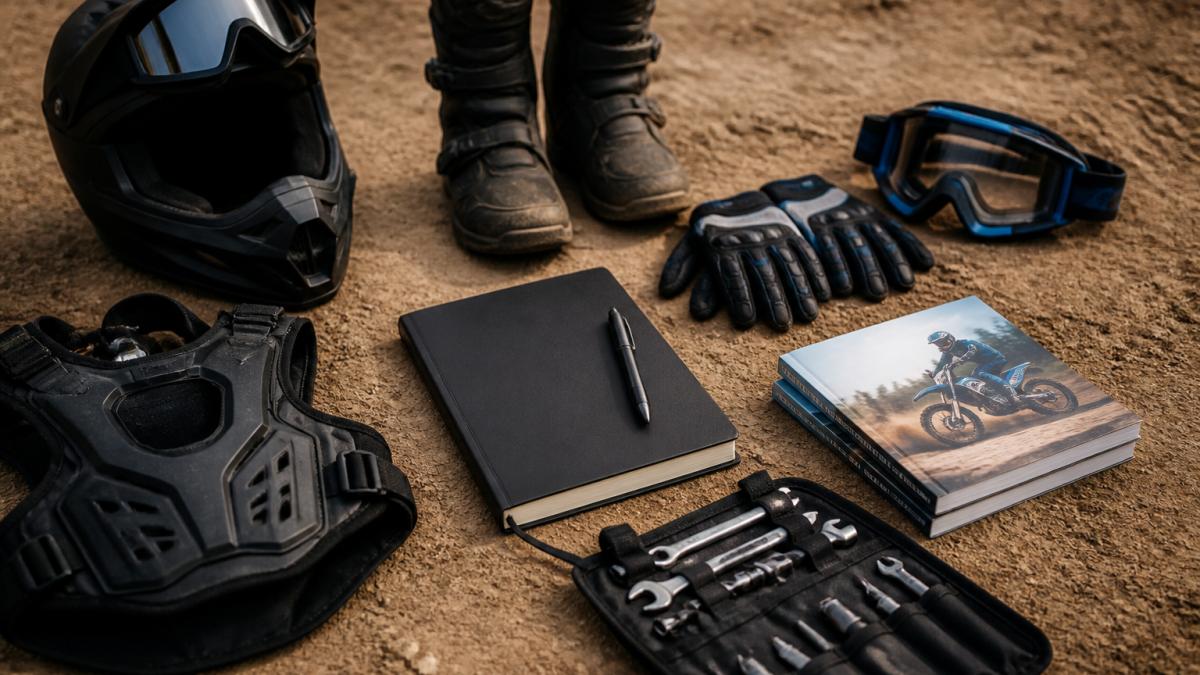
Nelmgerian MX recognizes that complete rider development requires both on-bike and off-bike work. Our rider training journals help young athletes track both their physical conditioning progress and their on-bike skill development, creating a comprehensive picture of their growth as riders.
Building a young motocross rider takes time, consistency, and patience. The 10 motocross fitness exercises for kids outlined here form the foundation of any solid training program. They address the specific physical demands of motocross: core stability, balance, grip strength, cardiovascular endurance, and injury resilience.
Start where your child is, progress slowly, and focus on movement quality over intensity. A five-year-old doing perfect planks will develop better habits than a nine-year-old grinding through poor-form exercises. The goal isn't to create mini CrossFit athletes, it's to build young riders whose bodies can handle the demands their passion creates.
For families committed to their child's development as a motocross rider, consider pairing this training program with structured tracking tools. Nelmgerian MX offers rider training journals designed specifically for young athletes, helping them document their progress both off the bike and on it. Building confidence and knowledge comes from seeing improvement over time, and these journals make that progress visible and tangible.
Frequently Asked Questions
What age is appropriate to start motocross fitness exercises?
Children as young as 5 can begin basic motocross fitness exercises with proper supervision. Focus on bodyweight movements, balance drills, and fun activities that build coordination and body awareness. As kids grow older, you can gradually introduce more structured training, resistance work, and higher-intensity conditioning. Always match the exercise difficulty to your child's age, strength level, and maturity. Starting early builds a strong foundation for physical literacy and confidence on the bike.
How often should kids train for motocross fitness?
Young riders benefit from 3-4 training sessions per week, each lasting 20-30 minutes. This frequency allows for adequate recovery while building consistency. Include at least one rest day between intense sessions to prevent overuse injuries and allow muscle recovery. For kids aged 5-9, keep sessions short, fun, and varied to maintain engagement. Off-bike training should complement, not replace, actual riding practice. Always prioritize quality over quantity and listen to your child's body signals.
What role does core strength play in motocross riding?
Core strength is essential for motocross riders because it stabilizes the body, improves balance, and enables better bike control during turns and jumps. A strong core helps kids maintain proper posture, reduces fatigue during races, and protects against injuries. Core stability also enhances the transfer of power from the upper body through the bike, improving throttle control and cornering technique. Exercises like planks, bird dogs, and dead bugs directly strengthen the muscles that support riding performance and injury prevention.
Can young riders do motocross fitness exercises without special equipment?
Yes, most effective motocross fitness exercises for kids require little to no equipment. Bodyweight movements like planks, squats, lunges, and balance drills are highly effective and free. Jump rope, resistance bands, and balance boards are affordable tools that enhance training but are not essential. Many core and coordination exercises use only body weight, a mat, and open space. Start with basics at home, and as your child progresses, consider adding tools like balance boards or resistance bands to increase variety and challenge.
How can parents help kids stay motivated with fitness training?
Keep training sessions short, fun, and game-based to match kids' attention spans and learning styles. Celebrate small wins and progress rather than focusing only on performance. Vary exercises regularly to prevent boredom. Use Nelmgerian MX training journals to track improvements visually, giving kids a sense of achievement. Practice alongside your child when possible, and connect the exercises directly to riding skills they'll notice on the bike. Set realistic goals together and make fitness part of the family's motocross lifestyle rather than a chore.
This article was written using GrandRanker