 listicle
7 Best Youth Motocross Chest Protectors
Table of Contents
- Why Chest Protection Matters for Young Motocross Riders
- Roost Guard vs. Full Chest Protector: What's the Difference?
- CE Level 1 vs Level 2 Chest Protection: Understanding Safety Ratings
- How to Fit a Youth Chest Protector: Step-by-Step Guide for Parents
- 7 Best Youth Motocross Chest Protectors
- 1. Leatt 2.5 Kids Roost Deflector
- 2. Fox Racing Pee Wee Titan Roost Deflector
- 3. Troy Lee Designs BP 7850 HW Youth Protective Shirt
- 4. EVS F1 Roost Deflector Youth
- 5. Thor Sentinel GP Youth Roost Protector
- 6. O'Neal Racing Youth Split Lite Roost Deflector
- 7. Alpinestars Bionic Action Youth Protector
- Quick Comparison Table
- Key Features to Evaluate When Choosing Youth Chest Protectors
- Maintenance and Care for Long-Lasting Protection
Last Updated: August 12, 2026
Why Chest Protection Matters for Young Motocross Riders
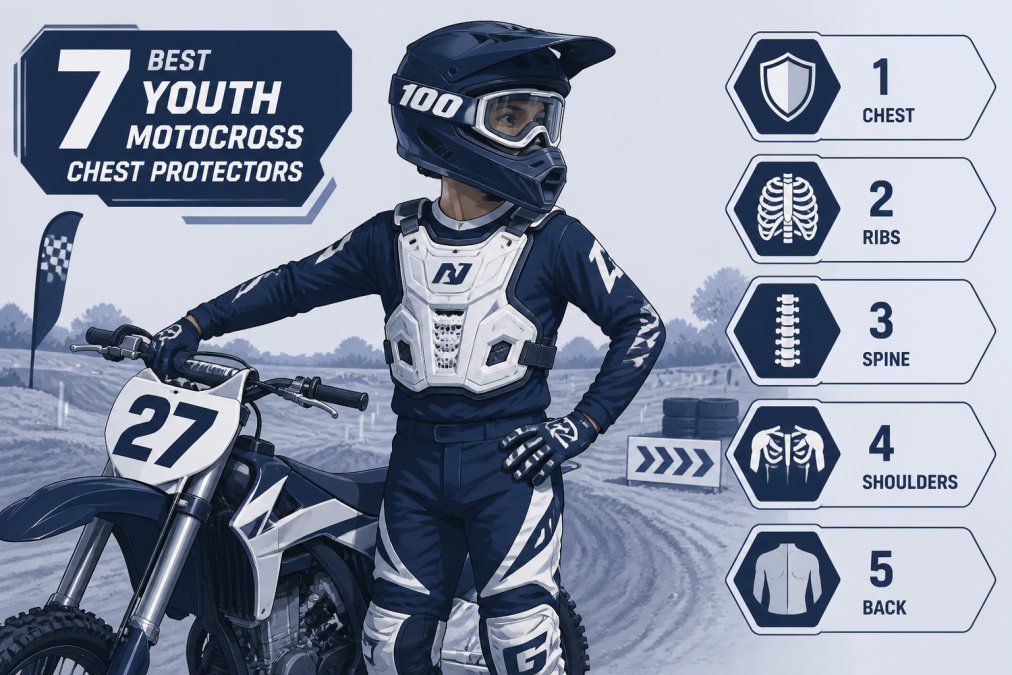
Chest injuries in youth motocross range from minor bruising to serious rib fractures and internal injuries. A roost (flying debris kicked up by other riders) or falls at any speed pose real risks to developing bodies. Proper youth motocross chest protectors absorb and disperse energy that would otherwise transfer directly to the sternum, ribs, and organs.
Young riders aged 4-12 are particularly vulnerable because their skeletal systems are still developing. While rib cage flexibility can seem advantageous, it means ribs bend rather than break during impact, but the organs they protect can still sustain injury. At Nelmgerian MX, we understand that safety gear is only effective when worn properly and kept in place, which is why this guide focuses on helping parents navigate options with confidence.
Roost Guard vs. Full Chest Protector: What's the Difference?
A roost guard is a lightweight deflector designed primarily to protect against flying debris and minor impacts. It typically covers the chest and upper back with a hard plastic shell backed by foam padding. Roost guards are thinner, more breathable, and less restrictive than full protectors, making them popular for younger riders (ages 4-7) and warm climates.
A full chest protector absorbs and disperses larger impacts across a wider surface area with multiple protection zones, chest, ribs, shoulders, and sometimes upper arms, with thicker padding and articulated hard shells. Full protectors offer CE-certified impact protection, meaning they've been tested to specific safety standards. They're bulkier and warmer but provide significantly more protection against crashes.
The practical difference comes down to riding style and risk profile. Roost guards work well for riders learning basics at slower speeds on small-displacement bikes (50cc, 65cc). However, once your child progresses to faster speeds, larger bikes, or more aggressive riding, a full protector becomes the safer choice.
CE Level 1 vs Level 2 Chest Protection: Understanding Safety Ratings
CE certification is the global standard for motocross protective equipment. Understanding the difference between CE Level 1 and CE Level 2 is critical when evaluating youth chest protectors.
CE Level 1 protectors are tested to absorb impacts of up to 50 joules of energy, roughly equivalent to a fall from waist height or being struck by a roost at moderate speed. Level 1 protectors must reduce transmitted force to below 18 kN (kilonewtons). These are suitable for recreational riding and younger riders.
CE Level 2 protectors are tested at 60 joules, a significantly higher impact energy threshold. They must also reduce transmitted force to below 18 kN but are validated against harder, more severe impacts. Level 2 is the standard for competitive racing and riders who push speed and intensity.
If your child rides casually at local tracks, CE Level 1 provides adequate protection. If your child competes or rides at higher speeds, CE Level 2 is worth the investment. Not all roost deflectors carry CE certification; always check whether the protector carries CE Level 1 or Level 2 certification.
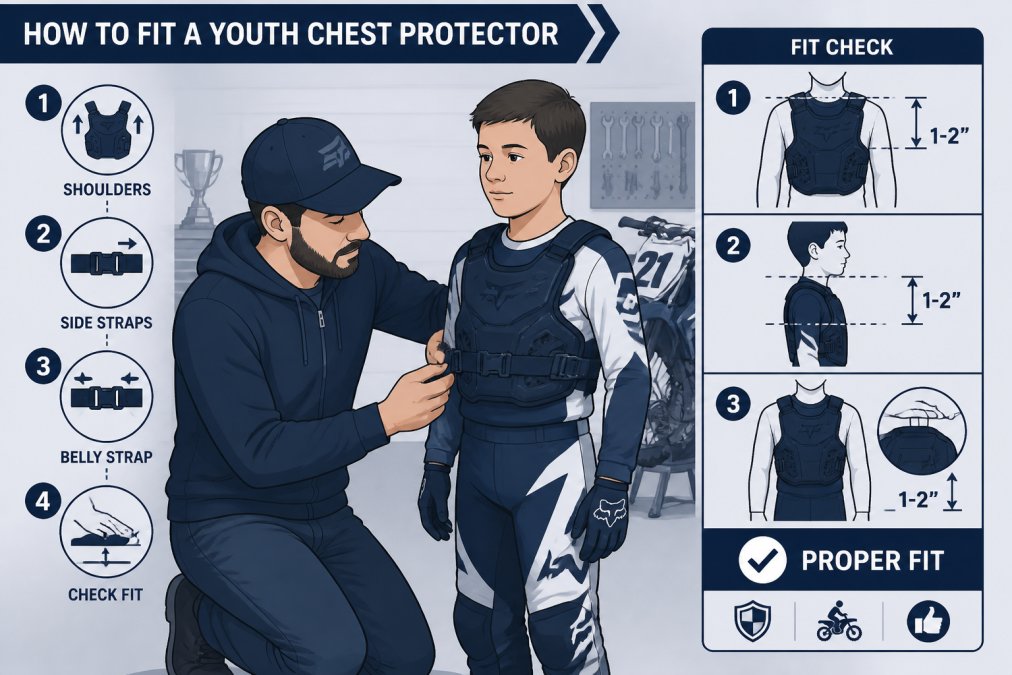
How to Fit a Youth Chest Protector: Step-by-Step Guide for Parents
Proper fit is the difference between protection that works and protection that fails when your child needs it. A protector that shifts or rides up leaves critical areas exposed.
Step 1: Measure Your Child's Chest and Torso
Have your child stand straight in a t-shirt. Measure around the fullest part of the chest with a soft measuring tape, keeping it snug but not tight. Also measure the distance from the base of the neck to the bottom of the rib cage. Most manufacturers provide size charts based on these measurements and age ranges.
Step 2: Choose the Right Size Category
Youth protectors typically come in three size ranges: peewee (ages 4-6), youth small (ages 6-8), and youth medium (ages 8-12). Order the size your child measures into, not the size you think they'll grow into. An oversized protector will shift and reduce protection.
Step 3: Put It On and Check the Fit
Have your child wear the protector over a base layer or jersey. The protector should sit centered on the chest with no twisting. The shoulder cups should align with the shoulder joint. The bottom should sit at the natural waist, not riding up or sagging.
Step 4: Test Movement and Comfort
Have your child bend forward, reach overhead, and rotate their torso. The protector should move with the body without bunching or creating pressure points. If your child can't move freely or complains of discomfort, the fit is wrong.
Step 5: Adjust All Straps and Closures
Most youth protectors use elastic straps with hook-and-loop (Velcro) closures or quick-release buckles. Adjust shoulder straps so they sit snugly without pinching. Then tighten torso/waist straps so the protector doesn't shift side to side.
Step 6: Check for Gaps and Coverage
With the protector on and adjusted, visually inspect for gaps under the armpits, shoulders, and lower chest. If you can see skin gaps where the protector doesn't make contact, the fit isn't right.
Step 7: Do a Ride Test
Have your child wear the protector for a short practice ride. Watch for shifting or discomfort. After 15-20 minutes, check the fit again. If the protector has shifted significantly, adjust the straps or reconsider the size.
7 Best Youth Motocross Chest Protectors
1. Leatt 2.5 Kids Roost Deflector
The Leatt 2.5 Kids Roost Deflector is our top pick for young riders aged 4-7. It's CE-certified with a Stone Shield that deflects roost effectively while the 3D close-fitting design keeps the protector stable during rides. Excellent ventilation keeps kids cool, and it integrates seamlessly with Leatt Neck Braces. The shoulder cups are proportioned for kids' narrower frames, and adjustable waist straps ensure a secure fit. At $93.49, it's competitively priced for a quality, certified protector.
Best for: Young riders (ages 4-7) on 50cc bikes, recreational riding, warm climates.
Pros: CE-certified roost protection, excellent ventilation, neck brace compatible, proportioned for smaller children.
Cons: Roost deflector only, not ideal for high-speed or competitive riding.
2. Fox Racing Pee Wee Titan Roost Deflector
Fox Racing's Pee Wee Titan targets the youngest riders (ages 3-6) with a design that prioritizes comfort. The perforated foam chassis provides excellent airflow, and hard rubber chest and back pads deliver solid roost deflection. Injection-molded shoulder pads add protection for a common impact area. At $54.95, it's one of the most affordable options, making it excellent for families with multiple kids or those testing commitment to wearing protection.
Best for: Peewee and very young riders (ages 3-6) on 50cc bikes, families prioritizing comfort and affordability.
Pros: Very affordable, lightweight and comfortable, good airflow, easy-to-use closures, durable construction.
Cons: Minimal impact protection, roost deflection only, not suitable for high-speed riding.
3. Troy Lee Designs BP 7850 HW Youth Protective Shirt
The Troy Lee Designs BP 7850 HW Youth Protective Shirt offers comprehensive protection without the bulk of a full chest protector. This under-armor protective shirt has integrated protection zones for the chest, ribs, shoulders, and upper arms. Shock Doctor technology disperses impact energy effectively, and the open armpit design keeps it breathable. At $134.99, it's premium-priced, but multi-zone coverage justifies the cost for serious young riders.
Best for: Youth riders (ages 6-10) seeking comprehensive upper body protection, riders in warm climates, those using neck braces.
Pros: Multi-zone integrated protection, excellent ventilation, neck brace compatible, worn under jersey for clean appearance.
Cons: Requires undershirt to prevent skin irritation, higher price point.
4. EVS F1 Roost Deflector Youth
The EVS F1 Roost Deflector Youth delivers lightweight protection with a compact, form-fitting design. The injection-molded construction with plush bio-foam liner absorbs impact effectively, and grid-style air vents keep cooling airflow constant. At $75.00, it's mid-range pricing with solid value. The modular design means you can upgrade components as your child grows.
Best for: Youth riders seeking versatile, comfortable roost protection, riders who value adjustability.
Pros: Lightweight and form-fitting, good ventilation, versatile wear options, modular design, affordable pricing.
Cons: Roost deflection only, not impact-certified, not suitable for high-speed competitive riding.
5. Thor Sentinel GP Youth Roost Protector
The Thor Sentinel GP Youth Roost Protector combines roost deflection with an integrated Level 1 back protector, giving dual protection zones in one package. The stone shield uses energy-dispersing molded panels, while the Level 1 back protector reduces force transmission to the spine. The adjustable elastic torso strap with ratcheting buckle closure ensures a secure fit. At $99.95, it's competitively priced for the dual protection offered.
Best for: Youth riders wanting back protection plus roost deflection, riders transitioning to more comprehensive protection.
Pros: Dual protection (roost + Level 1 back protector), energy-dispersing panels, secure ratcheting closure, good ventilation.
Cons: Back strap kit sold separately, still primarily roost-focused.
6. O'Neal Racing Youth Split Lite Roost Deflector
O'Neal Racing's Youth Split Lite Roost Deflector delivers solid roost protection at an accessible price. The lightweight design prevents the protector from feeling burdensome, and ventilated construction prevents overheating. Adjustable straps ensure a secure fit across different body types. At $89.99, it's affordable without sacrificing basic functionality.
Best for: Budget-conscious families, younger riders needing basic roost protection, recreational riders.
Pros: Affordable price point, lightweight and comfortable, adequate roost protection, adjustable fit, durable construction.
Cons: Basic features, limited protection zones, not ideal for competitive riding.
7. Alpinestars Bionic Action Youth Protector
The Alpinestars Bionic Action Youth Protector is our premium pick for young riders needing certified impact protection. It carries CE Level 1 certification for both chest and back, tested to absorb impacts up to 50 joules. The perforated shells maximize breathability while maintaining impact-absorption capability. The removable back panel integrates seamlessly with Alpinestars BNS neck braces. At $129.95, it's the most expensive option, but certified protection justifies the investment for serious young riders.
Best for: Competitive youth riders, older children (ages 8-12), riders using Alpinestars neck braces, maximum protection priority.
Pros: CE Level 1 certified impact protection (chest and back), highly ventilated perforated shells, seamless BNS neck brace integration, removable back panel.
Cons: Highest price point, more protector than recreational riders need.
Quick Comparison Table
| Product | Price | Type | Best For | Key Feature |
|---|---|---|---|---|
| Leatt 2.5 Kids | $93.49 | Roost Guard | Ages 4-7, recreational | CE-certified, neck brace compatible |
| Fox Racing Pee Wee Titan | $54.95 | Roost Guard | Ages 3-6, budget-conscious | Most affordable, lightweight |
| Troy Lee Designs BP 7850 HW | $134.99 | Protective Shirt | Ages 6-10, warm climates | Multi-zone protection, vent-track cooling |
| EVS F1 Youth | $75.00 | Roost Guard | Versatile riders | Modular design, over/under jersey |
| Thor Sentinel GP | $99.95 | Roost + Back | Transitional riders | Dual protection zones, ratcheting closure |
| O'Neal Racing Split Lite | $89.99 | Roost Guard | Budget riders | Lightweight, straightforward protection |
| Alpinestars Bionic Action | $129.95 | Full Protector | Competitive riders, ages 8-12 | CE Level 1 certified, BNS compatible |
Key Features to Evaluate When Choosing Youth Chest Protectors
Impact Absorption and Material
Hard-shell protectors with bio-foam or shock-absorbing liners disperse impact energy across a wider surface area. Injection-molded plastic shells are durable and lightweight. Perforated designs improve airflow without sacrificing protection.
Ventilation and Breathability
Kids overheat quickly in protective gear, and overheating leads to resistance. Grid-style vents, perforated foam, and open-armpit designs all improve airflow. For riders in warm climates or summer riding, ventilation is as important as protection.
Strap System and Ease of Use
Young children need closures they can manage themselves. Hook-and-loop (Velcro) straps are easier for kids than buckles. Ratcheting buckles with one-hand adjustment offer security without complexity.
Neck Brace Compatibility
If you're using a neck brace, your chest protector must be compatible. Leatt, Alpinestars, and Troy Lee Designs all offer compatibility with leading neck brace systems.
Weight and Mobility
A protector that restricts movement or feels heavy discourages wearing. Lightweight designs (under 2 pounds for youth protectors) feel less burdensome. Articulated designs or open-armpit construction allow better shoulder and arm mobility.
Sizing and Growth Accommodation
Youth riders grow quickly. Some protectors offer adjustable sizing through strap systems or modular components, extending usable lifespan.
Durability and Maintenance
Motocross gear gets dirty. Look for materials that withstand regular washing and UV exposure. Some protectors have removable, washable liners.
Maintenance and Care for Long-Lasting Protection
Regular Cleaning
After each riding session, wipe down the exterior with a damp cloth. For deeper cleaning, most youth protectors can be hand-washed with mild soap and cool water. Avoid hot water and harsh detergents.
Drying and Storage
Air-dry the protector completely before storing. Never use a dryer or direct heat source. Store in a cool, dry location away from direct sunlight, which degrades materials over time.
Inspection for Damage
Before each ride, inspect the protector for cracks, dents, or foam compression. Small cracks can be sealed with plastic epoxy if caught early. Foam that's permanently compressed no longer absorbs impact effectively.
Replacement Timeline
A well-maintained youth chest protector typically lasts 2-3 seasons of regular riding. For competitive or frequent riders (more than twice weekly), consider replacing every 2 years. For recreational riders, 3 years is reasonable if the protector shows no visible damage.
Choosing the right youth motocross chest protector requires balancing protection level, fit, comfort, and your child's riding style. The protectors on this list range from affordable roost guards for beginners to certified impact protectors for competitive riders. Your child's age, skill level, and riding intensity should guide your selection. At Nelmgerian MX, we believe safety gear is an investment in your child's confidence and long-term participation in the sport. Start with proper protection, ensure a good fit, and maintain the gear consistently, that foundation keeps your young rider protected so they can focus on improving their skills and enjoying the track.
Frequently Asked Questions
What is the difference between a roost guard and a full youth chest protector?
A roost guard (or roost deflector) protects against flying debris and stones kicked up during riding, using a lightweight plastic shell. A full chest protector offers comprehensive impact protection across the chest, ribs, shoulders, and back with multiple protection zones and certified safety ratings. Roost guards work best for younger beginners on smaller bikes, while full protectors suit riders progressing to faster speeds and rougher terrain. Many parents start with a roost guard and upgrade to full protection as their child's skills advance.
How should a youth chest protector fit properly?
A properly fitted youth chest protector should sit snugly against the chest without restricting breathing or arm movement. The shoulder cups should align with the natural shoulder line, and the protector should cover from the collarbone to the lower ribs. Straps should be adjusted so you can fit one finger between the protector and your child's body. The protector should not shift when your child moves or rides. Always measure your child's chest circumference and refer to the manufacturer's sizing chart before purchasing, as fit varies significantly between brands.
Are CE-rated chest protectors necessary for kids riding motocross?
CE certification (European safety standard) indicates the protector has passed impact testing and meets specific safety thresholds. While not legally required for recreational riding in most areas, CE-rated protectors provide measurable protection against impact energy. CE Level 1 offers basic protection, while Level 2 provides higher impact absorption. For young riders just starting out with a roost guard, CE certification is less critical. However, as your child progresses to faster speeds and more challenging terrain, a CE-certified full chest protector significantly reduces injury risk from crashes and impacts.
What is the best youth motocross chest protector for beginners?
For beginners aged 4-7 on 50cc bikes, lightweight roost deflectors like the Fox Racing Pee Wee Titan or O'Neal Racing Pee Wee offer affordable, comfortable entry-level protection. These prioritize breathability and ease of use over maximum impact protection. As your child grows and rides faster bikes, transition to full protective shirts like the Troy Lee Designs BP 7850 or CE-certified options like the Alpinestars Bionic Action. The best choice depends on your child's age, bike size, riding frequency, and your budget.
How do I maintain and clean a youth chest protector?
Most youth chest protectors can be hand-washed with mild soap and warm water. Remove any removable padding or liners and wash separately if recommended by the manufacturer. Avoid machine washing, harsh detergents, or high heat that can degrade foam padding and plastic shells. Air-dry completely before storage to prevent mold and odor. Check straps, buckles, and foam regularly for wear or damage. Replace the protector if padding becomes compressed or plastic shells crack, as damaged protection cannot absorb impact effectively.
This article was written using GrandRanker