 listicle
7 Ways to Keep Kids Engaged with Motocross Off-Season
Table of Contents
- 1. Build a Simple Indoor Practice Setup for Off-Season Riding
- 2. Cross-Training Sports That Build Strength and Balance
- 3. Youth Motocross Training Tips for Skill Progression at Home
- 4. Motocross Goal Setting for Young Riders During the Winter
- 5. Turn Off-Season Training into a Game Kids Want to Play
- 6. How to Start Motocross Racing Kids Can Look Forward To Next Season
- 7. Fuel the Passion with Books, Journals, and Family Track Time
- Frequently Asked Questions
Last Updated: September 22, 2026
1. Build a Simple Indoor Practice Setup for Off-Season Riding
You do not need a track, a trailer, or a four-figure home gym to keep a young rider sharp during the motocross off-season.
Tier 1, The $50 driveway kit (ages 4-8)
- Six to eight flat soccer cones or cut-down plastic cups for figure-eight and slalom drills
- Sidewalk chalk to mark a start gate and a finish line on the driveway
- A rolled towel or foam pool noodle for throttle-grip simulation while seated on the bike
- Total footprint: roughly 10 feet by 20 feet of flat, swept pavement
Tier 2, The $150-$300 garage setup (ages 6-12)
- A balance board (a 2x4 scrap with a length of PVC pipe underneath works fine) for standing balance holds
- A used bicycle trainer or a set of bike rollers if your rider already has a BMX or mountain bike
- Interlocking foam floor tiles or a 4x6 rubber horse-stall mat to protect concrete and cut noise
- A cheap digital kitchen timer or a phone stopwatch for station rotations
Tier 3, The $500+ dedicated corner (ages 8+)
-
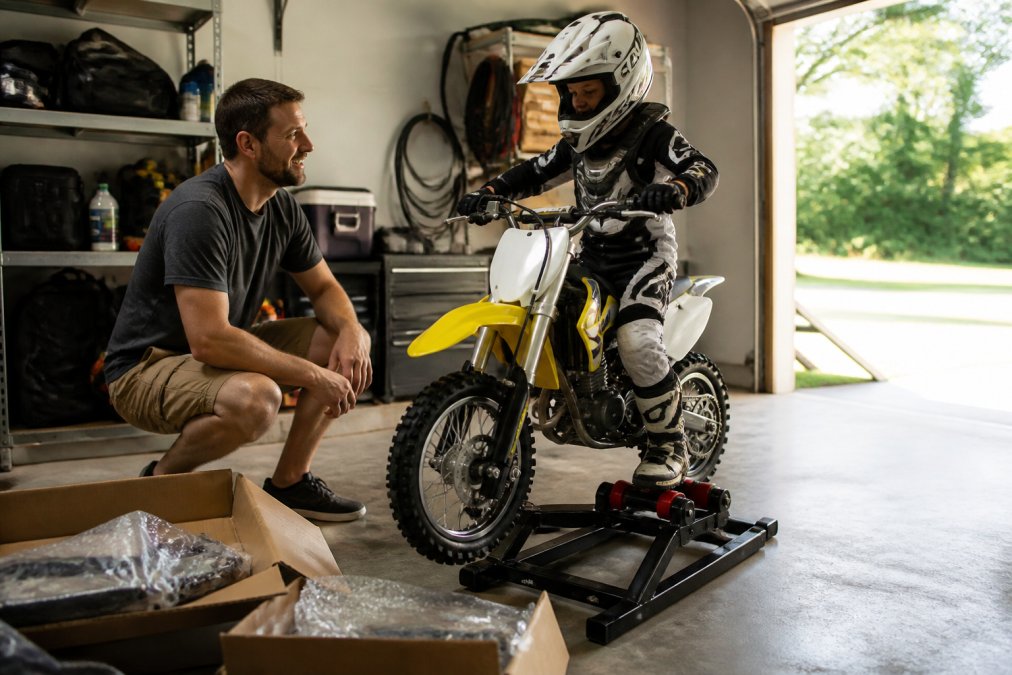
A purpose-built stationary moto trainer or a mini-ramp for standing-position reps
-
A wall-mounted mirror so kids can see their own body position instead of relying on a parent's description
-
A small fan and a water bottle station, because a garage in January still gets warm once a rider is in full gear
-
Sweep the floor before every session, grit under a kickstand or a boot sole is how kids slip
-
Keep the bike's front wheel chocked or the trainer locked so the bike cannot roll forward unexpectedly
-
Store gear on a hook or a milk crate so suiting up takes two minutes, not twenty
-
Leave the cones and chalk marks in place between sessions so practice can start on a whim
2. Cross-Training Sports That Build Strength and Balance
Cross-training is the fastest way to build the endurance, agility, and coordination that translate directly to the bike. Many parents overlook this because they assume only seat time counts. It does not. A rider who spends winter swimming, biking, or playing basketball comes back with better stamina and body awareness than one who sat still for three months, and, just as importantly, a lower risk of the overuse injuries that come from repeating the same motion year-round.
- BMX or mountain biking, trains balance, line choice, and the habit of weighting the outside peg through a corner. Two or three 45-minute rides a week is plenty for most kids. This is the single closest off-bike analog to motocross.
- Swimming, builds full-body endurance and, more usefully, teaches controlled breathing under effort. A rider who can hold a steady breath through a hard lap is a rider who stays relaxed on a long moto. Two sessions a week, 30-45 minutes each, covers it.
- Gymnastics or martial arts, develops core strength, spatial awareness, and the ability to fall safely. Both sports teach kids to tuck and roll rather than post an arm, which is exactly the instinct you want when a bike goes down.
- Basketball or soccer, trains agility, footwork, and quick reaction to a changing field. The stop-start, change-of-direction demands mirror what happens in traffic on a start straight.
- Wrestling or climbing, builds grip strength and upper-body pulling power that helps a rider hold the bars and lift the bike off the ground after a tip-over.
3. Youth Motocross Training Tips for Skill Progression at Home
Youth motocross training tips work best when they focus on one skill at a time. Trying to fix body position, throttle control, and cornering in the same session overwhelms young riders.
Practice Drills Without a Bike
Off-bike drills build muscle memory that carries over to the track. These require no special equipment:
- Balance holds on one foot or a wobble board, 30 seconds per side
- Body position reps on a stationary bike, practicing standing and seated posture
- Throttle simulation using a grip trainer or a rolled towel to build hand control
- Reaction drills with a parent calling directions: left, right, brake, stand
Keeping Track of Progress
A training journal turns scattered practice into visible progress. Write down the date, the drill, and one thing that improved. Over a winter, that log becomes proof of how far your rider has come.
4. Motocross Goal Setting for Young Riders During the Winter
Motocross goal setting for young riders should be specific, small, and achievable within a few weeks. Vague goals like "get faster" do not motivate a seven-year-old.
Better goals sound like this:
- "Hold a steady throttle for ten laps without stopping"
- "Stand on the pegs through the whole straightaway"
- "Finish a full practice session without needing a break"
5. Turn Off-Season Training into a Game Kids Want to Play
Gamification keeps kids riding when the track is closed. The trick is to borrow the mechanics of the video games they already love and apply them to real practice.
Simple ways to do it:
- Award points for each completed drill, with a reward at a set total
- Create a "level up" chart where each skill unlocks the next challenge
- Time drills and let kids beat their own previous record
- Turn practice into a family competition with handicaps for younger riders
6. How to Start Motocross Racing Kids Can Look Forward To Next Season
Learning how to start motocross racing begins long before the first gate drop. The off-season is the right time to prepare a young rider mentally and practically for competition.
A few things to cover before the season:
- Review the track rules and flag signals together
- Practice a mock start at home or in an open field
- Talk through what happens if your rider falls or stalls
- Set a simple goal for the first race that has nothing to do with placement
7. Fuel the Passion with Books, Journals, and Family Track Time
Books and family time keep the riding passion alive when the bike is parked. Reading about motocross builds knowledge and vocabulary, and it gives kids a way to stay connected to the sport on rainy days.
Frequently Asked Questions
What is a good age to start motocross?
Most kids can start riding a 50cc dirt bike around age 3 to 5 with proper safety gear and close supervision. At this age, focus on basic balance, throttle control, and having fun rather than competition. Starting young builds confidence and coordination, but every child develops differently. Some are ready at 3, others at 6. The key is matching the bike size to your child's height and strength, and keeping sessions short and positive.
How can I keep my child motivated to ride during the winter months?
Use off-season months to gamify training. Set up a simple indoor practice area for balance drills, create a points chart for completed exercises, and let your child pick a reward for hitting weekly goals. Cross-training sports like swimming or biking keep fitness up without feeling like work. Reading motocross storybooks and filling out a training journal also keeps the sport present in daily life. The goal is staying connected to riding, not adding pressure.
What are some indoor training exercises for young dirt bike riders?
Balance drills on a stationary bike or balance board build core stability. Squats, lunges, and wall sits strengthen legs for standing on the pegs. Practicing throttle control on a trainer bike teaches smooth acceleration. Agility ladders improve coordination and footwork. Set up a simple obstacle course with cones for weaving practice. Keep sessions to 15-20 minutes, three times a week. Always supervise and make it feel like play, not a workout.
How do I maintain my child's interest in racing when the tracks are closed?
Watch professional races together and talk about what riders do in different situations. Set small off-season goals like mastering a new skill or reading a motocross book. Use a training journal to track progress and celebrate improvements. Plan family trail rides or visit a track just to watch. Keep the racing conversation alive by asking your child what they are excited about for next season. Engagement comes from connection, not constant riding.
How can reading and activity books help young motocross riders?
Motocross-themed books and activity books keep kids connected to the sport when they cannot ride. They build reading skills, spark imagination, and reinforce lessons about confidence, perseverance, and sportsmanship. A training journal gives young riders a place to set goals and track practice, which builds discipline. For kids who love dirt bikes, these materials make off-season time feel purposeful and fun, not like a break from what they love.
The off-season can quietly decide how next season goes. Riders who stay engaged, even in small daily ways, come back sharper than those who wait for spring. Nelmgerian MX supports that stretch with children's motocross books, a rider training journal for tracking goals and progress, and screen-free activities that keep young riders connected to the sport they love. Get started with Nelmgerian MX and give your young rider the tools to build confidence, skills, and a lasting passion for motocross.