 how-to
How to Get Kids Excited About Reading
Table of Contents
- Start with What Your Child Already Loves
- How to Make Reading Fun for Kids with Stories They Care About
- Choosing Books for Reluctant Readers
- Reading Activities for Kids That Keep Engagement High
- How to Build a Reading Habit for Kids Through Consistency
- Teaching Phonics and Letter Sounds with Motocross Themes
- Building Confidence and Celebrating Reading Progress
- Frequently Asked Questions
Last Updated: October 6, 2026
Start with What Your Child Already Loves
The fastest way to get kids excited about reading is to meet them where they are.
Most parents assume reading must come before passion.
Kids who wouldn't touch a book suddenly ask to read when the main character rides a dirt bike.
Notice what genuinely captures your child's attention, the speed, the competition, the skill, the bikes. That's your hook.
How to Make Reading Fun for Kids with Stories They Care About
Reading becomes fun when it's not a chore: forced reading builds resistance, while reading that feels like a reward draws kids in.
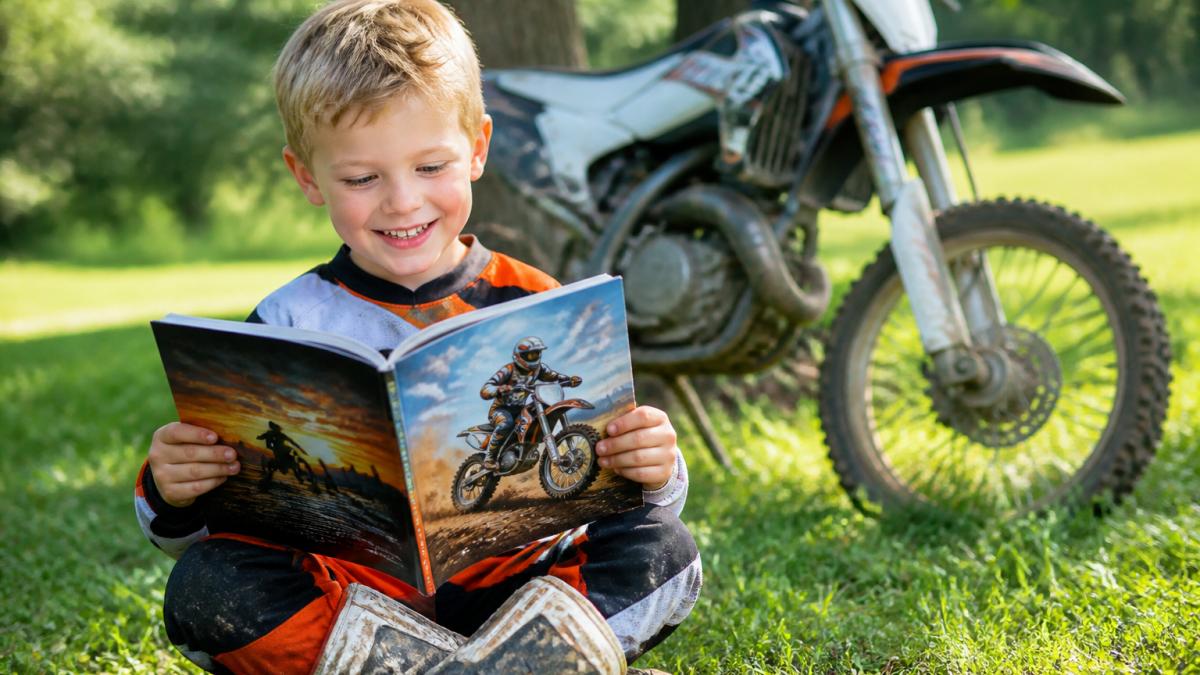
Stories with motocross themes work because they combine two things your child already loves: dirt bikes and adventure.
Choose books that match your child's reading level and interests: too hard frustrates, too easy bores.
Make reading shared when possible: sit together, ask questions, and let your child predict what happens next, turning reading from isolation into connection.
Choosing Books for Reluctant Readers
Reluctant readers usually have a specific reason for avoiding books: reading is hard, the stories feel irrelevant, or the books look babyish in front of friends. Naming the barrier is the first step, the right book for a frustrated decoder is not the right book for a bored advanced reader.
Match the book to the barrier, not the age
| Barrier | What to look for | What to avoid |
|---|---|---|
| Decoding is hard | Decodable text with controlled vocabulary; short sentences; one idea per line | Long paragraphs; unpredictable spelling patterns |
| Books feel boring | High-interest topic (motocross, animals, sports, space); fast plot; dialogue on page one | Slow openings; heavy description; "lesson" stories |
| Books feel babyish | Chapter books with older-looking covers; protagonists the same age or older | Board books; cartoon covers aimed at toddlers |
| Reading feels like homework | Choice, humor, comics, graphic novels, magazines | Anything assigned or timed |
| Attention is short | Short chapters (2-4 pages); frequent illustration breaks; cliffhangers | Dense pages; long chapters; no visual rest |
A simple selection framework
Use the five-finger rule: have your child read one page aloud, counting one finger per word they cannot decode. Zero to one finger builds fluency; two to three is instructional, good for reading together; four or more is frustration-level right now, no matter how much they love the topic.
Then check three more things before you commit:
- Interest match. Does the topic connect to something your child already talks about?
- Character mirror. Does the protagonist resemble your child in age, interest, or struggle?
- Format fit. Graphic novel, illustrated chapter book, or short novel? Format matters as much as reading level.
Reading-level benchmarks, roughly
These are common ranges, not rules. Use them as a starting point, then trust the five-finger check.
- Ages 4-5: Picture books with predictable text; 1-2 sentences per page.
- Ages 5-6: Decodable readers; CVC and digraph words; heavy illustration support.
- Ages 6-7: Early chapter books; 3-5 short chapters; illustrations every few pages.
A 7-year-old who loves motocross will happily read a book written at a 6-year-old level if the story is about dirt bikes. Interest beats level every time.
Adapting for different readers
- Emerging readers: Choose decodable text that practices the sound you are teaching that week, so the book becomes the practice.
- Multilingual learners: Prioritize strong picture support and repeated sentence patterns; predictable structure lowers the language load so the story can carry them.
- Children who need extra repetition: Rereading is not failure, a child who reads the same book five times is building fluency and confidence. Keep favorites within reach.
What to avoid
A quick way to test a book before you buy
Open to page three and read the first paragraph aloud yourself. Ask: Would my child understand every word? Does something happen in this paragraph? Would my child want to know what happens next?
Books like Ryder's First Motocross Race work because they combine beginner-friendly language with a story young riders actually care about: a young protagonist facing real challenges, illustrations that support the text, and a plot that moves forward without unnecessary detail, exactly what a reluctant reader needs to keep turning pages.
Reading Activities for Kids That Keep Engagement High
Reading doesn't have to stop when the book closes. Activities built around stories extend engagement and reinforce learning.
After reading, try these approaches:
- Ask your child to draw their favorite scene from the story
- Have them act out a part of the story
- Create a simple story map showing what happened first, next, and last
These activities aren't busywork, they deepen comprehension and keep the story alive, whether a child is drawing a character or acting out a scene.
Create a simple reading space that feels special, a comfortable chair, good lighting, and books your child actually wants to read.
How to Build a Reading Habit for Kids Through Consistency
Habits form through repetition. Reading becomes a habit when it happens regularly, at the same time, in the same way.
Start small.
Make reading part of your routine:
- Read together before bed
- Read during a specific quiet time each day
- Read in the car on the way to practice
The key is predictability: your child's brain learns that reading happens at this time, in this way, turning it into something expected, not imposed.
Celebrate milestones: finishing a first book, or a full month without missing a day. These celebrations reinforce the habit and build confidence.
Teaching Phonics and Letter Sounds with Motocross Themes
Phonics is the foundation of reading. Children who understand how letters map to sounds can decode new words instead of memorizing each one. Teach it in a sequence, not a random pile of worksheets, and hang every step on a theme your child already loves.
The sequence that works
Most reading practitioners follow a progression from single sounds to whole words. You can run the same progression with motocross vocabulary:
- Letter-sound correspondence (ages 4-5). One letter, one sound. Use the first letters of words your child already says: B for bike, D for dirt, H for helmet, T for track, R for ride, M for moto.
- Short vowel CVC words (ages 5-6). Consonant-vowel-consonant words are the first real decoding win. Motocross gives you a ready-made word bank: rid, mud, gas, lap, pit, ram, top, hot, wet, big.
- Digraphs and blends (ages 5-7). Two letters, one sound, or two sounds blended. Motocross language is unusually rich here:
- SH, the sound of a bike sliding through a turn
- CH, the sound of a chain
- TH, the sound of throttle
- WH, the sound of a wheel spinning
- PH, the sound of physics in action
- CK, the sound of a kick start
- NG, the sound of an engine
- ST, TR, GR, start, track, grip
- Silent-e and long vowels (ages 6-7). Ride, race, brake, gate, line, slope. These are the words your child already uses out loud, which makes the rule feel useful instead of abstract.
- Fluency and connected text (ages 6-8). Once decoding is automatic, the goal shifts to reading smoothly in phrases. Short sentences about a rider, "Ryder grips the bars. The gate drops. He rides the line.", build fluency without overwhelming the reader.
A 15-minute lesson you can run tonight
You don't need a curriculum binder, just one sound and one theme.
- Minute 0-3, Warm-up. Lay out five letter cards (B, D, H, T, R). Say a motocross word and have your child point to its first letter.
- Minute 3-8, New sound. Introduce one digraph, say SH. Show it. Say it. Have your child trace it in the air, then on paper.
- Minute 8-12, Word hunt. Read a short motocross passage together and have your child circle every SH word. Common finds: shock, shift, shove, wash, shut.
That's the whole lesson. Repeat with a new sound tomorrow.
Age-appropriate objectives
- Ages 4-5: Recognize 15-20 letter sounds; hear and say the first sound in a spoken word.
- Ages 5-6: Decode simple CVC words; read 10-15 high-frequency words on sight.
- Ages 6-7: Read digraphs and blends in unfamiliar words; read a short decodable passage aloud.
Adapting for different learners
- Emerging readers: Stay on one sound for a full week. Repetition is not a delay; it is the work.
- Multilingual learners: Pair every new sound with a picture and a physical gesture; the gesture becomes a memory hook.
- Children who need multisensory practice: Add sand trays, magnetic letters, or sidewalk chalk. Tracing a letter while saying its sound recruits more of the brain than reading silently.
Checking progress
You do not need a formal assessment. Three quick checks tell you whether to move on:
- Sound recognition: Can your child say the sound when shown the letters, without a picture prompt?
- Decoding accuracy: Out of 10 unfamiliar words with the target sound, how many does your child read correctly? Aim for 8 or more before advancing.
- Retention: Can your child still read last week's sound? If not, review before adding a new one.
Books like Ryder's Digraph Dirt Track are built around this exact sequence, so the story and the skill move together instead of competing for your child's attention.
Building Confidence and Celebrating Reading Progress
Confidence is everything.
Every child progresses at their own pace, and comparison is counterproductive.
Celebrate effort, not just results.
Use specific praise.
Track progress in concrete ways.
Getting kids excited about reading starts with honoring what they already love.
At Nelmgerian MX, we've built our entire library around this principle. Stories like Ryder Meets Pepper and Ryder and Wheelie's Big Ride work because young riders don't need generic reading instruction, they need characters like them, facing challenges they recognize.
Our books, activities, and training journals keep kids engaged with reading and learning even off the track.
Start with your child's passion. Choose stories that match their interests and reading level.
Frequently Asked Questions
How can I get kids excited about reading if they prefer riding dirt bikes?
Connect reading directly to their passion for motocross. Choose dirt bike-themed storybooks featuring characters like Ryder and Pepper who experience adventures on the track. When children see themselves and their interests reflected in stories, they're far more likely to stay engaged. Pair reading time with motocross activities, read together before or after practice days, or use books to teach skills that transfer to riding, like balance and focus.
What age should kids start learning to read with phonics?
Children ages 4-6 typically benefit most from structured phonics instruction combined with engaging stories. At this age, they're developing letter recognition and beginning to decode simple words. Motocross-themed phonics books that teach digraphs like SH, CH, and TH through dirt bike vocabulary make learning feel like play rather than work. Even younger children (ages 3-4) can enjoy being read aloud to and learning letter sounds through repetition and fun.
How do I encourage a child who doesn't like reading?
Start by removing pressure and making reading a shared, enjoyable activity rather than a task. Let your child choose books about topics they love, dirt bikes, racing, adventure. Use short reading sessions (10-15 minutes) and alternate between you reading aloud and your child reading to you. Celebrate small wins: finishing a page, recognizing a word, or sitting still for five minutes. Pairing reading with a reward, like extra track time or a favorite snack, builds positive associations.
How often should kids read to build a strong reading habit?
Daily reading, even for just 15-20 minutes, builds stronger habits than sporadic longer sessions. Consistency matters more than duration. Set a specific time each day, perhaps after dinner or before bed, so reading becomes routine like brushing teeth. Motocross training journals paired with storybooks create a natural rhythm: kids read a story, then write or draw about their own riding goals and progress, reinforcing both literacy and confidence in the sport they love.