 listicle
Screen-Free Activities for Motocross Kids
Table of Contents
- Why Screen-Free Time Matters for Young Riders
- Outdoor Physical Activities That Build Motocross Skills
- Physical Fitness Exercises for Young Riders at Home
- Motocross Activity Books for Kids and Creative Play
- Motocross Training for Kids at Home
- Indoor Crafts and Mechanical Skill-Building Projects
- Nature-Based Exploration and Quiet Time Activities
- Conclusion
Last Updated: August 29, 2026
Why Screen-Free Time Matters for Young Riders
Young riders benefit enormously from screen-free activities that build physical and mental resilience. When children engage in hands-on play, they develop the coordination, problem-solving skills, and confidence that translate directly to the track. The motocross lifestyle demands focus, discipline, and the ability to visualize movement before executing it, all skills that thrive without screens.
At Nelmgerian MX, we understand that keeping young riders engaged between practice sessions means intentional, purposeful activities that deepen their connection to the sport while building foundational skills. These activities support gross motor skills, fine motor skills, balance, and stamina, the physical building blocks of motocross performance.
Screen-free time also strengthens family bonds. When parents and kids work together on track visualization exercises, mechanical projects, or outdoor challenges, they're building shared understanding of what it takes to succeed in motocross. This collaborative approach creates confidence and accountability that extends far beyond the garage.
Research shows that children who engage in independent play and hands-on activities develop better focus and attention span than those relying heavily on screens (peer-reviewed research). For young motocross enthusiasts, this translates to improved concentration during training, better retention of coaching feedback, and the mental toughness required for competitive riding.
Outdoor Physical Activities That Build Motocross Skills
The best outdoor activities for young riders mirror the demands of motocross itself. Balance work, agility drills, and endurance challenges prepare the body for riding while building confidence through mastering difficult tasks.
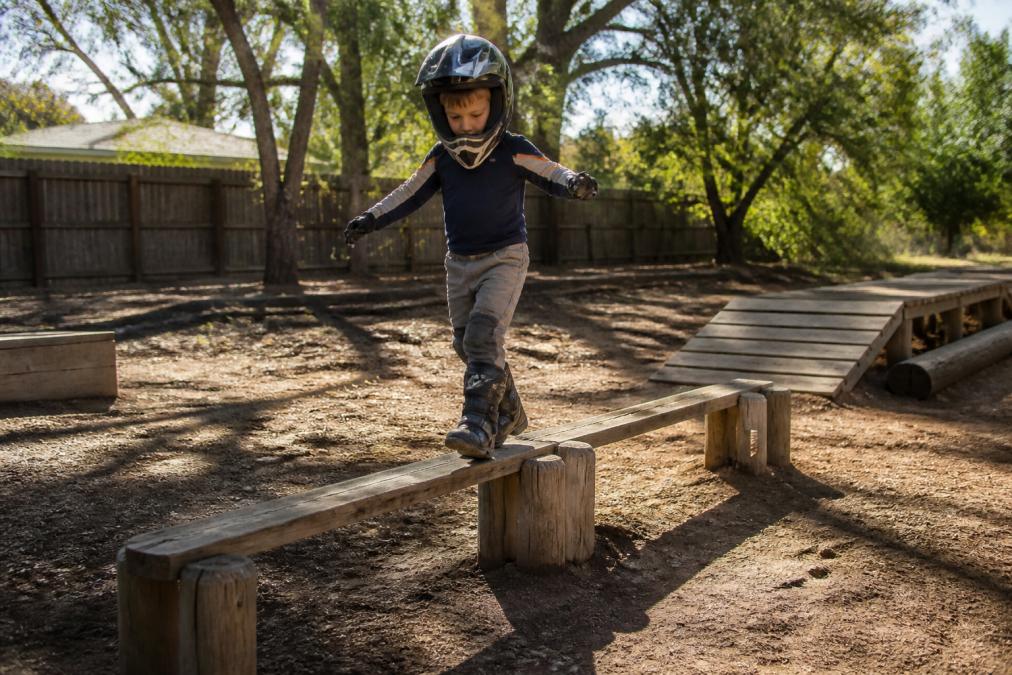
Balance and coordination exercises form the foundation of motocross readiness. Set up simple balance beams using fallen logs or wooden planks placed low to the ground. Have your child walk forward and backward across them, then progress to walking on one foot. These exercises develop the precise weight distribution and core stability needed to control a bike through turns and obstacles. Start with 10-15 minutes of practice, gradually increasing difficulty as confidence builds (aap.org).
Agility ladder drills teach rapid foot placement and body awareness. Create a simple agility ladder using rope or chalk lines on the ground, spacing them about 18 inches apart. Have your child move through the pattern with quick, controlled steps, forward, backward, and laterally. This builds the reactive footwork that helps riders stay centered during unexpected track conditions.
Hill running and climbing builds leg strength and cardiovascular endurance. Find a gentle slope near your home and have your child run up and down it multiple times. Start with 5-10 repetitions and work up to 15-20 as fitness improves. The explosive power developed translates directly to the leg strength needed for standing on the pegs during acceleration and braking.
Obstacle course challenges combine multiple skills in one engaging activity. Create a backyard circuit using cones, low hurdles, balance beams, and crawling tunnels. Time your child as they move through the course, encouraging improvement each week. This builds problem-solving ability, spatial awareness, and the mental toughness required to push through fatigue.
Jumping and plyometric work develops explosive power. Simple box jumps, broad jumps, and single-leg hops prepare the legs for motocross demands. Start with low heights (12-18 inches) and focus on proper landing mechanics before increasing difficulty. Even 10-15 minutes twice per week significantly improves a young rider's power output.
Physical Fitness Exercises for Young Riders at Home
Home-based fitness keeps young riders in peak condition when weather or schedule prevents outdoor training. These exercises require minimal equipment and adapt to any age or fitness level.
Core strengthening is essential for motocross riders. Planks, modified sit-ups, and bird-dog exercises build the abdominal and back strength that keeps riders centered on the bike. Have your child hold a plank position for 20-30 seconds, rest, and repeat 3-5 times. As strength improves, increase hold time to 45-60 seconds. Core work 3-4 times per week produces noticeable improvements in riding stability.
Push-ups and upper body work develop the arm and shoulder strength needed to control handlebars through rough terrain. Modified push-ups on the knees work well for younger riders. Start with 5-10 repetitions and build toward 20-30 as strength develops. Upper body strength prevents arm pump during longer practice sessions and races.
Leg squats and lunges build the lower body power that drives acceleration and maintains control through corners. Bodyweight squats are accessible for all ages. Have your child perform 10-15 squats, rest, and repeat 3 sets. Walking lunges add variety and target slightly different muscle groups. Do these exercises 2-3 times per week.
Flexibility and stretching routines prevent injury and improve range of motion. Young riders often neglect stretching, but 10-15 minutes of guided stretching after workouts keeps muscles supple and reduces soreness. Focus on hip flexors, hamstrings, calves, and shoulders.
Endurance circuits combine multiple exercises into one comprehensive session. Have your child perform 30 seconds of jumping jacks, 30 seconds of high knees, 30 seconds of mountain climbers, and 30 seconds of rest. Repeat this circuit 4-6 times. Circuit training builds cardiovascular fitness while improving muscular endurance.
Motocross Activity Books for Kids and Creative Play
Reading about motocross heroes builds confidence and keeps young riders mentally engaged with the sport. Stories featuring characters overcoming challenges, learning from mistakes, and celebrating progress inspire children to apply those same principles to their own riding.
Nelmgerian MX publishes titles that speak directly to young riders' experiences. Ryder's First Motocross Race follows a young rider through the emotions and challenges of competition, teaching resilience and sportsmanship. Ryder and Wheelie's Big Ride explores friendship and teamwork through motocross adventure. Ryder Meets Pepper introduces themes of inclusivity and mutual respect. These stories combine the excitement of motocross with meaningful life lessons for children ages 3-9.
Creative play activities extend learning beyond the page. After reading a motocross story, encourage your child to draw their own version of characters or track, create a comic strip showing a motocross adventure, act out scenes with toy bikes, or write their own short story about a motocross character. This creative expression reinforces themes while developing fine motor skills and imaginative thinking.
Motocross Training for Kids at Home
Structured training between practice sessions accelerates skill development and builds the mental framework that separates casual riders from serious competitors. A training journal transforms practice into purposeful progression.
Track visualization exercises teach young riders to mentally rehearse lines before executing them physically. Have your child close their eyes and imagine themselves on a familiar track. Walk them through the visualization: "You're approaching the first turn. What does it feel like? What line are you taking?" This mental practice activates the same neural pathways as physical riding, improving performance without requiring track time.
Skill-specific drills at home target weaknesses identified during practice sessions. If your child struggles with body positioning, practice correct posture for 10-15 minutes. If throttle control needs work, use a motocross simulator or practice smooth hand movements. Focused, deliberate practice produces faster improvement than casual riding time.
Goal-setting and tracking builds accountability and motivation. Work with your child to establish 2-3 specific, measurable goals for the week: "Master the rhythm section without dabbing," "Improve lap time by 2 seconds," or "Complete 10 consecutive laps without a mistake." Record these goals in a training journal and track progress. Tangible improvement builds confidence and keeps riders mentally connected to their sport.
The Nelmgerian MX Training Journal provides a structured framework for progression tracking. Young riders record daily practice notes, sketch track layouts, set weekly goals, and celebrate milestones. This tangible record of improvement builds confidence between sessions.
Coaching feedback integration accelerates learning. After each practice session, have your child write down 2-3 things their coach emphasized. During home training, focus on those specific points. This bridges the gap between formal coaching and independent practice.
Indoor Crafts and Mechanical Skill-Building Projects
Mechanical understanding accelerates a young rider's development and builds the problem-solving skills that separate good riders from great ones. When children understand how their bike works, they ride with greater confidence and can communicate issues to their mechanic or coach.
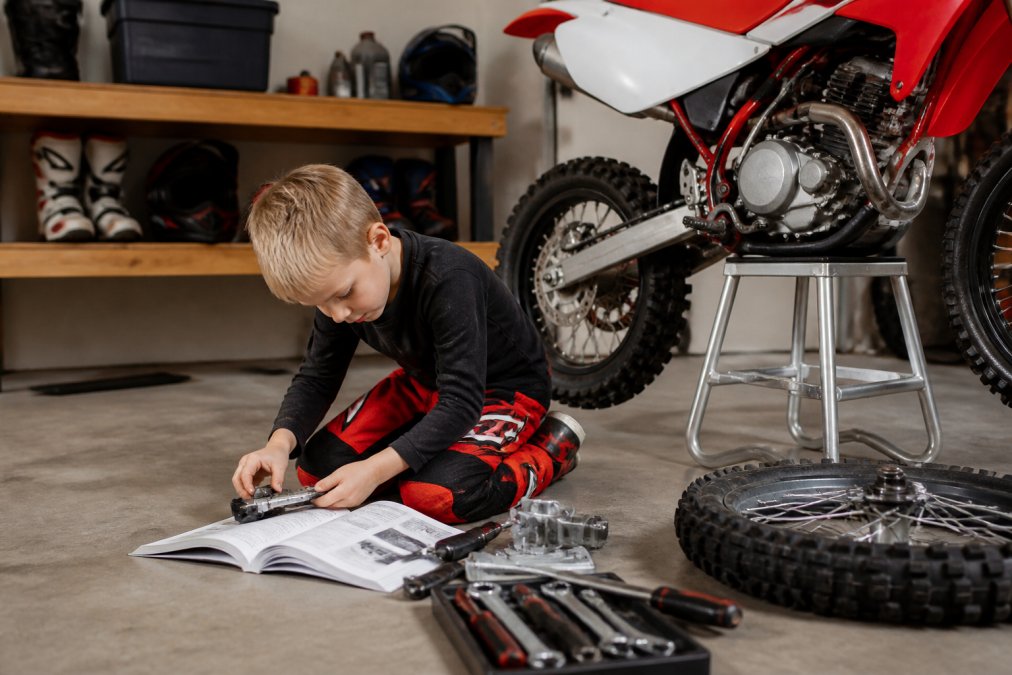
Bike maintenance projects introduce mechanical literacy in age-appropriate ways. Younger children (3-5) can help wash and dry the bike. Slightly older children (6-7) can help check tire pressure, inspect chains, and wipe down components. Children 8-9 can learn to clean air filters, check oil levels, and understand basic maintenance schedules. This hands-on learning builds respect for the machine and introduces mechanical concepts naturally.
Model building and assembly projects develop fine motor skills and spatial reasoning. Building scale model motorcycles, assembling simple gear systems, or constructing track obstacles from craft materials teaches how components fit together. These projects improve hand-eye coordination and problem-solving ability.
Track layout design projects teach spatial visualization and strategic thinking. Have your child design their own motocross track on paper, labeling features like jumps, berms, and rhythm sections. This exercise builds the mental ability to visualize track layouts and plan racing lines.
Gear maintenance activities teach responsibility and equipment care. Have your child help organize and maintain protective gear: cleaning helmets, checking padding, organizing goggles, and storing gear properly. Understanding that equipment requires care builds the discipline motocross demands.
Nature-Based Exploration and Quiet Time Activities
Balance and tranquility matter as much as intensity for young riders. Quiet time activities develop focus, creativity, and the mental resilience required for competitive pressure.
Nature walks and outdoor exploration provide sensory engagement that screens cannot replicate. Walking trails, examining plants and insects, and observing how terrain changes builds observational skills and spatial awareness. These walks also provide mental recovery from structured training, essential for preventing burnout.
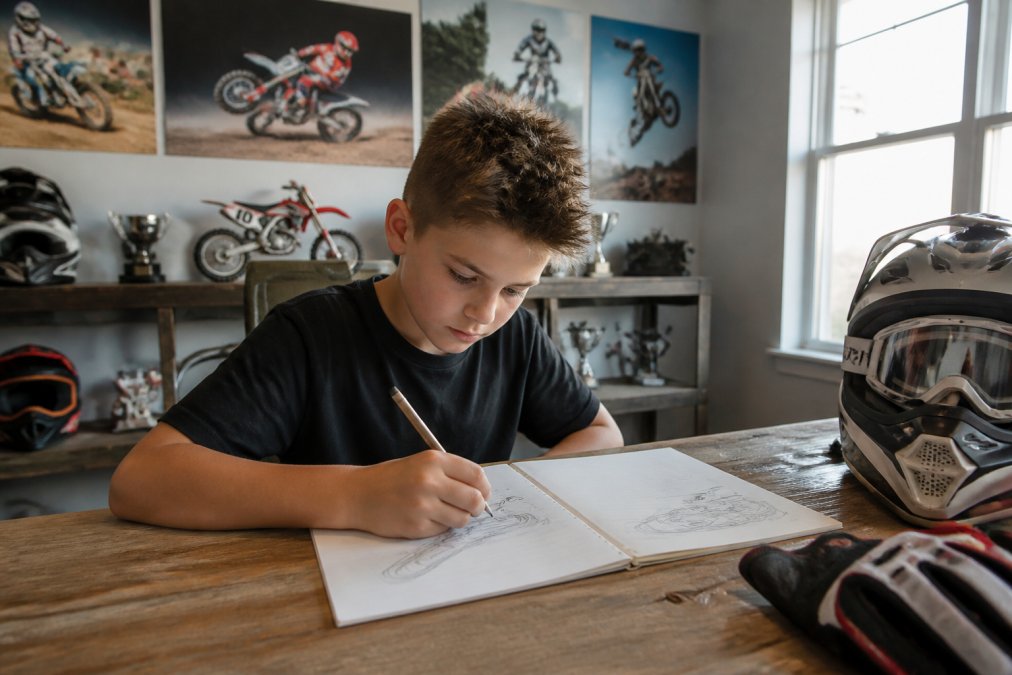
Journaling and sketching activities develop self-awareness and creative expression. Provide your child with a notebook and encourage them to sketch favorite tracks, draw their dream motocross bike, or write about riding experiences. This quiet reflection builds emotional intelligence and gives children an outlet for processing competitive emotions.
Imaginative outdoor play without structured goals develops creativity and independent thinking. Building forts, creating obstacle courses from natural materials, or simply exploring the backyard encourages problem-solving and self-directed learning. This unstructured play develops resilience and adaptability.
Quiet time with books supports literacy while providing mental rest. Beyond motocross-specific stories, general children's books build reading skills and vocabulary. Reading for pleasure creates positive associations with books and learning.
Meditation and breathing exercises build mental toughness and emotional regulation. Simple guided breathing exercises, inhale for 4 counts, hold for 4, exhale for 4, teach children to manage anxiety and maintain focus under pressure (peer-reviewed research). Even 5-10 minutes before bed or before competition improves emotional resilience.
| Activity Type | Best Age Range | Duration | Frequency | Primary Benefit |
|---|---|---|---|---|
| Outdoor balance work | 3-9 | 15-20 min | 3-4x/week | Coordination, confidence |
| Home fitness circuits | 5-9 | 15-30 min | 3-4x/week | Strength, endurance |
| Motocross storybooks | 3-9 | 15-30 min | Daily | Reading, motivation, confidence |
| Track visualization | 6-9 | 10-15 min | 3-5x/week | Mental preparation, focus |
| Bike maintenance projects | 5-9 | 20-30 min | 1-2x/week | Mechanical literacy, responsibility |
| Nature exploration | 3-9 | 30-45 min | 2-3x/week | Sensory development, creativity |
| Journaling and sketching | 5-9 | 15-20 min | 2-3x/week | Self-expression, reflection |
Keeping young motocross riders engaged between practice sessions requires intentional, purposeful screen-free activities that build physical skills, mechanical understanding, and mental resilience. The activities outlined above develop confident, capable riders who understand not just how to ride, but why they ride.
Resources like those created by Nelmgerian MX, including motocross storybooks featuring characters like Ryder, Pepper, and Wheelie, plus the Nelmgerian MX Training Journal for tracking progress, give families the tools to make screen-free time both engaging and developmental. These resources transform downtime into skill-building opportunity, keeping young riders mentally connected to the sport they love while building the discipline and focus that competitive motocross demands.
Frequently Asked Questions
What are some screen-free activities for motocross kids when they can't ride?
Young riders benefit from a mix of activities that keep them engaged with the sport without a screen. Outdoor games like obstacle courses, balance drills, and agility ladder work build gross motor skills and balance. Indoor activities include motocross activity books, coloring projects, and building or sketching track layouts. Training journals let kids track their progress between practice days. These activities maintain focus on motocross while developing the physical and mental skills that translate directly to better riding.
How can motocross activity books for kids help with reading and skill development?
Motocross-themed storybooks and activity books engage young readers by connecting reading to their passion for dirt bikes. Characters like Ryder, Pepper, and Wheelie teach lessons about confidence, responsibility, and perseverance through stories kids actually want to read. Activity books with puzzles, mazes, and coloring develop fine motor skills and focus. When kids read about motocross adventures, they build reading fluency while reinforcing the mental toughness and problem-solving skills that help them improve on the track.
What physical fitness exercises for young riders can we do at home?
Home fitness for young motocross riders should focus on balance, core strength, and hand-eye coordination. Exercises include standing on one leg, doing modified push-ups, planks held for short intervals, and jumping rope. Agility drills like ladder work, cone weaving, and balance beam walking build the stability needed on a bike. Stretching and flexibility work prevent injury. Keep sessions short (10-15 minutes) and fun. A training journal helps kids track what they've done and sets goals, making fitness feel like part of their motocross development rather than a chore.
How do I keep my child interested in motocross during off-days?
Off-days are opportunities to build mental connection to the sport. Use training journals to review recent rides and set goals for the next session. Read motocross storybooks together or let kids work through activity books independently. Create DIY track layouts using chalk, sticks, or toys to help kids visualize lines and strategy. Talk about gear maintenance and let older kids help clean or organize their equipment. These activities keep the sport top-of-mind while building confidence and mechanical understanding that makes kids better, more thoughtful riders.
This article was written using GrandRanker
Frequently Asked Questions
What are some screen-free activities for motocross kids when they can't ride?
Young riders benefit from a mix of activities that keep them engaged with the sport without a screen. Outdoor games like obstacle courses, balance drills, and agility ladder work build gross motor skills and balance. Indoor activities include motocross activity books, coloring projects, and building or sketching track layouts. Training journals let kids track their progress between practice days. These activities maintain focus on motocross while developing the physical and mental skills that translate directly to better riding.
How can motocross activity books for kids help with reading and skill development?
Motocross-themed storybooks and activity books engage young readers by connecting reading to their passion for dirt bikes. Characters like Ryder, Pepper, and Wheelie teach lessons about confidence, responsibility, and perseverance through stories kids actually want to read. Activity books with puzzles, mazes, and coloring develop fine motor skills and focus. When kids read about motocross adventures, they build reading fluency while reinforcing the mental toughness and problem-solving skills that help them improve on the track.
What physical fitness exercises for young riders can we do at home?
Home fitness for young motocross riders should focus on balance, core strength, and hand-eye coordination. Exercises include standing on one leg, doing modified push-ups, planks held for short intervals, and jumping rope. Agility drills like ladder work, cone weaving, and balance beam walking build the stability needed on a bike. Stretching and flexibility work prevent injury. Keep sessions short (10-15 minutes) and fun. A training journal helps kids track what they've done and sets goals, making fitness feel like part of their motocross development rather than a chore.
How do I keep my child interested in motocross during off-days?
Off-days are opportunities to build mental connection to the sport. Use training journals to review recent rides and set goals for the next session. Read motocross storybooks together or let kids work through activity books independently. Create DIY track layouts using chalk, sticks, or toys to help kids visualize lines and strategy. Talk about gear maintenance and let older kids help clean or organize their equipment. These activities keep the sport top-of-mind while building confidence and mechanical understanding that makes kids better, more thoughtful riders.