 how-to
Why Dirt Bike Stories Help Children Learn and Grow
Table of Contents
- Why Dirt Bike Stories Help Children Learn and Grow
- Building Confidence Through Riding Adventures
- How to Get Kids Excited About Reading Motocross Stories
- Dirt Bike Books for Kids Teach Real-World Skills
- Reading Activities for Kids That Connect to the Track
- Children's Books About Goal-Setting and Perseverance
- Separating Fictional Adventure From Real-World Riding Safety
- Frequently Asked Questions
Last Updated: October 8, 2026
Why Dirt Bike Stories Help Children Learn and Grow
Reading dirt bike and motocross stories does more than entertain young riders. It builds confidence, teaches responsibility, and strengthens parent-child bonds.
When children read about characters like Ryder, Pepper, and Wheelie facing obstacles and pushing through, they see themselves in these stories, imagining themselves riding, winning, and overcoming difficulty.
This guide explores how dirt bike stories support your child's growth and shows you how to choose age-appropriate stories and build reading routines that keep your child engaged between practice days and races.
Building Confidence Through Riding Adventures
Confidence grows when children see characters like them succeed. Reading about young riders who start scared and become skilled creates a mental blueprint.
When a child reads a story where the main character doubts their abilities but keeps trying, they recognize the pattern: struggle comes before success.
Stories normalize fear and persistence. A character who feels nervous before their first race but rides anyway gives your child permission to feel nervous too.
The best dirt bike stories for building confidence include real challenges. Characters fall, get back up, and try again, teaching resilience safely on the page rather than in real life.
Reading together amplifies this effect.
How to Get Kids Excited About Reading Motocross Stories
Most parents asking this really want to know: how do I pick the right dirt bike story for my child's age and reading level, and how do I make reading time something my child looks forward to?
Match the story to the reader, not the other way around
Parents and reading specialists match three variables: reading level, emotional readiness, and interest. Dirt bike stories are the interest hook; the other two determine whether the book gets finished.
- Ages 3-5 (pre-readers and early listeners): Picture-led books with one or two sentences per page and clear illustrations of a rider, bike, and track, resolving in a single sitting. Choose books where the helmet, bike, and finish line are visually obvious enough that your child can "read" the pictures back to you.
- Ages 5-7 (emerging readers): Early-reader chapter books with short sentences, large type, heavy illustration support, and one clear problem per chapter. This is the sweet spot for dirt bike stories because the sport supplies built-in stakes, a jump, a race, a repair, without complex subplots.
- Ages 7-9 (independent readers): Chapter books with a real arc, a goal, a setback, a choice, a result, where the character's skill visibly improves. Perseverance and goal-setting themes land hardest here.
A quick test: open to a random page and read it aloud. If you stumble, your child will too. If the page has no dialogue or action, your child will lose interest.
A five-step storytime routine that works
This structure takes 15-20 minutes and works for ages 4-9.
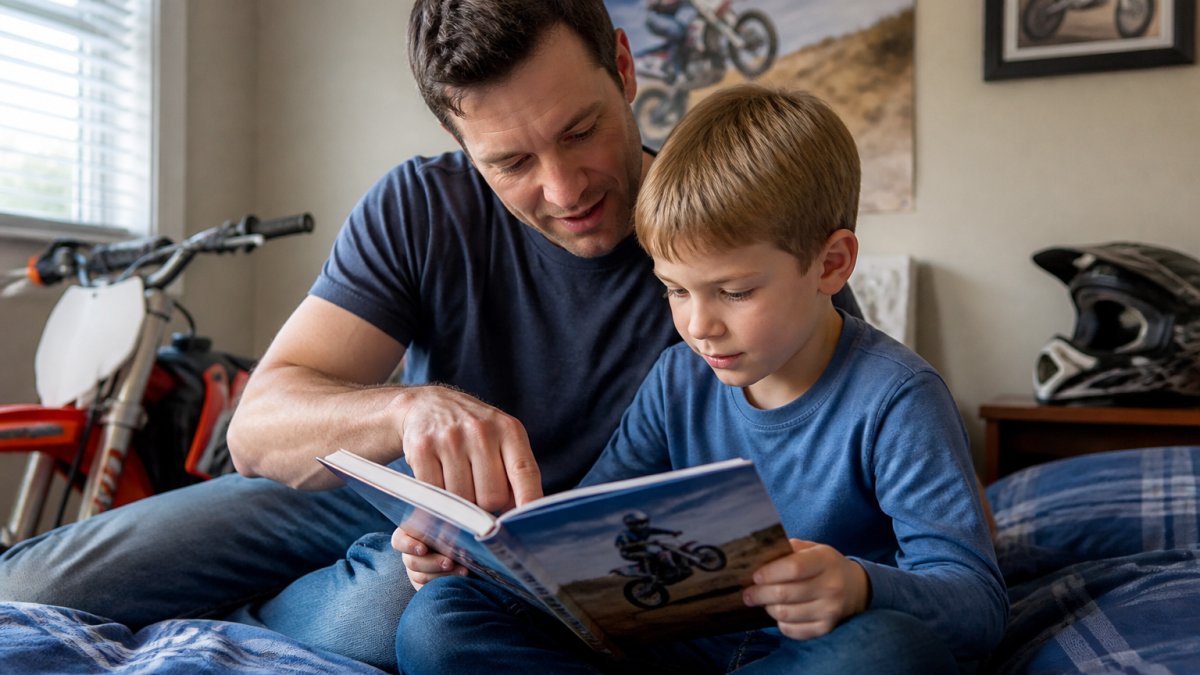
- Preview (1 minute). Show the cover and ask, "What do you think is going to happen?" Guessing builds prediction skills, a core part of comprehension.
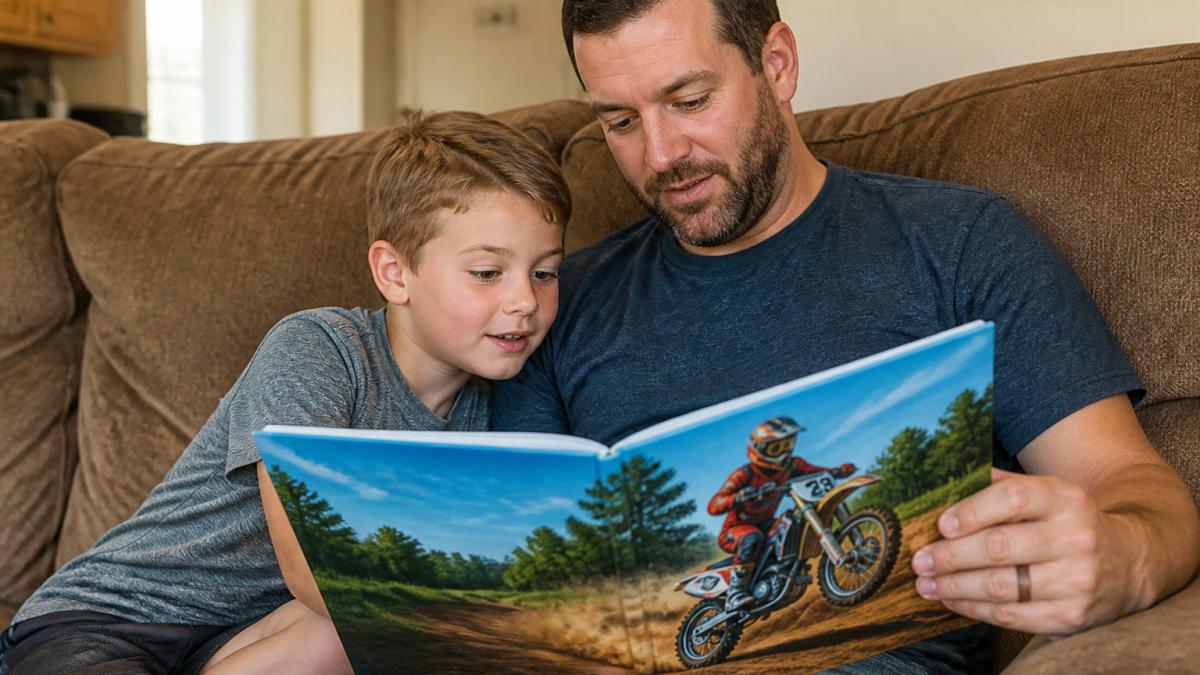
- Read aloud with voices (8-12 minutes). Change your voice for different characters. Slow down at tense moments. Stop at one cliffhanger per session, never at the end of a chapter if you can help it. Stopping mid-tension is what makes a child ask for "one more."
- Pause-and-ask (2 minutes, woven in). Every few pages, ask one question. Keep it open-ended:
- "What would you do if you were Ryder right now?"
- "How do you think Pepper feels?"
- "What do you think happens next?"
- Connect to real life (2 minutes). Link the story to something your child knows: "Remember when you were nervous before your first ride? That's how this character feels."
- Close the loop (1 minute). Ask, "What did the character learn today?" Don't correct the answer, whatever your child says is the lesson they needed.
Choosing stories that hold up to re-reading
A dirt bike story earns its shelf space if it:
- It shows a character failing and trying again. Stories where the hero succeeds on the first attempt teach nothing.
- It includes specific, accurate details. Naming bike parts, describing the feel of a helmet, or showing a rider checking tire pressure gives your child something concrete. Vague stories about "riding fast" blur together.
- It leaves room for your child's imagination. The best stories leave a gap your child fills in, what the track looks like, what the engine sounds like, what the character is thinking.
What to do when your child says no
Some children resist reading no matter how good the book is. Patterns that work:
- Read to a stuffed animal or a pet. The pressure of performing for a parent disappears.
- Let your child "read" the pictures to you. They narrate what they see, real comprehension practice.
- Pair the book with the bike. Read a chapter in the garage next to the bike. The setting does a lot of the work.
Dirt Bike Books for Kids Teach Real-World Skills
Why dirt bike stories help children goes beyond entertainment. These stories teach practical skills that transfer to real riding and real life.
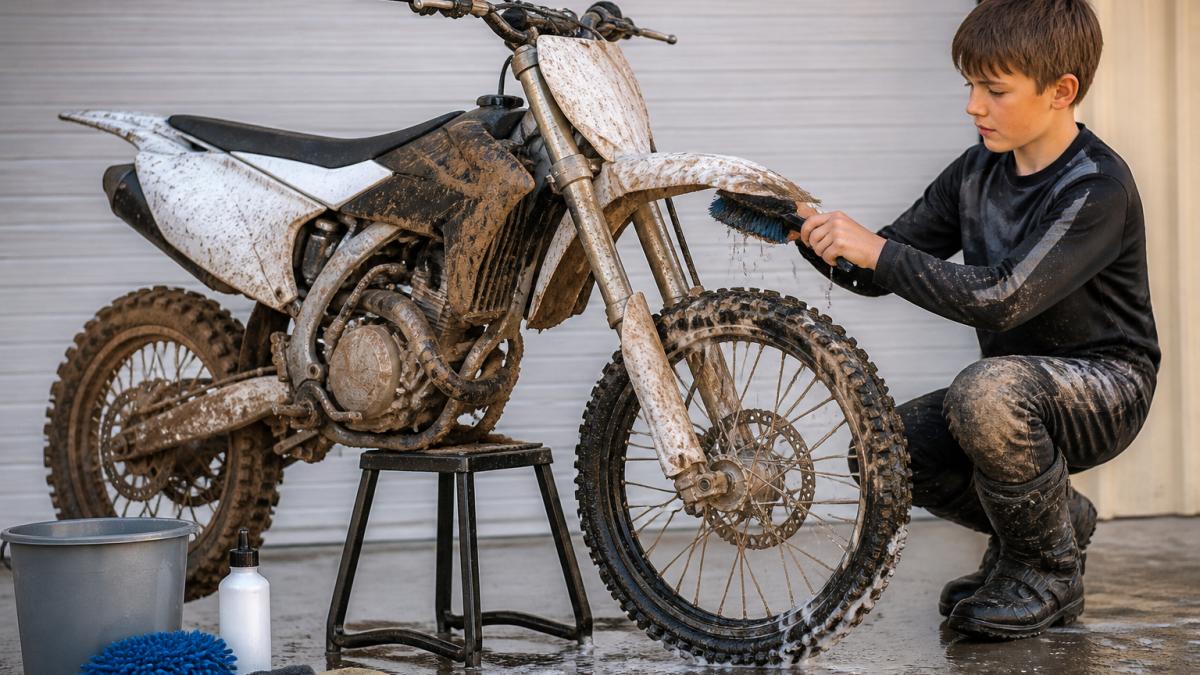
Stories about bike maintenance teach responsibility.
Stories about goal-setting show process, not just outcome.
Stories about safety teach without preaching. A character wears a helmet and protective gear because they're smart, not because they have to, and checks weather and track conditions before riding.
Stories about sportsmanship show what it looks like to lose well and win humbly.
Nelmgerian MX offers rider training journals that extend these lessons. Kids can track goals, record progress, and reflect on what they learned. The story plants the seed; the journal makes it personal.
Reading Activities for Kids That Connect to the Track
The activities below extend the story beyond the last page and build literacy and social-emotional skills separate from anything your child gains from riding. That distinction matters: a child who cannot ride, does not want to ride, or rides less than their peers can still get every benefit a dirt bike story offers. The story is the intervention; the bike is the hook.
Story-based activities that build skills (not just fill time)
**1.
**2.
Ryder's First Motocross Race →
**3.
4. "What would you do?" cards. Write five story-based scenarios on index cards: "Your bike won't start before a race. What do you do?" "A friend falls on the track.
5. Build the track. Use blocks, cardboard, or floor tape to build the story's track, and have your child retell the story while moving a toy bike through it.
Stories for every child, not just the ones who ride
A dirt bike story does not require a dirt bike. Consider who else these stories serve:
- Children with physical disabilities or chronic conditions who cannot ride but love the sport. Look for books where the character's love of riding is the focus, not their physical ability.
- Children in families that cannot afford a bike, gear, or track fees. The story is free at the library. The benefits are not gated behind equipment.
- Children in single-parent, grandparent-led, or foster families. Choose stories that don't assume a married mother and father. If a book shows only one family shape, talk about it: "Who else could have taught Ryder to ride?"
Separating what stories do from what riding does
It's tempting to credit dirt biking itself for every good outcome, but the evidence doesn't support that. What reading and storytelling research does support is more modest and more useful:
- Vocabulary and comprehension grow from hearing and discussing stories, not from riding.
- Narrative thinking, understanding cause and effect, character motive, and sequence, is built by stories.
- Emotional regulation improves when children see characters name and manage big feelings and a trusted adult talks with them about it.
Riding contributes something different: physical coordination, real-world risk assessment, and firsthand experience with practice and failure. The two are complementary but not the same.
A weekly rhythm that fits real family life
You don't need a daily routine to get the benefits. A pattern that holds up:
- Two or three read-aloud sessions per week, 15-20 minutes each.
- One activity per week from the list above, the one your child liked most.
- One conversation per week connecting the story to something real: a fear, a goal, a friendship, a mistake.
That's roughly 45-60 minutes a week, enough to build the habit without turning reading into a chore.
Children's Books About Goal-Setting and Perseverance
The best dirt bike stories for children ages 3-9 focus on characters who set goals and work toward them.
Look for clear, achievable goals: completing a first ride, winning a local race, mastering a new technique. Concrete goals show your child what perseverance looks like.
Stories should show setbacks as part of the process, not failures. A character crashes, gets back up, and tries again; doesn't win the first time but improves with practice.
Nelmgerian MX books feature characters who face real challenges. Through characters including Ryder, Pepper, and Wheelie, Nelmgerian MX combines the excitement of motocross with positive lessons about reading, learning, confidence, responsibility, friendship, sportsmanship, perseverance, and believing in yourself.
Choose books where the character's goal connects to your child's. If your child wants to ride faster, find a story where the character improves their speed; if they want to be braver, choose one about facing fear. That personal connection makes the lesson stick.
Separating Fictional Adventure From Real-World Riding Safety
Reading about dirt bikes is thrilling. Real riding requires safety. Help your child understand the difference.
Stories can inspire adventure and confidence, never recklessness. When you read together, point out safety behaviors: "Did you notice Ryder wore his helmet?
Discuss the difference between stories and real riding.
Use stories as teaching tools for safety rules.
Make safety rules feel connected to success, not punishment. Fast riders wear helmets because they're smart and want to keep riding. Skilled riders maintain their bikes because they care about performance. Safe riders progress faster because they avoid injuries that stop their training.
Your child should understand that story characters are fictional.
Frequently Asked Questions
What can children learn from dirt bike stories?
Dirt bike stories teach children discipline, responsibility, goal-setting, and perseverance through characters and adventures they connect with. Stories show how riders prepare, practice, overcome challenges, and celebrate achievements. Kids also learn problem-solving as characters navigate difficult terrain and racing situations. Beyond the sport itself, these stories build confidence, encourage focus, and demonstrate the importance of safety and protective gear, lessons that apply both on and off the track.
How can stories help children learn to read?
Stories capture children's attention through exciting narratives and familiar characters, making reading feel like fun rather than a chore. When kids are invested in what happens next to Ryder or Pepper, they're motivated to read more and practice regularly. Motocross-themed stories are especially powerful for young riders because the subject matter matches their passion. This natural interest builds reading fluency, expands vocabulary, and strengthens comprehension skills faster than generic beginner readers.
What age can kids start reading motocross books?
Children as young as 3 years old can enjoy motocross picture books and stories read aloud by parents. Beginning readers aged 5-7 benefit from learn-to-read books with simple text and engaging illustrations. By ages 7-9, children can tackle longer stories independently. The key is choosing age-appropriate books that match your child's reading level and interest in dirt bikes. Starting early with read-aloud sessions builds a love of reading before independent reading skills develop.
How do I get my child excited about reading when they'd rather be riding?
Connect reading directly to their passion for dirt bikes. Use motocross stories as a bridge between track time and indoor activities. Make reading a family ritual before or after riding days. Ask your child questions about the story characters and their challenges. Let them pick which book to read next. Motocross training journals that track their own progress also combine reading, writing, and goal-setting with their love of the sport, keeping them engaged in screen-free learning.