 blog
Best Motocross Mental Preparation Exercises for Beginners
Table of Contents
- Why Mental Preparation Matters for New Riders
- Motocross Mental Training Exercises to Start With
- Dirt Bike Visualization Exercises for Track Awareness
- Motocross Breathing Exercises for Calm and Emotional Control
- Building Confidence and Managing Fear on the Bike
- A Pre-Race Routine for Motocross Riders: The Night Before to the Gate Drop
- Tracking Progress: How to Know Mental Preparation Is Working
- Common Mistakes Beginners Make With Mental Preparation
- Frequently Asked Questions
Last Updated: October 18, 2026
Why Mental Preparation Matters for New Riders
Most beginners lose more races in their head than on the track, which is why motocross mental preparation matters so much.
Here's what most guides get wrong. They treat mental training as something you do after you've mastered the bike.
Why does it matter so much?
- Fear steals speed. A tense rider grips too hard and sits too stiff.
- Focus fades fast. A beginner's attention drifts after a few laps without a routine.
- Confidence is trainable. It comes from repetition and small wins, not talent.
The good news: mental skills are simple to practice. Below, we'll show you exactly how to start, with exercises you can do in ten minutes a day.
Motocross Mental Training Exercises to Start With
Start with two short exercises. Both take under five minutes and need no equipment. Do them at home, in the truck, or on the starting line. These are the foundation of any motocross mental training exercises routine.
Exercise 1: The Two-Minute Body Scan
The body scan teaches self-awareness, the skill that lets you notice tension before it slows you down.
- Sit still and close your eyes. Time: 2 minutes.
- Start at your feet. Notice how they feel.
- Move up slowly: legs, stomach, chest, shoulders, jaw.
- Wherever you find tightness, relax that spot on your exhale.
- Finish with three slow breaths.
Do this once before every practice session. Repeat it five times a week for two weeks before you judge whether it works.
Exercise 2: Focus Word Repetition
Pick one word that describes how you want to ride: smooth, steady, or calm.
- Say the word silently as you breathe in.
- Breathe out slowly and picture yourself riding that way.
- Repeat for ten breaths.
Dirt Bike Visualization Exercises for Track Awareness
Visualization, also called mental rehearsal, is the practice of picturing your ride before it happens. Dirt bike visualization exercises build track awareness without burning fuel.
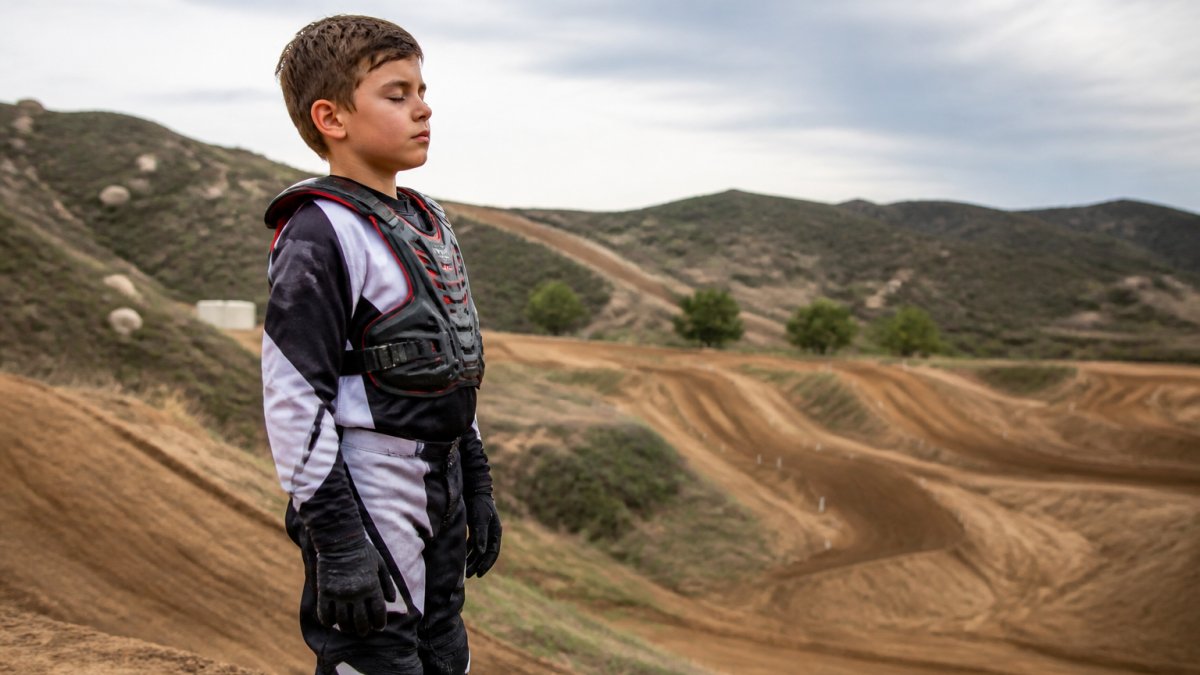
The Track Walk Visualization
Walk the track slowly before you ride. Stop at each corner and look for three things:
- The rut patterns and where the ruts lead
- Your line selection through the corner
- The safest fastest line for your skill level
Then close your eyes and replay that corner in your mind. Picture your body positioning, your balance, and your throttle control. Do this at every corner. This is track awareness you can build on foot.
The Five-Lap Mental Rehearsal
Sit somewhere quiet and ride five full laps in your head.
- Picture the start gate and your first shift.
- See yourself entering turn one with the other riders around you.
- Rehearse each corner, jump, and straight in order.
- If you make a mistake in your mind, rewind and ride it clean.
Five laps takes about five minutes. Run it the night before a race.
Motocross Breathing Exercises for Calm and Emotional Control
Breathing is the fastest way to calm your body. Motocross breathing exercises give you emotional control when nerves hit. The technique is simple: breathe in for four counts, hold for four, out for six.
Try this box-style pattern before a moto:
- Breathe in through your nose for four counts.
- Hold for four counts.
- Breathe out slowly for six counts.
- Repeat five times.
The long exhale is the key. It slows your heart rate and settles your nerves. Practice it at home first, so it feels automatic at the track.
Building Confidence and Managing Fear on the Bike
Confidence comes from evidence. Every small win on the bike is proof you can handle the next step. Fear management works the same way: you face one small challenge at a time, not the whole track at once. But beginners need more than encouragement. They need a way to tell the difference between useful caution and anxiety that is holding them back, and a step-by-step ladder that builds confidence without pushing them past their skill level.
Caution vs. Anxiety: How to Tell the Difference
Useful caution is specific and track-focused. It sounds like: "That rut is deeper than last week, so I will slow down and stay centered." Anxiety is vague and body-focused. It sounds like: "I can't do this.
A simple rule: if the worry names a specific section and a specific action, treat it as information. If the worry is a general feeling of dread, treat it as a signal to breathe and shrink the task.
A Safety-Aware Exposure Ladder for Beginners
Use this progression over four to six sessions. Do not skip steps, and do not move up until the rider finishes a step calmly twice in a row.
- Static familiarization (5 minutes). Sit on the bike with the engine off. Practice the body scan and focus word. Goal: feel relaxed in gear.
- One-section repetition (10-15 minutes). Ride a single corner or short straight. Goal: three clean passes with loose grip.
- Two-section link (15 minutes). Connect two sections at a pace that feels easy. Goal: carry the focus word from one section to the next.
- Half-lap flow (15-20 minutes). Ride half the track without stopping. Goal: one calm mistake recovery.
- Full-lap practice (20 minutes). Complete full laps at 70 percent effort. Goal: steady breathing on the bike.
- Passing exposure (10 minutes). Practice being passed and passing a slower rider in a safe area. Goal: stay relaxed when another rider is close.
Each step should feel almost too easy. That is the point. Confidence grows from repeated evidence, not from surviving a scary session.
Nelmgerian MX Training Journal →
Fear-Naming Script for Young Riders
When fear shows up, run this three-line script out loud or in the rider's head:
- Name it: "I am worried about the whoops."
- Shrink it: "I will ride the whoops at half speed and stay loose."
- Schedule it: "I will do that three times, then stop."
This script turns a vague feeling into a small, measurable task. It also gives parents and coaches a calm way to respond instead of saying "don't be scared."
Gear and Skill Check
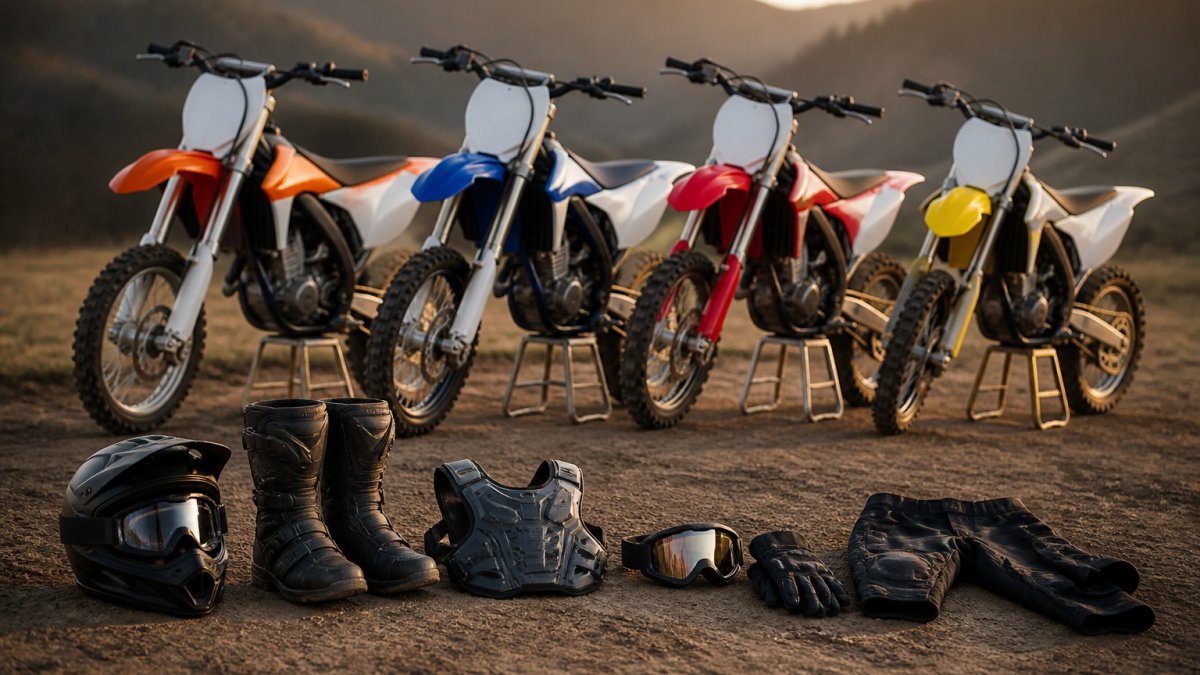
The CDC's guidance on youth sports and injury prevention points out that young athletes do best with age-appropriate progression and proper gear.
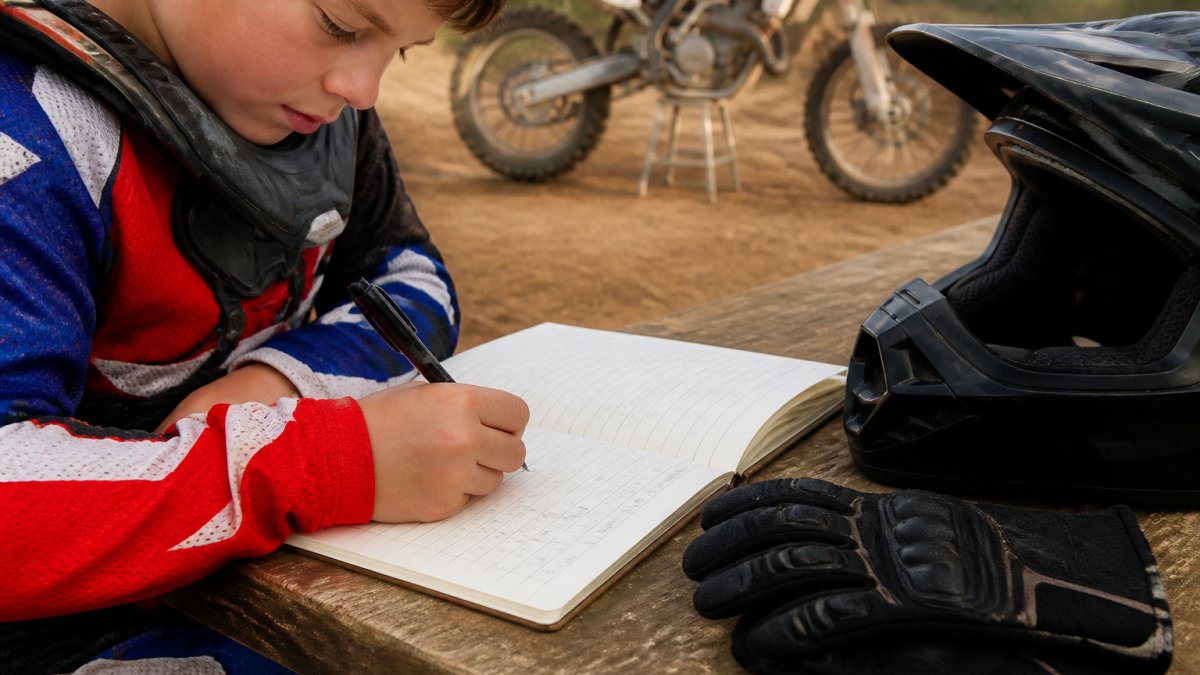
A training journal helps here. Writing down one win after each session turns a good day into proof your rider can look back on. Our Nelmgerian MX Training Journal gives young riders a simple place to track goals, laps, and progress.
A Pre-Race Routine for Motocross Riders: The Night Before to the Gate Drop
A pre-race routine for motocross riders removes guesswork. When nerves spike, a familiar routine gives your rider something to follow instead of something to fear. Here is the schedule we suggest.
| When | What to Do | Time |
|---|---|---|
| Night before | Pack gear, run the five-lap mental rehearsal | 15 min |
| Morning | Eat a normal breakfast, light stretch | 20 min |
| At the track | Walk the track, note ruts and lines | 15 min |
| 30 min before | Body scan and breathing exercise | 5 min |
| 5 min before | Focus word repetition at the gate | 2 min |
Keep it the same every race. Repetition is what makes a routine calming.
Tracking Progress: How to Know Mental Preparation Is Working
You can't measure calm directly, but you can track its results. The gap in most beginner guides is that they tell riders to "notice improvement" without giving them a way to record it. Use a simple one-page log after every practice session. It takes two minutes and turns vague feelings into patterns you can act on. Identifying these recurring patterns often reveals that mechanical feedback is actually the root cause of your hesitation, a connection explored further in this suspension tuning guide.
The Four-Metric Beginner Log
Rate each item from 1 to 5 after every session. Write the number, not a paragraph.
| Metric | What to Rate | 1 Means | 5 Means |
|---|---|---|---|
| Focus | How long you stayed on your plan | Mind wandered every lap | Stayed on the focus word all session |
| Confidence | Willingness to try one new section | Avoided everything new | Tried one new section calmly |
| Breathing | How often you used the breathing pattern | Forgot completely | Used it before every moto |
| Consistency | Lap-to-lap variation | Big speed swings | Steady pace across laps |
Add one line: "One thing that went well" and "One thing to try next time." That is the whole log.
How to Set a Baseline
Before you start any exercise, log three sessions with no changes. Average the four scores. That average is the baseline. For example, a beginner might start at Focus 2, Confidence 2, Breathing 1, Consistency 2. After four weeks of daily body scans and breathing practice, riders may see movement in their metrics. If nothing moves after six weeks, change one variable: shorten the session, add a track walk, or reduce the goal to one section.
What to Look For Over Four to Six Weeks
- Fewer tense-grip reminders from parents or coaches
- Steadier lap times across a session, not just one fast lap
- Your rider talks about the track instead of just the result
Practice-Session Tracking, Not Just Race Day
Most mental preparation advice focuses on race day. Beginners build habits faster if they track practice sessions too. Use the same log for practice, and note whether the rider did the body scan and breathing exercise before riding.
Log one note after each practice. A simple journal entry ("stayed calm in turn three, lost focus on lap four") shows patterns fast. That record is how you know the work is paying off.
Common Mistakes Beginners Make With Mental Preparation
The biggest mistake is treating mental training as a one-time fix. It's a habit, like any drill. Here are the others we see most often:
- Practicing only on race day. Skills need reps at home first.
- Skipping the boring parts. Breathing and body scans feel slow, but they work.
- Setting giant goals. "Win the moto" creates pressure; "one clean lap" builds skill.
One more: parents pushing results over effort. Encouragement about focus and effort keeps the sport fun, and fun keeps kids riding.
For young riders who want to see the sport in story form, books help too. Ryder's First Motocross Race follows a beginner through race-day nerves, which makes the mental side of the sport easier to talk about at home.
Mental preparation is the part of racing most families skip, and it's often the part that decides who improves fastest.
Frequently Asked Questions
What should a beginner think about before riding motocross?
Before a ride, beginners should focus on three things: the track layout, their breathing, and one or two specific skills to practice. Walk the track to note rut patterns and line selection, take five slow deep breaths to settle nerves, and pick a single goal like smoother throttle control. This simple motocross mental preparation routine takes about ten minutes and helps riders start calm and focused instead of overwhelmed.
How can a beginner build confidence on a dirt bike?
Confidence comes from repetition and small wins. Start with fundamental drills in a safe area, then add one new challenge per session. Use dirt bike visualization exercises before each ride to mentally rehearse body positioning and balance. Track progress in a journal so you can see improvement over weeks, not just single rides. Parents can help by praising effort and consistency rather than lap time.
How do motocross riders stay calm under pressure?
Riders use motocross breathing exercises to manage pressure. A common pattern is a four-count inhale, a four-count hold, and a six-count exhale, repeated five times. This slows the heart rate and reduces tension in the arms and grip. Pair breathing with a short focus word or phrase repeated before the gate drop, and practice the same routine at every practice session so it becomes automatic on race day.
How can parents help a young motocross rider manage nerves?
Parents can help by keeping pre-race conversations calm and consistent. Avoid adding pressure with results-focused talk; instead, ask what the rider wants to practice that day. Use a simple pre-race routine for motocross riders at home, like packing gear together the night before and doing a short breathing exercise in the truck. A training journal also gives kids a screen-free way to set goals and see progress, which reduces anxiety over time.