 blog
Best Beginner Dirt Bikes for Adults: 2026 Guide
Table of Contents
- How to Choose the Best Beginner Dirt Bikes for Adults
- Dirt Bike Size for Adults: Height, Weight, and Inseam
- Two-Stroke vs Four-Stroke Dirt Bike: Which Is Easier to Learn On?
- Best 250cc Dirt Bike for Beginners: Power Without the Overwhelm
- Trail Bikes vs Motocross Bikes: Match the Bike to Your Terrain
- Dirt Bike Safety Gear for Beginners: What to Buy Before You Ride
- Total Ownership Costs: Bike, Gear, and Maintenance
- Common Mistakes New Adult Riders Make
- Frequently Asked Questions
Last Updated: October 16, 2026
How to Choose the Best Beginner Dirt Bikes for Adults
The best beginner dirt bikes for adults are the ones that match your body, your terrain, and your comfort level, not the ones with the biggest engine or the loudest spec sheet. This guide walks through sizing, engine type, and cost so you can buy once and ride with confidence. A dirt bike is a two-wheeled off-road motorcycle built for trails, tracks, and open terrain, with long-travel suspension and knobby tires. Most new adult riders assume they need the most powerful bike they can afford. The opposite is true: a bike that overpowers you slows your learning more than one that feels tame on day one.
Our Selection Criteria: What Actually Matters
Beginner bikes are often judged on five factors, in this order: fit, power delivery, weight, maintenance demand, and total cost. Fit comes first because a bike you cannot touch the ground on is a bike you will drop. Power delivery matters more than raw engine size, since a smooth, predictable throttle builds skill faster than a snappy one.
A common mistake is shopping by engine size alone. A well-mannered 250cc four-stroke is easier to learn on than a peaky 125cc two-stroke for most adults.
Dirt Bike Size for Adults: Height, Weight, and Inseam
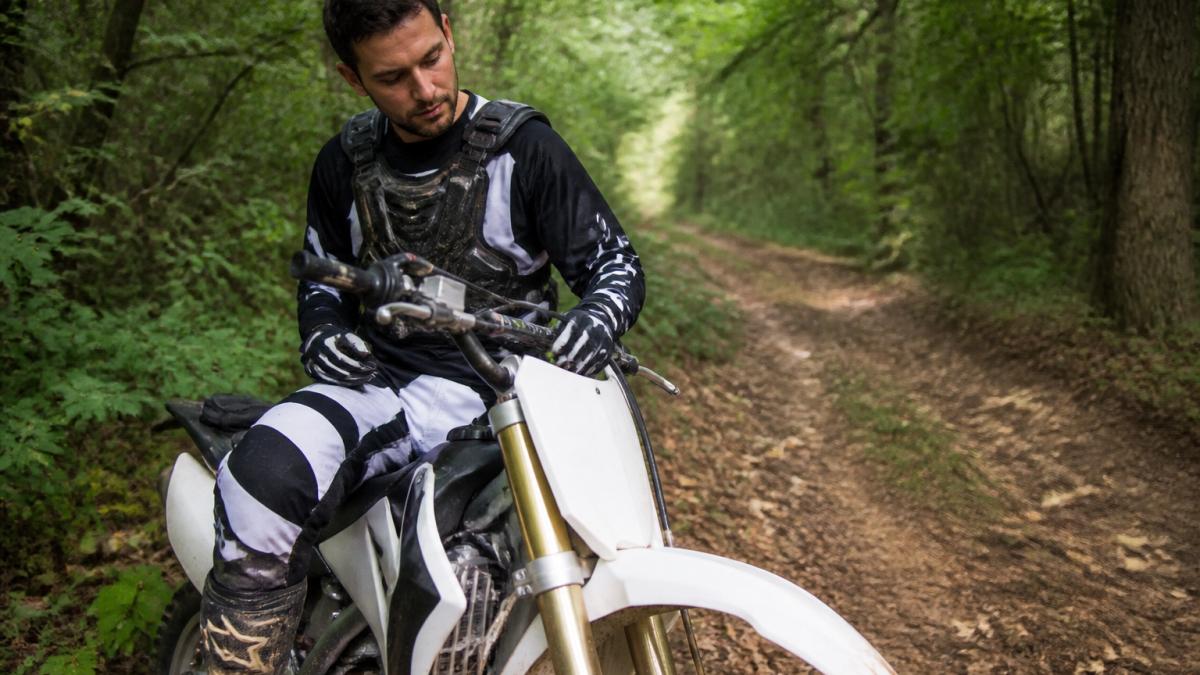
Dirt bike size for adults comes down to seat height versus your inseam, plus engine size versus your weight. You want both feet to reach the ground with your boots on, or at least the balls of your feet. Seat height is the distance from the ground to the top of the seat, and it is the number that decides whether you feel stable at a stop. Measure your inseam in boots, then compare it to the bike's listed seat height. Riders under about 5 feet 6 inches usually fit better on a lower seat, while taller riders can handle a full-size frame.
- Rider height under 5'6": look for lower seat heights and lighter frames
- Rider height 5'6" to 5'10": most full-size trail bikes fit comfortably
- Rider height over 5'10": standard full-size frames work well
- Rider weight over 200 lbs: choose more suspension travel and a larger engine
Two-Stroke vs Four-Stroke Dirt Bike: Which Is Easier to Learn On?
The two-stroke vs four-stroke dirt bike question has a simple answer for beginners: a four-stroke is easier to learn on. A four-stroke engine delivers power smoothly across the rev range, so a small twist of the throttle does not surprise you. A two-stroke builds power sharply as the revs rise, which rewards experienced riders but punishes new ones with sudden surges.
| Engine Type | Power Delivery | Maintenance | Best For |
|---|---|---|---|
| Four-stroke | Smooth, predictable | Less frequent top-end work | Beginners, trail riders |
| Two-stroke | Sharp, high-revving | More frequent top-end work | Experienced racers |
Four-strokes also tend to run cleaner and need less mixing of fuel and oil. Two-strokes are lighter and cheaper to rebuild when they do need work, which keeps them popular with racers. For a first bike, the smooth power of a four-stroke is worth the trade-off.
Best 250cc Dirt Bike for Beginners: Power Without the Overwhelm
The best 250cc dirt bike for beginners is a four-stroke trail model with a soft throttle and a low seat, not a motocross race bike.
What separates a good first 250 from a bad one is not the number on the side panel. It is how the power arrives, how much the bike weighs, and whether the seat height lets you plant a boot.
| Use Case | Typical Displacement | What to Look For | Why It Fits Beginners |
|---|---|---|---|
| Casual trail and fire-road riding | 125cc-230cc four-stroke | Low seat height, electric start, soft suspension | Light weight and gentle power build confidence fast |
| Mixed trail and technical terrain | 230cc-250cc four-stroke | Wide-ratio transmission, tractable low-end, kickstand | Enough torque for hills without a race-tuned hit |
| Track and closed-course riding | 125cc two-stroke or 250cc four-stroke motocross | Adjustable suspension, aggressive gearing | Only once basic skills are solid; stiffer and taller |
| Dual-purpose and open land | 250cc four-stroke dual-sport | Street-legal lighting, taller gearing | Compromise bike; heavier and softer than a pure trail model |
Look for electric start, which saves you from kicking a hot engine on a hill, and a wide-ratio transmission built for varied terrain.
A few well-known beginner-friendly categories to research, rather than a single "best" pick:
- Air-cooled 230cc-250cc trail four-strokes. Simple engines, low maintenance, and a low seat height make these the default first bike for many adults. They are not fast, and that is the point.
- Liquid-cooled 250cc trail four-strokes. More power and better suspension for taller or heavier riders, at the cost of more maintenance and a higher seat.
- 125cc-150cc four-strokes. Best for lighter riders or anyone under about 5'6", where a full-size frame is too tall to manage confidently.
- Small-bore two-strokes. Light and cheap to rebuild, but the sharp power delivery makes them a poor first choice for most adults.
Seat height is the number that decides whether a 250 works for you. Full-size trail bikes commonly sit in the low-to-mid 30-inch range, while lowered or small-wheel variants drop several inches.
Trail Bikes vs Motocross Bikes: Match the Bike to Your Terrain
Trail bikes and motocross bikes are built for different jobs, and picking the wrong one makes learning harder. A trail bike, also called an enduro or off-road model, has softer suspension, a quieter exhaust, and gearing built for slow, technical terrain. A motocross bike is stiff, loud, and tuned for the track, with a tall seat and aggressive power.
If you plan to ride forest trails, fire roads, or open land, a trail bike is the right call. If your goal is racing on a closed course, a motocross model makes sense once you have basic skills. Most adult beginners ride trails, so start there.
Dirt Bike Safety Gear for Beginners: What to Buy Before You Ride
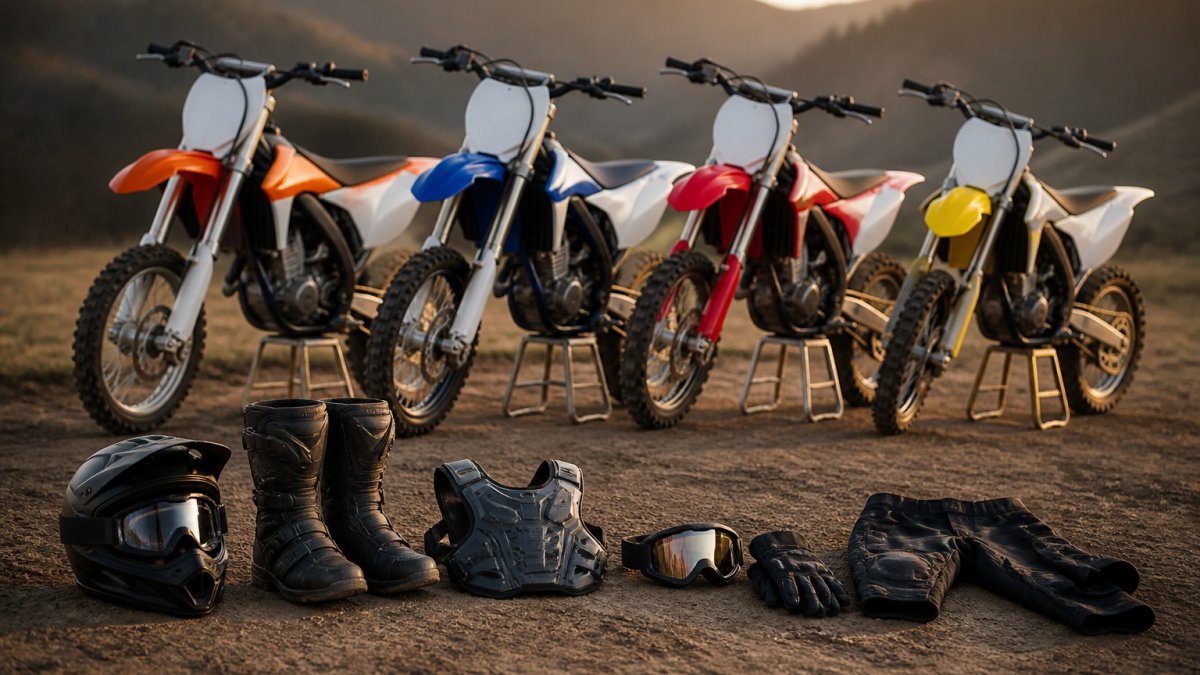
Dirt bike safety gear for beginners is not optional, and a helmet is the first item on the list. Off-road riding means falls, and the right gear turns a bad crash into a bruise instead of a hospital visit. Budget for gear as part of the bike purchase, not as an afterthought.
- A certified full-face off-road helmet
- Goggles that seal against dust
- Riding boots with ankle support
- Gloves, chest protector, and knee guards
- A jacket or jersey with long sleeves
Many riders also look for beginner training resources to build skills before their first trail day. Nelmgerian MX publishes children's motocross books and rider training journals that help young riders track practice, goals, and progress, and the same habit of logging rides helps adults too.
Total Ownership Costs: Bike, Gear, and Maintenance
Total ownership costs go well beyond the sticker price, and gear plus maintenance often surprises new riders. The bike itself is only the start. Add a helmet, boots, gloves, and protective gear, then plan for ongoing maintenance like oil changes, air filters, chain care, and tires.
What most guides skip is the shape of the budget. Rather than quote a single number that goes stale, think in ranges and proportions, then verify against current listings in your area.
| Cost Category | What It Covers | One-Time or Ongoing | Rough Share of First-Year Spend |
|---|---|---|---|
| Bike purchase | New or used machine | One-time | Largest single line item |
| Protective gear | Helmet, goggles, boots, gloves, chest protector, knee guards | One-time, replace as worn | Meaningful and often underestimated |
| Initial setup | Title, registration where required, spark arrestor, hand guards, skid plate | One-time | Small but easy to forget |
| Routine maintenance | Oil, oil filter, air filter, chain lube, tires, brake pads | Ongoing | Recurring monthly or per-ride |
| Repairs | Top-end work, suspension service, clutch, bearings | Occasional | Spikes with hard use or a neglected used bike |
A few practical rules of thumb that hold across models:
- Gear is not a rounding error. A full set of certified off-road gear can rival a meaningful fraction of a used bike's price. Budget it before you shop, not after.
- Four-strokes cost less to own day to day. Longer service intervals and no fuel-oil mixing make them cheaper to run for most beginners.
- Two-strokes cost less to rebuild when they finally need it. The trade-off is more frequent top-end service.
- Used bikes shift cost from purchase to repair. A cheap used bike with a worn chain, tired suspension, and a near-due top end can cost more in the first year than a slightly pricier well-maintained one.
- Tires and chains are consumables. On a trail bike ridden regularly, expect to replace them as normal wear items, not as surprises.
Before buying any used bike, inspect the frame for cracks, check the chain and sprockets for hooking, compress the suspension for leaks, and confirm the air filter is clean. A compression test on a two-stroke and a valve-clearance check on a four-stroke tell you more about condition than any listing photo.
Reliability matters more than a low price. A well-maintained used trail bike in the right size will cost less over three years than a neglected motocross bike bought for less up front.
Common Mistakes New Adult Riders Make
The most common mistake new adult riders make is buying too much bike for their skill level. A powerful machine feels exciting in the showroom and terrifying on a muddy trail. Start smaller than you think you need, then upgrade once your skills catch up.
Other frequent errors include skipping protective gear, riding terrain above your ability, and ignoring basic maintenance until something breaks. Take a beginner training course if one is available near you, and practice throttle and clutch control in a flat, open area before hitting trails.
Learning to ride is a challenge that rewards patience, and the right start makes all the difference.
Frequently Asked Questions
What cc dirt bike is right for an adult beginner?
Most adult beginners do well on a 230cc to 250cc four-stroke trail bike. A 125cc two-stroke or a 250cc four-stroke offers manageable power delivery and a predictable learning curve. Avoid 450cc motocross bikes until you have solid throttle and clutch control, since their power delivery is aggressive and unforgiving. Your height, weight, and riding goals should guide the final pick.
Should a beginner adult buy a two-stroke or four-stroke dirt bike?
A four-stroke is usually the better first bike for adults. It delivers smoother power delivery, requires less clutch and throttle finesse, and needs less frequent top-end maintenance than a two-stroke. Two-strokes are lighter and cheaper to rebuild when they do need work, but their hit of power can surprise new riders. Choose a two-stroke only if you plan to ride motocross tracks and want the lighter feel.
Is a 250cc dirt bike too powerful for a beginner?
A 250cc four-stroke trail bike is not too powerful for most adult beginners, especially if you weigh over 140 pounds. The key difference is the model type: a 250cc trail bike delivers smooth, linear power, while a 250cc motocross bike is tuned for racing and hits harder. Start on a trail-oriented 250cc, and you will build throttle control and clutch control without fighting the bike.
What safety gear does an adult beginner need for dirt bike riding?
At minimum, buy a DOT-certified helmet, goggles, gloves, riding boots, knee and shin guards, elbow pads, and a chest protector. Many riders also add a neck brace and hip padding. Gear is not optional: off-road riding means falls are part of learning, and good gear is what keeps a minor tip-over from becoming a serious injury. Budget for gear before you buy the bike.