 blog
blog
5 Best Motocross Training Exercises for Balance (2026)
Table of Contents
- Why Balance Is the Foundation of Faster Motocross Lap Times
- The 5 Best Motocross Training Exercises for Balance
- Motocross Core Strength Training: The Missing Link in Your Routine
- Dirt Bike Balance Drills for Beginners: On-Bike Practice
- Building a Motocross Fitness Routine for Kids
- Tracking Progress: Metrics That Matter for Balance Training
- Common Balance Training Mistakes and How to Avoid Them
- Final Lap: Your Weekly Balance Training Plan
- Frequently Asked Questions
Last Updated: September 4, 2026
Why Balance Is the Foundation of Faster Motocross Lap Times
Every motocross training exercises program starts with one question: how do you keep the bike underneath you when the track tries to throw you off? Balance is the skill that separates riders who survive a rutted corner from those who eat dirt. It is not just about staying upright; it is about maintaining optimal body positioning so your bike can do what you ask of it.
When your core is stable and your proprioception is sharp, you react faster to unexpected hits and bumps. This guide breaks down the 5 best motocross training exercises for balance 2026, giving you a clear path to build the kind of stability that shows up in your lap times.
The best part? Most of these drills require nothing more than a few pieces of basic equipment and twenty minutes a day. Below, we will show you exactly how to perform each one, what mistakes to avoid, and how to track your progress so you know the work is paying off.
The 5 Best Motocross Training Exercises for Balance
The 5 best motocross training exercises for balance 2026 focus on dynamic balance, core stability, and the fast-twitch muscle fibers that fire when you correct a slide. These are not random gym moves. Each exercise was chosen because it mimics a specific demand you face on the bike, from absorbing braking forces to holding your line through a whoop section.
| Exercise | Primary Benefit | Key Muscle Groups | Best For |
|---|---|---|---|
| Single-Leg Deadlifts | Dynamic stability and hip control | Hamstrings, glutes, core | Cornering and braking |
| Stability Ball Knee Tucks | Core strength and trunk control | Abdominals, hip flexors | Absorbing impacts |
| Bosu Ball Squats | Proprioception and ankle stability | Quads, glutes, stabilizers | Technical terrain |
| Offset Weighted Carries | Anti-rotation strength | Obliques, shoulders, grip | Maintaining body positioning |
| Plyometric Box Jumps | Fast-twitch muscle fiber recruitment | Calves, quads, glutes | Explosive corrections |
1. Single-Leg Deadlifts for Dynamic Stability
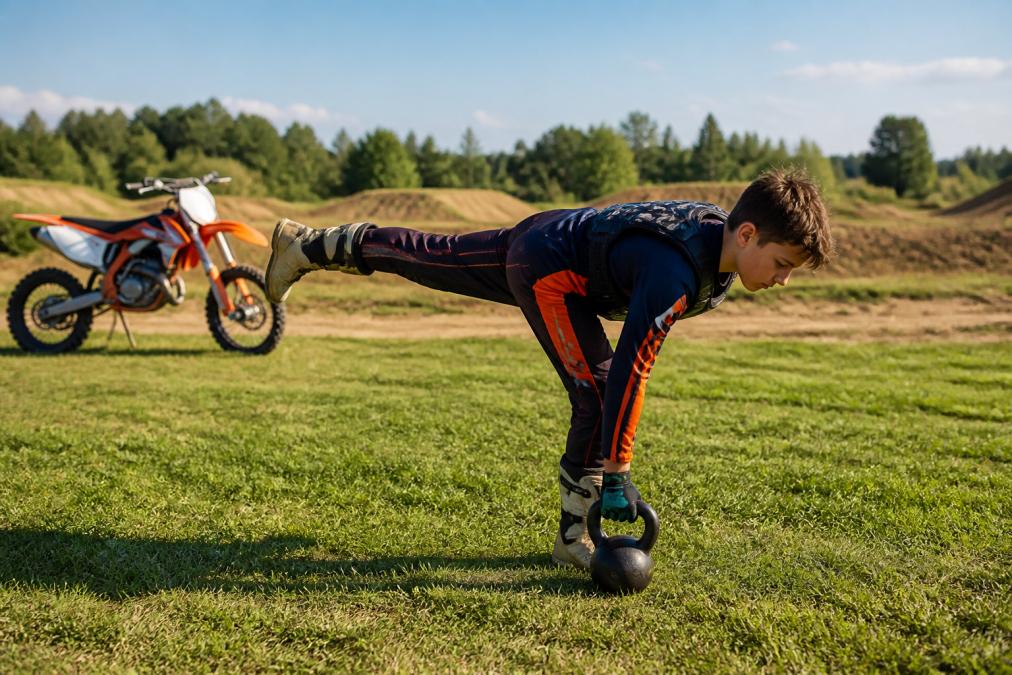
Stand on one leg with a light dumbbell in the opposite hand. Hinge at the hip, keeping your back flat, and lower the weight toward the ground while your free leg extends behind you. Return to standing by squeezing your glute. This exercise trains the stabilizers in your ankle, knee, and hip to work together, which is exactly what happens when you weight the outside peg through a corner.
A common mistake is rushing the movement or letting the raised leg drift. Slow down. Aim for three sets of eight reps per leg, focusing on a two-second pause at the bottom. The goal is control, not speed.
2. Stability Ball Knee Tucks for Core Strength
Place your shins on a stability ball with your hands on the floor in a plank position. Pull your knees toward your chest, rolling the ball forward, then extend back out. This move forces your core to fight instability from two directions, building the trunk strength you need to absorb heavy landings without losing your body positioning.
Keep your hips low and avoid letting your lower back sag. If this is too hard, start with your knees on the floor and the ball closer to your body. Three sets of ten reps will leave your abs shaking in a way that translates directly to holding on through rough sections.
3. Bosu Ball Squats for Proprioception
Proprioception is your body's ability to sense where it is in space (merriam-webster.com). Motocross demands constant position changes, and a Bosu ball squat trains your nervous system to make those adjustments automatically. Stand on the flat side of a Bosu ball with feet shoulder-width apart and perform a controlled squat.
The unstable surface forces your ankles and knees to constantly micro-correct. Keep your chest up and push through your heels. If balancing on the flat side is too easy, flip it over and stand on the dome. Three sets of twelve reps builds the kind of kinesthetic awareness that helps you feel the bike's center of gravity before it gets away from you.
4. Offset Weighted Carries for Anti-Rotation Strength
Hold a dumbbell or kettlebell in one hand and walk in a straight line for forty yards. Your core must fight to keep your torso from twisting toward the weight. This anti-rotation strength is critical for motocross because it keeps your upper body stable while the bike moves beneath you, which is the essence of proper motorcycle handling.
Do not let your shoulders dip to one side. Walk tall, brace your abs, and keep your gaze forward. Switch hands and walk back. Two sets per side is enough to feel the burn in your obliques.
5. Plyometric Box Jumps for Fast-Twitch Muscle Fibers
Fast-twitch muscle fibers are responsible for explosive power, and they are the first to fatigue (peer-reviewed research). Box jumps train them to fire quickly and with force. Find a sturdy box or platform that allows you to land softly with bent knees. Jump up, land quietly, and step down.
The landing is where the motocross benefit lives. Quiet landings mean you are absorbing force through your muscles rather than your joints, which is a key part of injury prevention. Three sets of five jumps, focusing on quality over height, will improve your ability to make split-second corrections when the rear wheel steps out.
Motocross Core Strength Training: The Missing Link in Your Routine
Many riders spend hours on arm strength and ignore their core. That is backwards. Motocross core strength training is what connects your upper and lower body, allowing power to transfer from your legs through your hips and into the handlebars. Without a strong core, every bump in the track forces your body to compensate, which drains energy and slows your reaction time.
The deadbug is an excellent addition to any routine. Lie on your back with arms extended toward the ceiling and knees bent at ninety degrees. Slowly lower your right arm and left leg toward the floor, keeping your lower back pressed into the ground. Return to start and switch sides. This movement teaches your trunk to resist unwanted motion, which is the foundation of staying centered on the bike.
Pallof presses and medicine ball slams are two more tools that build the anti-rotation and explosive power you need. The key is consistency. Ten minutes of focused core work three times a week will do more for your riding than an hour once a month.
Dirt Bike Balance Drills for Beginners: On-Bike Practice
Off-bike training builds the physical capacity, but you also need dirt bike balance drills for beginners that happen on the bike itself. These drills teach your body to feel the machine's balance point and respond without conscious thought. They are best done in a flat, open area away from traffic and obstacles.
Start with slow-speed figure eights. Keep your elbows up, look where you want to go, and use the clutch and rear brake to modulate your speed. The slower you can go without putting a foot down, the better your clutch modulation and throttle control become. This drill forces you to manage the bike's lean angle and traction management in a controlled setting.
Another effective drill is the standing stop. Ride in a straight line in second gear, then brake to a stop while standing on the pegs. Hold your position for three seconds before continuing. This builds the leg and core strength needed to absorb braking forces and teaches you to keep your weight centered over the bike's center of gravity. For a full library of beginner drills and structured practice ideas, the Nelmgerian MX training journal offers a place to log sessions and track skill milestones.
Building a Motocross Fitness Routine for Kids
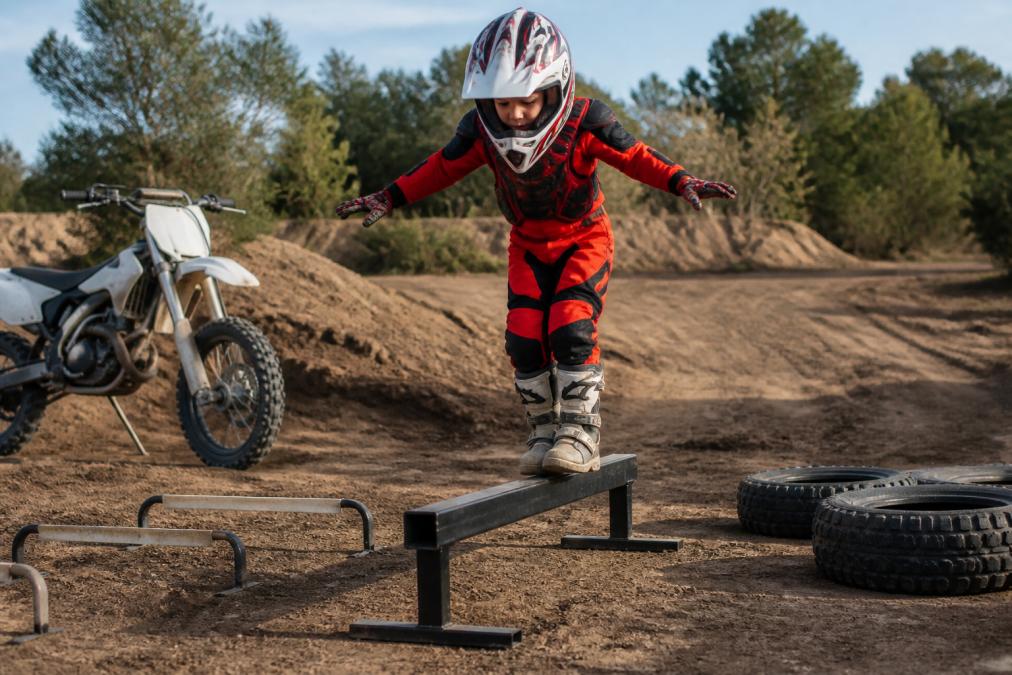
Young riders have different needs than adults. A motocross fitness routine for kids should prioritize fun, short sessions, and basic movement patterns over heavy weights or long endurance work. The goal is to build a love for movement while developing the balance and coordination that will serve them for years.
For children between the ages of three and nine, body weight exercises are perfect. Body weight squats, animal walks, and simple balance games like standing on one leg while tossing a ball keep them engaged without feeling like a chore. Keep sessions under fifteen minutes and end with a game they enjoy. If they are laughing, they are learning.
Recovery is just as important for kids as it is for adults. Their nervous systems are still developing, and fatigue can lead to sloppy technique and frustration. Make sure they get plenty of sleep and unstructured playtime. The American Academy of Pediatrics guidelines on youth sports emphasize that young athletes need adequate rest to prevent overuse injuries and maintain a positive relationship with their sport.
Tracking Progress: Metrics That Matter for Balance Training
You cannot improve what you do not measure. Data-driven progress tracking turns vague feelings of improvement into clear evidence that your training is working. For balance work, the most useful metrics are simple and repeatable.
Time a single-leg stand on each leg with your eyes closed. Record the best time and retest every two weeks. Track the number of consecutive stability ball knee tucks you can complete without breaking form. Note how many times you put a foot down during a two-minute slow-speed drill session. These numbers give you a clear picture of your neuromuscular coordination improving over time.
A training journal is the simplest way to track these metrics. Logging your workouts, how you felt, and your test results creates a record you can look back on to see progress. It also builds discipline, which carries over into every other part of your riding.
Common Balance Training Mistakes and How to Avoid Them
The biggest mistake riders make is training balance in isolation and expecting it to fix everything. Balance is a system. It involves your inner ear, your eyes, and the proprioceptors in your muscles and joints. If you only train one part of that system, you will plateau quickly.
Another common error is neglecting recovery. Balance training places a heavy load on your central nervous system. When your CNS is fatigued, your reaction times slow and your coordination suffers. This is why recovery protocols matter as much as the training itself. Make sure you are sleeping enough and taking rest days between intense balance sessions.
Finally, do not rush the progression. Trying advanced exercises before you have mastered the basics is a recipe for injury. Master the single-leg deadlift before you add weight. Nail the Bosu ball squat before you try it with a barbell. Patience is not passive; it is an active part of getting faster.
Final Lap: Your Weekly Balance Training Plan
Here is a simple weekly plan that combines everything we have covered. It takes about thirty minutes per session and fits easily into a busy schedule.
| Day | Focus | Exercises | Duration |
|---|---|---|---|
| Monday | Dynamic Stability | Single-leg deadlifts, Bosu ball squats | 20 minutes |
| Wednesday | Core Strength | Stability ball knee tucks, deadbugs, pallof press | 15 minutes |
| Friday | Power & Explosiveness | Box jumps, medicine ball slams | 15 minutes |
| Saturday | On-Bike Practice | Slow-speed figure eights, standing stops | 20 minutes |
Warm up for five minutes before each session with light cardio and dynamic stretches. Cool down with static stretches for the muscles you worked. This routine, done consistently over eight to twelve weeks, will build the kind of balance and core stability that shows up as faster lap times and fewer crashes.
For families looking to keep young riders engaged off the bike, Nelmgerian MX offers a range of children's motocross books, activity books, and rider training journals designed to build confidence and knowledge between practice days. The Nelmgerian MX training journal is a practical tool for logging drills, tracking progress, and setting goals that keep young riders motivated all season long.
Balance training is not the most glamorous part of motocross, but it is the foundation everything else is built on. Whether you are a parent coaching a five-year-old on a 50cc or a weekend warrior chasing podiums, consistent work on these exercises will make you a smoother, faster, and safer rider. At Nelmgerian MX, we believe the lessons learned on the bike, discipline, perseverance, and confidence, carry over into everything else in life. Get started with Nelmgerian MX and give your young rider the tools to succeed on and off the track.
Frequently Asked Questions
What are the best balance exercises for motocross riders?
The best motocross training exercises for balance target your core, legs, and proprioception. Single-leg deadlifts build dynamic stability, stability ball knee tucks strengthen your trunk, and Bosu ball squats improve ankle and knee control. Offset carries train anti-rotation strength, which is critical for controlling the bike in rough terrain. Add plyometric box jumps to develop fast-twitch muscle fibers for quick corrections. Practice these exercises 2-3 times per week alongside on-bike drills for the best results.
How often should motocross riders train for balance?
Aim for 2-3 dedicated balance training sessions per week, lasting 20-30 minutes each. Your nervous system needs recovery time to adapt, so avoid daily intense balance work. On off days, focus on active recovery like light stretching or walking. For kids, keep sessions shorter, around 10-15 minutes, and turn the drills into games to maintain engagement. Consistency beats intensity: regular short sessions produce better balance gains than occasional long workouts.
Can balance exercises help prevent motocross injuries?
Yes. Balance training strengthens the stabilizer muscles around your ankles, knees, and hips, which are common injury sites in motocross. Improved core stability helps protect your lower back from the repetitive impacts of jumps and rough terrain. Proprioception training trains your body to react correctly when the bike kicks sideways, reducing the chance of awkward landings. Adding balance work to your routine builds a resilient foundation that handles the physical demands of racing.
How does balance training improve dirt bike performance?
Better balance translates directly to better bike control. When your core and legs are stable, you can grip the bike properly and move your body weight precisely. This improves cornering speed, helps you maintain traction on slippery surfaces, and reduces arm pump because you are not hanging on for dear life. Strong balance also supports proper body positioning, allowing you to shift your center of gravity smoothly through whoops and turns.
This article was written using GrandRanker
Frequently Asked Questions
Q: What are the best balance exercises for motocross riders?
A: The best motocross training exercises for balance target your core, legs, and proprioception. Single-leg deadlifts build dynamic stability, stability ball knee tucks strengthen your trunk, and Bosu ball squats improve ankle and knee control. Offset carries train anti-rotation strength, which is critical for controlling the bike in rough terrain. Add plyometric box jumps to develop fast-twitch muscle fibers for quick corrections. Practice these exercises 2-3 times per week alongside on-bike drills for the best results.
Q: How often should motocross riders train for balance?
A: Aim for 2-3 dedicated balance training sessions per week, lasting 20-30 minutes each. Your nervous system needs recovery time to adapt, so avoid daily intense balance work. On off days, focus on active recovery like light stretching or walking. For kids, keep sessions shorter, around 10-15 minutes, and turn the drills into games to maintain engagement. Consistency beats intensity: regular short sessions produce better balance gains than occasional long workouts.
Q: Can balance exercises help prevent motocross injuries?
A: Yes. Balance training strengthens the stabilizer muscles around your ankles, knees, and hips, which are common injury sites in motocross. Improved core stability helps protect your lower back from the repetitive impacts of jumps and rough terrain. Proprioception training trains your body to react correctly when the bike kicks sideways, reducing the chance of awkward landings. Adding balance work to your routine builds a resilient foundation that handles the physical demands of racing.
Q: How does balance training improve dirt bike performance?
A: Better balance translates directly to better bike control. When your core and legs are stable, you can grip the bike properly and move your body weight precisely. This improves cornering speed, helps you maintain traction on slippery surfaces, and reduces arm pump because you are not hanging on for dear life. Strong balance also supports proper body positioning, allowing you to shift your center of gravity smoothly through whoops and turns.