 blog
Motocross Mental Toughness Exercises for Young Riders
Quick Summary
Mental toughness for young motocross riders means staying calm, focused and committed when a race gets hard. Simple habits help build it, including visualizing a clean lap, slow four-two-six breathing before a moto, and short on-bike drills with clear completion rules.
- Visualize a clean lap for about two minutes with eyes closed before riding.
- Use a four-count inhale, two-count hold and six-count exhale, repeated three to five times.
- Keep drill sessions to 20 to 30 minutes so fatigue does not undo focus work.
- After a mistake, reset in 10 seconds: breathe, name the error, pick one cue, then roll on.
- Track clean reps, pre-race nerves on a 1 to 5 scale, and one cue in a training journal weekly.
Table of Contents
- Why Mental Toughness Matters for Motocross Riders
- Visualization Exercises for Motocross Riders
- Breathing Exercises to Stay Calm on the Line
- On-Bike Drills That Build Confidence and Control
- Building a Motocross Pre-Race Routine
- Resetting After a Crash or a Bad Start
- Tracking Progress With a Motocross Mental Training Journal
- Start Your Child's Mental Training This Week
- Frequently Asked Questions
Why Mental Toughness Matters for Motocross Riders
Last Updated: November 16, 2026
Mental toughness is the ability to stay calm, focused and committed when a race gets hard. For young motocross riders, it can be the difference between a clean finish and a rough crash.
A rider who panics at the start may ride tight and stiff, while a calmer rider can read the track and adjust. Mental training gives young riders tools to handle those moments.
Mental toughness is not the same as being fearless. It means a rider can feel nervous, acknowledge that feeling and still ride with purpose.
- Stays focused through long motos and tough sections
- Handles nerves before the gate drops
- Recovers quickly after a mistake or a bad start
- Builds confidence that carries from practice to race day
The exercises below are designed for young riders and the parents who support them.
Visualization Exercises for Motocross Riders
Visualization means picturing a ride in detail before you do it. Many athletes use mental rehearsal to prepare for competition, and it works well for young riders too.
Start with a short routine:
- Sit quietly for two minutes with eyes closed
- Picture the track from the start gate to the finish
- Imagine one corner, jump or bump, and how you take it
- Replay a clean lap, then end with a calm breath
Parents can help by asking questions like "Where do you brake before the big jump?" This keeps the focus on the ride rather than on the result. Keeping visualization sessions short helps young riders stay interested.
Watch out: Do not let visualization turn into worrying about crashes. If your child pictures the same mistake over and over, switch to a positive cue like "smooth hands" and replay the clean version instead.
Breathing Exercises to Stay Calm on the Line
Breathing is one of the fastest ways to settle nerves. When a rider feels tense, breathing gets shallow and fast, and the body tightens up. Slow, controlled breathing helps the body relax and keeps the mind on the task.
Try this simple pattern before a moto:
- Breathe in through your nose for four counts
- Hold for two counts
- Breathe out slowly through your mouth for six counts
- Repeat three to five times
Practice this at home first, then use it at the track during warm-ups. Over time, the breathing pattern becomes a cue that signals calm.
On-Bike Drills That Build Confidence and Control
Mental skills stick faster when they are tied to a track task.
How to count a clean rep: A rep is clean only if the rider completes the task and can name the cue they used immediately afterward.
Drill 1, Smooth throttle run (beginner, ages 6-9). Ride a straight line for five laps keeping throttle steady. Completion criteria: five laps with no sudden jerk and the rider says "steady" out loud at the end of each lap. Progress by adding a second straight or a gentle roller.
Drill 2, Corner focus with an exit cue (beginner to intermediate). Pick one corner and ride it ten times, looking at the exit each time. Completion criteria: eight of ten reps where the rider's eyes are up before the bike reaches the apex. Progress by linking two corners and using one cue for both.
Drill 3, Brake marker repeat (intermediate). Set a cone and brake at the same spot every lap.
Drill 4, Calm restart under mild pressure (intermediate to advanced). Stop, take one slow breath, and restart smoothly three times in a row. Completion criteria: three restarts with no stall and a visible breath before each. Progress by having a parent count down from three before the restart to simulate a gate drop.
Drill 5, Section repeat with a single cue (advanced). Choose one challenging section, such as a whoop run or a set of doubles, and repeat it five times using one cue like "eyes up" or "smooth hands." Completion criteria: four of five reps where the rider repeats the same cue and does not change line mid-section. This is the closest on-bike match to race-day focus.
Adapting by age and experience. Riders ages 6-9 should stay with Drills 1 and 2 and keep sessions under 20 minutes. Beginners ages 10-13 can add Drills 3 and 4 once they can hold a line. Experienced racers should spend most of their drill time on Drill 5 and rotate the cue each week so they do not become dependent on one phrase.
Tracking completion. Keep a simple tally on a phone note or in a training journal: date, drill, clean reps out of total, and the cue used.
Watch out: Do not let a rider repeat a drill after they are visibly tired or frustrated.
The drills below each pair a focus cue with a completion rule, so a rider knows exactly when a rep counts.
| Drill | Who it suits | Completion criteria |
|---|---|---|
| Smooth throttle run | Ages 6-9 | Five laps, no jerks, says "steady" each lap |
| Corner focus with an exit cue | Beginner to intermediate | Eight of ten reps with eyes up before apex |
| Brake marker repeat | Intermediate | Six of eight reps within one bike length |
| Calm restart under mild pressure | Intermediate to advanced | Three restarts, no stall, visible breath each time |
| Section repeat with a single cue | Advanced | Four of five reps, same cue, no line change |
Building a Motocross Pre-Race Routine
A consistent pre-race routine helps young riders feel prepared. When the steps are familiar, the mind has less room to worry. A routine also signals to the body that it is time to focus.
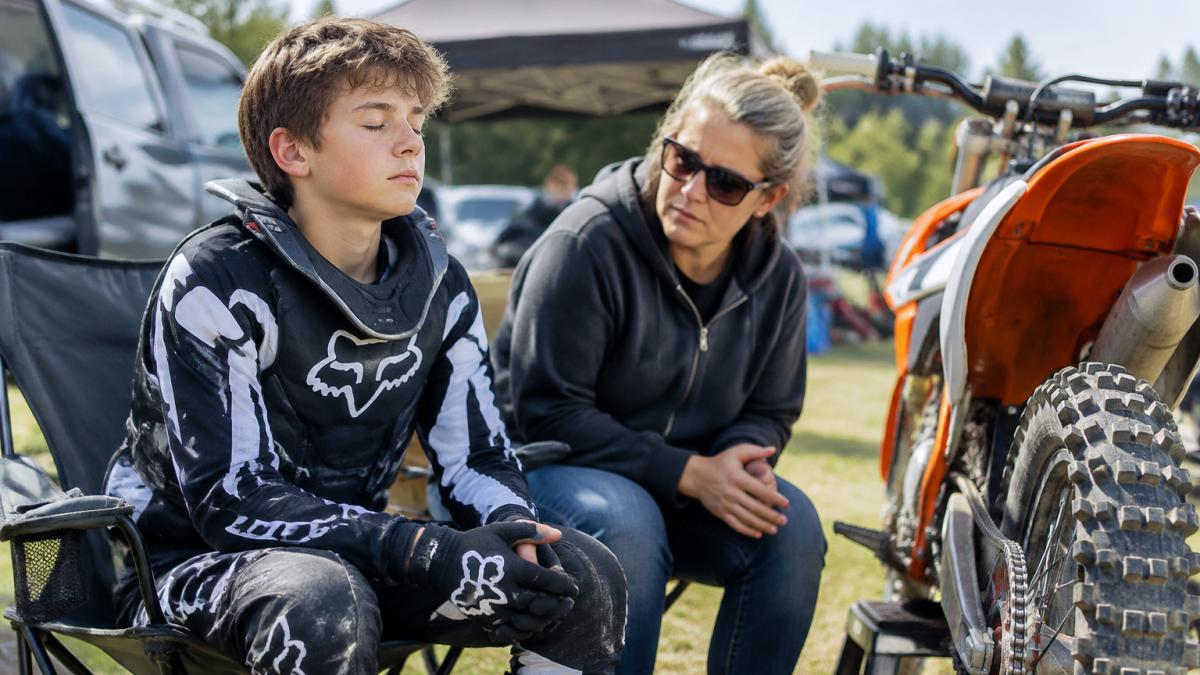
Here is a sample routine for a race morning:
- Eat a light breakfast and drink water
- Check gear and bike the night before, then check again in the morning
- Walk the track with your coach or parent and note key sections
- Do three minutes of breathing exercises in the pit area
- Visualize one clean lap, then stop before the gate
A calm and predictable routine helps young riders feel prepared. Avoid adding new tasks on race day. Riders feel more confident when they know exactly what comes next. For more guidance, see our resource on managing performance anxiety before a race to help your child handle nerves.
Resetting After a Crash or a Bad Start
Most mental training articles describe the reset in general terms. The version below is a timed, repeatable protocol a young rider can run in the moment, plus a parent script and safety boundaries so the reset does not become pressure to ride hurt or scared.
The 10-second reset (in the moment). Use this after a bad start, a tip-over, or a mistake that costs a position:
- Breathe (0-3 seconds). One slow breath in through the nose, out through the mouth. This is the same pattern used on the line, so the body already knows it.
- Name it (3-5 seconds). Say the mistake in one word out loud or in your head: "wide," "late," "tight." Naming it stops the mind from replaying it.
- Pick one cue (5-7 seconds). Choose a single cue for the next section, such as "eyes up" or "brake later." One cue only; two cues split attention.
- Roll on (7-10 seconds). Return to the throttle with the cue in mind. The reset is finished when the rider is moving again with a plan.
The 60-second reset (between motos or after a crash). When there is time to stop, extend the protocol:
- Walk away from the bike for 60 seconds and drink water.
- Say one thing that went well before saying what went wrong.
- Pick one cue for the next moto and write it on a glove or a pit board.
- Do three rounds of the four-two-six breathing pattern before gear check.
When the reset is not working. If a rider cannot name a cue or keeps replaying the same mistake for more than a few minutes, stop the session.
Safety boundaries. Never run a reset drill on a live track or in traffic. A rider who is dizzy, in pain, or visibly panicked after a crash should be checked by a parent or medical professional before riding again.
Watch out: Do not turn the reset into a lecture. The protocol works because it is short; a long debrief in the moment pulls the rider out of the next section and teaches them to dwell on the mistake.
Tracking Progress With a Motocross Mental Training Journal
Writing things down helps young riders notice their growth. A training journal turns mental skills into something a child can see and measure. Over a season, the pages show patterns in focus, confidence and recovery.
Our Nelmgerian MX Training Journal is designed for this purpose. You can track practice goals, race notes and breathing routines in one place, which makes it easy to review progress with your child.
Keep the journal simple. Each week, record:
- One drill completed and how many clean reps
- How the child felt before the race, on a scale from 1 to 5
- One thing that went well and one thing to work on
- A short reset cue used after a mistake
Review the entries together every few weeks. Celebrate small wins, such as a calmer start or a faster recovery after a bad corner. Progress in mental toughness often shows up as steady improvement rather than sudden breakthroughs.
Start Your Child's Mental Training This Week
Mental toughness is a skill that grows with practice, and young riders can start building it today. Begin with one visualization session, one breathing routine and one on-bike drill. Keep sessions short, positive and consistent.
Mental training also works best when it feels fun. Nelmgerian MX creates children's motocross books, activities and training journals for young riders and racing families, which can help keep kids engaged between practice days and races. Explore the range to find tools that fit your child's age and interests.
Frequently Asked Questions
What mental exercises help motocross riders stay calm under pressure?
Controlled breathing and short visualization sessions are the two most practical starting points for young riders. Breathing exercises such as slow inhale-and-exhale counts help a rider slow a racing heartbeat before a gate drop. Visualization means mentally rehearsing a section of track, such as a jump or a set of corners, before riding it. Practicing both at home for a few minutes a day gives children a calm routine they can reach for when nerves build at the track. Keep sessions short and consistent rather than long and occasional.
How often should motocross riders practice mental training?
Short, frequent sessions work better than occasional long ones, especially for children aged 3 to 9. Three to five brief sessions per week, each lasting five to ten minutes, is a practical target for most young riders. Pair mental training with on-bike practice days so the skills connect to real riding. Adjust the frequency to your child's attention span and energy, and stop before the activity starts to feel like a chore.
How can motocross riders build confidence before a race?
Confidence grows from preparation that the rider can see and measure. Build it by completing on-bike drills at a comfortable speed, recording what went well in a training journal, and repeating a familiar pre-race routine each time. Positive self-talk, such as a short phrase the child chooses, gives them a focus cue when doubt appears. Celebrate effort and specific improvements rather than only race results, since this keeps young riders motivated across a long season.
What should a motocross rider do after a crash or a bad start?
A simple reset routine helps riders move on quickly. Take one slow breath, name one thing that went right, and choose one focus cue for the next lap or moto. Parents can help by keeping the conversation calm and specific after the race. Avoid long post-mortems right after a crash, because children usually need a few minutes to settle before they can learn from the mistake. Review the moment later in the training journal, when it is easier to see what to practice next.