 how-to
Dealing With Fear in Youth Motocross: A Step-by-Step Plan
Quick Summary
Dealing with fear in youth motocross starts with understanding that fear is a normal response while a child learns speed, balance and danger. Helping a rider means building small wins, practicing basics at a slow pace, and separating healthy caution from fear that stops them from riding.
- Fear often comes from a recent crash, jumps or corners, watching others get hurt, or pressure from others.
- Ask whether the fear is a skill gap or a confidence issue, since each needs a different fix.
- Go back to basics: practice starting, stopping and turning at walking pace.
- Keep sessions short and frequent, and go back a step if fear spikes after a crash.
- Check any head impact, loss of consciousness or lasting symptoms with medical care before riding again.
Table of Contents
- Why Fear Shows Up in Young Motocross Riders
- Healthy Caution Versus Fear That Limits Riding
- How to Help a Child Overcome Fear of Riding
- Motocross Mental Skills for Kids
- Building a Pre-Race Routine for Young Motocross Riders
- Helping a Child Who Is Afraid of Falling on a Dirt Bike
- Scheduling Your Child's Next Ride After a Setback
- Frequently Asked Questions
Why Fear Shows Up in Young Motocross Riders
Last Updated: November 3, 2026
Fear is one of the most common feelings a young rider faces on a dirt bike. Families in youth motocross see it often, from a first wobble on a practice loop to a bad fall in the first moto of a race. Dealing with fear in youth motocross starts with understanding why it shows up in the first place.
Fear is a normal response. A child's brain is still learning to judge speed, balance and danger. When a rider can't yet predict what the bike will do, the body reacts with caution, tight grip and a hesitant throttle.
Several things tend to trigger it:
- A recent crash or fall, especially one that hurt
- Jumps, corners and braking zones that feel out of control
- Watching other riders get hurt
- Pressure from parents, coaches or other racers
- A bike that is too big or too fast for the rider's current skill
Injury risk is real in this sport. One study on youth motocross riders found that 48% of competitors under age 18 reported at least one concussion symptom during the season (Journal of Neurosurgery: Pediatrics study on youth motocross concussion symptoms). Numbers like that make it easy for a child to feel scared, and for parents to feel worried too.
Fear is not always a sign of a problem. Often it is a sign that a rider is paying attention. The goal is not to remove fear completely. The goal is to help the child respect it, understand it and ride through it at a pace that fits.
Healthy Caution Versus Fear That Limits Riding
Healthy caution keeps a rider alive. Fear that limits riding keeps a rider stuck. Knowing the difference helps you know when to push and when to slow down.
Healthy caution looks like this:
- The rider slows down before a tricky section
- They ask questions about a jump or corner
- They wear their gear and check the bike before riding
- They keep trying, even when it feels uncomfortable
Fear that limits riding looks different:
- The rider refuses to get on the bike at all
- They freeze at the top of a hill or in a corner
- They cry, shake or panic before every session
- They avoid the track or race entirely
A helpful test: ask whether the child's fear is tied to a real skill gap or to a specific worry. If the rider can't stop or turn at low speed, that's a skill issue to work on. If they're scared of a jump they've never tried, that's a confidence issue. Each one needs a different fix.
How to Help a Child Overcome Fear of Riding
Helping a child overcome fear starts with patience. Kids rarely get over fear by being pushed harder. They get over it by feeling safe, building small wins and seeing progress they can measure.
Here is a simple plan to start:
- Talk about the fear. Ask what worries them. Listen without judging.
- Check the bike. Make sure it fits and the suspension and brakes work well.
- Go back to basics. Practice starting, stopping and turning at walking pace.
- Set one small goal. For example, "Ride the flat loop three times."
- Celebrate effort. Praise trying, not just finishing.
Riders build confidence through seat time and repetition. The more comfortable they feel on the bike, the less fear controls them. Short, frequent sessions often work better than one long, tiring day. Establishing a consistent routine beyond the track helps build confidence in kids, providing a stable foundation that translates directly into better focus and reduced anxiety during their rides.
A Step-by-Step Return-to-Riding Plan by Age
After a crash or a break from riding, a child often needs a slower restart. A plan based on age can help. Ages are a rough guide, since skill and comfort matter more than birthdays.
- Ages 3-6: Start with balance and walking the bike. Use a small bike and a flat, open area. Keep sessions to 10-15 minutes.
- Ages 7-10: Add gentle loops and basic turns. Practice in a familiar space. Let the child set the pace.
- Ages 11-14: Work on braking, cornering and body position. Introduce small bumps and rollers before any jumps.
- Ages 15-17: Build race-pace confidence in stages. Focus on looking ahead and riding within their limits.
At every stage, go back a step if fear spikes. Moving backward is part of progress, not a failure.
Drills for Corners, Braking and Jumps
Specific drills help turn a scary moment into a routine one. Try these with your child:
- Corner drill: Set up cones in a wide arc. Ride the arc slowly, looking ahead to the exit. Speed up only after it feels smooth.
- Braking drill: Mark a line on the track. Practice stopping just before it, from a slow speed. Repeat until stops feel controlled.
- Jump drill: Start with a small table-top or bump. Roll over it at low speed first. Build height only after landings feel steady.
Keep each drill short and simple. Stop before the rider gets tired or frustrated.
Motocross Mental Skills for Kids
Mental skills matter as much as physical ones. A rider who can calm their breathing and focus on the next turn will handle fear better than one who lets worry take over.
Ryder's First Motocross Race →
Simple mental skills to practice:
- Slow breathing: Take a deep breath before a gate drop or a jump.
- Visualization: Have the child picture a clean lap before riding it.
- Positive self-talk: Teach phrases like "One corner at a time" or "I've done this before."
- Focus words: Pick one word, such as "look" or "smooth," and repeat it.
Detailed pre-performance planning and mental rehearsal are essential for developing motocross athletes, according to research from the University of Tennessee (University of Tennessee research on pre-performance planning and mental rehearsal for motocross athletes). Those habits can be taught at home, not just at the track.
Keep the practice light. Kids learn best when mental skills feel like part of the fun.
Mental skills can be practiced at home and help riders handle fear before and during a ride.
| Skill | How to practice | Best for |
|---|---|---|
| Slow breathing | Take a deep breath before a gate drop or jump | Calming pre-ride nerves |
| Visualization | Picture a clean lap before riding it | Building confidence |
| Positive self-talk | Use phrases like "One corner at a time" | Reframing worry |
| Focus words | Repeat one word such as "look" or "smooth" | Staying on the next turn |
Building a Pre-Race Routine for Young Motocross Riders
A steady pre-race routine can lower anxiety before the gate drops. When the steps are familiar, the child has less to worry about.
A simple routine might include:
- Eat a light meal a few hours before the race.
- Check the bike, tires, chain and brakes together.
- Put on gear in the same order every time.
- Walk the track or review the course map.
- Do a short warm-up ride.
- Take three slow breaths before lining up.
Write the routine on a card the child can read. Keep it short and use the same steps each race day.
Helping a Child Who Is Afraid of Falling on a Dirt Bike
Fear of falling is common, and it can make riders tense in ways that increase the chance of a crash. Start by reducing the stakes. Practice on soft, flat ground, and wear full gear every time.
Focus on body position. Riders who stand on the pegs, keep their elbows bent and look ahead tend to feel more in control. Teach your child how to bail off the bike safely, with feet ready and body away from the machine.
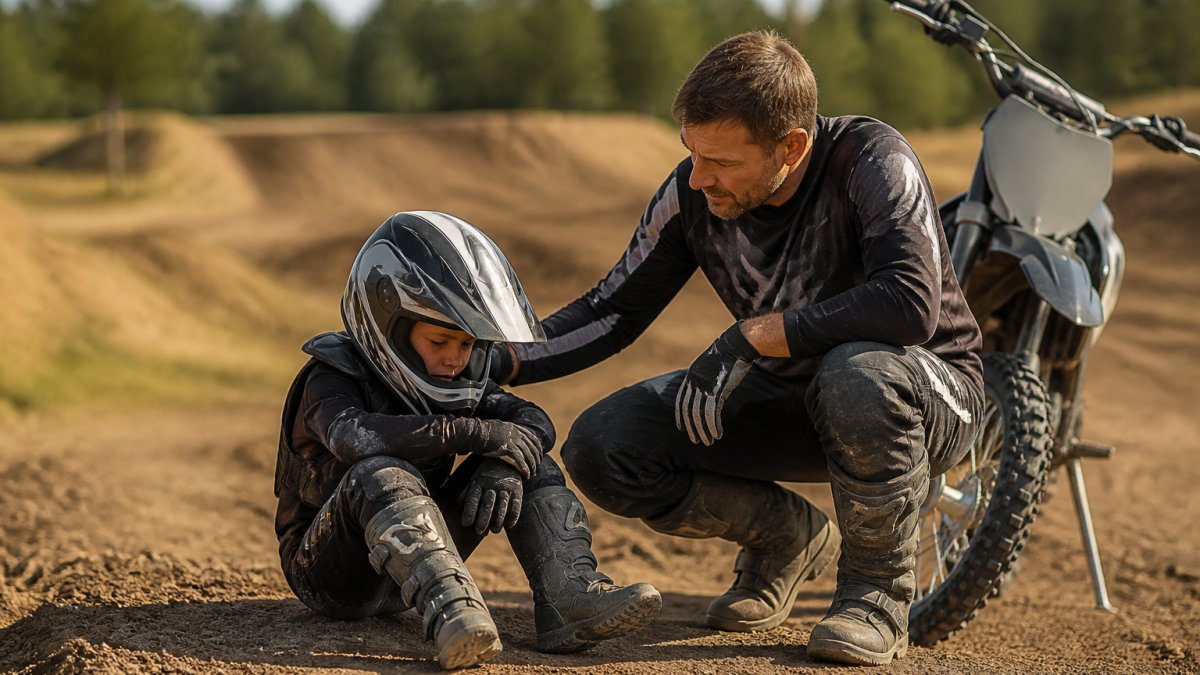
After a fall, check the rider right away. Look for injuries, especially to the head, neck and back. Ask about dizziness, headaches or vision changes. Seek medical care for any head impact, loss of consciousness, or symptoms that don't clear quickly. Do not let a child return to riding until they have been cleared.
Watch out: a child who keeps falling in the same spot may have a skill, equipment or track-safety problem, not just fear. Check the bike setup and the track condition before assuming it is only in their head.
Scheduling Your Child's Next Ride After a Setback
Timing the next ride matters. Go too soon and fear grows. Wait too long and the hesitation can stick.
A good approach is to return once the child is physically cleared and can talk calmly about the crash. Keep the first ride short and on familiar terrain. Plan two or three low-pressure sessions before any race.
Track progress in a notebook or training journal. Note what felt easy, what felt hard and how the child talked about it. Over time, you'll see patterns that show when they are ready to move up.
Best for: Parents who want a clear, step-by-step way to help a nervous rider. Skip if: Your child needs medical evaluation first. Get that care before planning any rides.
For more ideas, see our Nelmgerian MX Training Journal to track rides, goals and confidence over time. Our Ryder's First Motocross Race book can also help young riders picture what a first race feels like.
Frequently Asked Questions
How can a child overcome fear of falling while riding motocross?
Start with slower riding on a smaller track section and build repetitions before adding speed. Focus the child on bike control, braking and looking ahead through corners rather than on the fall itself. Practice getting up and checking the bike after a small tip-over so the process feels routine. Progress only when the child shows steady control at the current level. If fear persists or the child avoids riding entirely, a conversation with a coach or a pediatric professional can help identify whether the cause is confidence, equipment fit or a real safety concern.
How can a parent support a nervous youth motocross rider?
Listen to what the child says they are scared of and avoid dismissing it. Keep the focus on effort and small improvements rather than lap times or race results. Avoid pressuring the child to attempt jumps or faster sections before they are ready. Agree on a signal the child can use to stop or take a break. Praise specific skills, such as smoother braking or better vision through a turn, so the child sees evidence of progress.
When should a young rider take a break from motocross?
Take a break when fear begins to affect sleep, appetite, mood or willingness to go to the track, or when the child has had a crash with possible injury. Check for injuries first and seek medical care for any head impact, loss of consciousness, persistent headache, dizziness or pain that does not ease. A short break with light activities can help reset confidence before a gradual return to riding.
Fear is part of riding, and young riders can learn to manage it with patience, practice and the right support. Start small, celebrate progress and keep the focus on fun. With steady steps, many kids find their confidence grows one ride at a time.