 blog
blog
Motocross vs Enduro for Family Hobby: What to Choose
Table of Contents
- Motocross vs Enduro for Family Hobby: The Real Differences
- Quick Comparison: Motocross and Enduro Bikes at a Glance
- How to Start a Family Dirt Bike Hobby Without Overwhelm
- Best Dirt Bikes for Family Trail Riding vs. Track Days
- Motocross Training for Kids: Skills That Transfer to Both Sports
- Safety, Gear, and Total Cost of Ownership for Families
- Which Choice Fits Your Family's Budget and Schedule?
- Making the Call: Track, Trail, or Both for Your Crew
- Frequently Asked Questions
Last Updated: September 9, 2026
Motocross vs Enduro for Family Hobby: The Real Differences
Most families discover the motocross vs enduro question only after buying the wrong bike. The distinction is more than just tires and lights; it is two different philosophies of riding. Motocross is the groomed, closed-course sport of jumps and laps. Enduro is the long-distance, off-road discipline of trail riding, woods work, and navigation.
The core difference comes down to where you ride and how the bike is built for that terrain. Track bikes prioritize suspension stiffness and explosive power delivery. Trail bikes prioritize plush damping, low-end torque, and durability.
Quick Comparison: Motocross and Enduro Bikes at a Glance
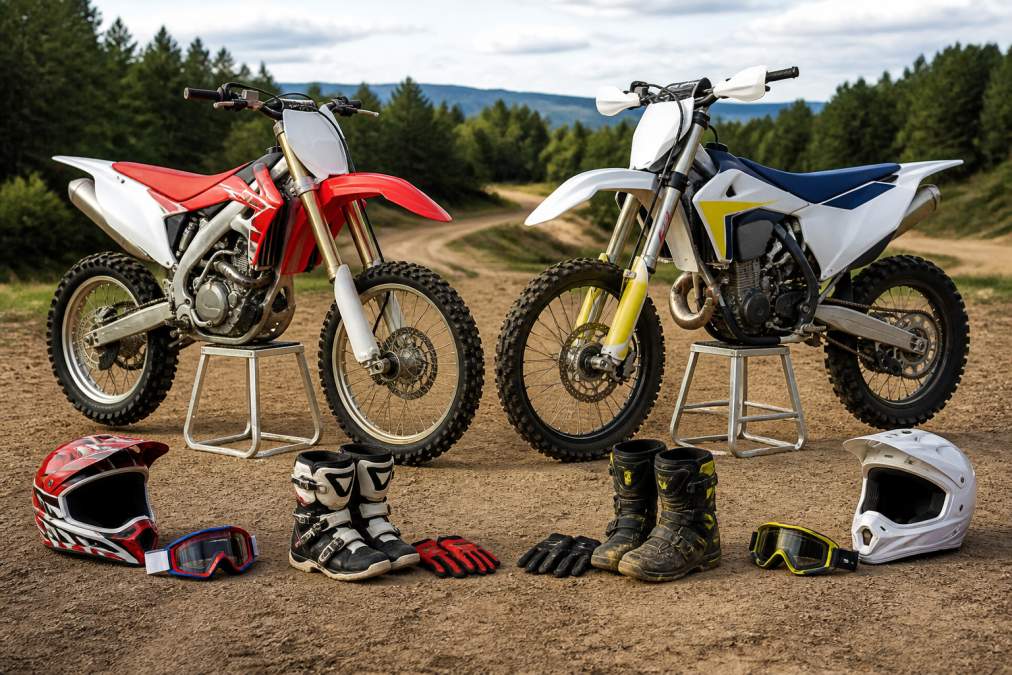
The fastest way to understand the choice is to see the machines side by side. Motocross bikes are built for closed-course racing, meaning no lights, no kickstand, and a close-ratio gearbox tuned for constant throttle. Enduro bikes are street-legal or trail-legal variants with a wide-ratio transmission, an oversized tank for range, and a spark arrestor for fire safety in the woods.
| Feature | Motocross Bike | Enduro Bike |
|---|---|---|
| Primary Terrain | Groomed track, jumps | Woods, single-track, fire roads |
| Suspension | Stiff, track-tuned | Plush, trail-tuned |
| Transmission | Close-ratio gearbox | Wide-ratio transmission |
| Power Delivery | High-rpm, peaky power band | Low-end torque, tractable |
| Lighting & Gear | Minimal, race-only | Headlight, spark arrestor |
| Maintenance | Frequent rebuild intervals | Longer service windows |
For a family hobby, the terrain question is the deciding factor. If you have a track within a reasonable drive, motocross offers structured practices. If you have public trails nearby, enduro gives you endless variety and a more relaxed pace.
How to Start a Family Dirt Bike Hobby Without Overwhelm
Starting a family dirt bike hobby does not require buying two race bikes and a truck full of parts on day one. The most successful families begin with one reliable, beginner-friendly machine and a clear schedule.
A common mistake is skipping proper safety gear to save money. A helmet, boots, gloves, and a chest protector are non-negotiable. The Consumer Product Safety Commission's guide on off-road vehicle safety emphasizes that protective equipment dramatically reduces the severity of injuries for young riders.
Set a realistic practice rhythm. One hour of focused practice twice a week builds more skill than a full day once a month. Track your child's progress in a simple journal, noting what they mastered, what felt hard, and what they want to try next.
Best Dirt Bikes for Family Trail Riding vs. Track Days
For family trail riding, the best dirt bikes prioritize tractability and ease of maintenance. Look for machines with a mellow power delivery and a wide-ratio transmission, which lets a young rider stay in one gear longer while navigating obstacles.
For track days, the calculus changes. Track bikes need stiffer suspension to handle jumps and a close-ratio gearbox to keep the engine in its power band. A motocross bike is lighter and more nimble, which helps a child learn aggressive cornering.
The all-rounder option deserves a look. Many manufacturers build cross-country models that split the difference, offering plush damping with enough bottoming resistance for small jumps.
Motocross Training for Kids: Skills That Transfer to Both Sports
Motocross training for kids should focus on fundamentals that transfer to any dirt bike. Body position is the first skill. Teach your child to stand on the pegs, grip the tank with their knees, and keep their elbows up.
Braking is the second critical skill. Most young riders grab a handful of front brake and panic. Practice progressive braking in a straight line until it becomes instinct.
Balance and throttle control round out the core. Set up slow-speed drills like figure-eights and tight circles. These force your child to manage the clutch and throttle with precision.
One of the best tools for young riders is a training journal. At Nelmgerian MX, we offer journals that help young riders log their practice goals, track their progress, and reflect on what they learned.
Safety, Gear, and Total Cost of Ownership for Families
For a family, the safety gear conversation is about outfitting a crew of different sizes and skill levels, and the bike choice dictates what gear is mandatory. On a motocross track, the risk is high-speed impacts, so the non-negotiables are a DOT- or Snell-certified helmet, motocross-specific boots with ankle support, knee braces, and a roost guard (the CDC). In enduro trail riding, the threats shift to low-speed tip-overs on rocks and roots, meaning the same helmet and boots are essential, but you also need a chest protector with shoulder coverage, elbow guards, and often a neck brace.
The total cost of ownership for a family is where the motocross vs. enduro decision really crystallizes. On a motocross bike, the maintenance clock runs on engine hours. A typical 85cc two-stroke race bike needs a top-end piston replacement every 15-20 hours of hard track use, which for a family riding twice a week translates to a rebuild every two months (PubMed). Parts run roughly $150-$250 per bike, so two kids on race bikes means a recurring $300-$500 expense every couple of months. Enduro bikes are engineered for longer service intervals; a modern four-stroke trail bike can go 50-100 hours between valve checks, with air filter and oil changes as the primary weekly upkeep.
Beyond the engine, the consumables tell the story. Motocross tires on a groomed track wear quickly; a rear tire may last only 10-15 rides. Enduro tires, running on softer loam and rocks, can last an entire season. Across three riders, the enduro route typically cuts the annual maintenance budget by 40-50%. However, enduro bikes carry their own hidden costs: handguards ($40-$80), a skid plate ($60-$120), and a spark arrestor are not optional for legal trail access in many areas.
Resale value is the quiet equalizer. Youth motocross bikes in the 50cc to 85cc range hold their value exceptionally well because there is a constant pipeline of families moving up in size. A well-maintained 65cc bike purchased used for $1,500 can often be sold two years later for $1,200-$1,300. Enduro bikes also hold value, but they depreciate slightly faster because the market is smaller and more regional.
To keep the budget sane, adopt a family rule: one bike per rider, but share the gear where sizes allow. Helmets are not shareable, but chest protectors, knee braces, and boots can be handed down between siblings if you buy quality brands. Track your maintenance in a shared family log, not just for the bike, but for the gear.
Which Choice Fits Your Family's Budget and Schedule?
The schedule question for a family is about the logistics of getting multiple riders to a riding location. Motocross demands a fixed calendar. Most tracks run practice days on specific weekends, often requiring a 1-2 hour drive. For a family with two or three kids, that means loading bikes, gear bags, and coolers into a truck or van with a trailer hitch. The drive time is not just travel; setup and breakdown at the track add another 45 minutes on each end.
Enduro riding, by contrast, offers a more flexible schedule. Public trail systems and OHV areas are often open dawn to dusk, seven days a week, and many are within a 30-45 minute drive. You can ride for two hours on a Saturday morning and still make a youth soccer game by noon. The trade-off is that trail riding requires more self-direction, you are responsible for navigation, weather checks, and knowing when to turn back.
The budget comparison extends beyond the bike purchase price. Motocross racing, if you choose to compete, adds entry fees of $30-$50 per race per rider, plus a district or AMA membership that runs $50-$100 annually. Practice days at a private track often cost $20-$40 per rider. Enduro riding on public land is often free or requires only a modest state OHV sticker ($25-$50 per year per bike).
A unique angle that most guides miss is the 'family progression path.' A motocross bike forces a structured progression, your child must master the track's rhythm, the jumps, and the passing rules before moving up a class. This builds discipline, but it can frustrate a child who just wants to explore. An enduro bike allows a more organic progression: a beginner can ride a flat fire road, then graduate to gentle single-track, then tackle hill climbs as confidence grows.
Ultimately, the schedule and budget decision comes down to a simple test: which option gets your family riding more consistently? A bike that sits in the garage because the track is too far or the fees are too high is a poor investment. For most families, the enduro route offers the lowest barrier to entry in both time and money, while motocross offers the highest structure for skill development.
Making the Call: Track, Trail, or Both for Your Crew
The motocross vs enduro decision for a family hobby rarely has a single right answer. The best choice is the one that gets your kids riding consistently and safely. If you have a quality track within an hour's drive, start there, the structured environment is unmatched for teaching discipline and racecraft.
Many families eventually own both, a trail bike for weekend camping trips and a track bike for race days. This is expensive, but it reflects how the sport grows with your children.
Choosing between these two disciplines is the first major decision of your family's riding journey. The right choice aligns with your local terrain, your budget, and your children's developing skills. Whichever path you take, the goal is to build confidence, responsibility, and a love for the sport. At Nelmgerian MX, we support that journey with books and training journals that keep young riders engaged between practice days.
Frequently Asked Questions
Is enduro or motocross suspension better for casual family trail riding?
For casual trail riding with kids, enduro suspension is the better choice. Enduro bikes use plush damping and softer spring rates designed to absorb roots, rocks, and braking bumps on single-track. Motocross suspension is stiff to handle big jumps and hard landings on a groomed track, which translates to a harsh, jarring ride on trails. A trail-tuned enduro setup also keeps the tires planted for better traction at lower speeds, making it easier for young or beginner riders to stay in control.
Can children participate in both motocross and enduro as a family hobby?
Yes, children can absolutely enjoy both, but it helps to start with one focus. Many families begin with motocross training for kids on a track because the controlled environment is ideal for building fundamental bike-handling skills. As young riders gain confidence and throttle control, trail rides on fire roads or easy single-track introduce them to enduro-style challenges like navigating obstacles and reading terrain. A beginner-friendly bike with a wide-ratio transmission can serve double duty, letting your child sample both disciplines before you commit to a specialized machine.
Is enduro harder than motocross for beginners?
For sheer physical stamina, enduro is often harder because rides last for hours over unpredictable terrain. For a beginner child, however, motocross presents a steeper learning curve in technique. A motocross track demands precise cornering, jumping, and consistent speed, which can be intimidating. Enduro allows riders to go at their own pace, walk tough sections, and build skills gradually on varied ground. For families, starting with relaxed trail riding is usually less pressure-filled and lets kids fall in love with riding before tackling competitive motocross.
Do I need different gear for motocross versus enduro riding?
The core safety gear is identical: a DOT-approved helmet, goggles, boots, gloves, and a chest protector are non-negotiable for both. The differences come down to layers and accessories. Enduro riders often add a hydration pack, a fanny pack with tools, and a spark arrestor on the exhaust for legal trail access. Motocross gear is typically lighter and more ventilated for high-intensity track sessions, while enduro gear may include a roost guard and knee braces for branch and rock protection. Investing in quality motocross boots and helmets first is the smartest move for any family.