 ultimate-guide
Beginner Motocross Riding Techniques for Kids: A Complete Guide
Table of Contents
- Beginner Motocross Riding Techniques for Kids: Core Fundamentals
- Why Proper Foundation Matters for Young Riders
- Youth Motocross Safety Gear: Essential Equipment Checklist
- Budget-Friendly Gear Options Without Compromising Safety
- Body Positioning and Riding Posture for Beginners
- Elbows Up and Gripping the Tank: Building Muscle Memory
- Throttle Control and Clutch Engagement Basics
- Progressive Drills for Smooth Acceleration and Shifting
- How to Corner on a Dirt Bike for Kids: Lean Angle and Technique
- Figure Eight Drills for Cornering Confidence
- Motocross Training Drills for Kids: Backyard Practice Routines
- Beginner Drills You Can Use at Home
- Braking Fundamentals and Balance Development
- Choosing the Right Beginner Dirt Bike for Your Child
- Frequently Asked Questions
Beginner Motocross Riding Techniques for Kids: A Complete Guide
Last Updated: July 4, 2026
Beginner Motocross Riding Techniques for Kids: Core Fundamentals
Getting the fundamentals right from day one makes the difference between a kid who progresses steadily and one who develops bad habits that take years to unlearn. Proper technique prevents injuries, boosts confidence, and creates the muscle memory needed for real progression. A child who learns to grip the tank correctly and position their body properly will feel more stable, more in control, and more willing to push harder.
The techniques covered here work for riders aged 4 to 16, from complete beginners to kids transitioning from pit bikes to bigger machines. Each skill builds on the last. Many fundamentals can be practiced in a backyard or empty parking lot before ever hitting dirt.
Why Proper Foundation Matters for Young Riders
Bad posture, improper grip, and sloppy throttle control compound every single ride. A young rider with correct fundamentals can recover from mistakes because their body is already positioned to absorb impact and their weight distribution keeps the bike predictable. Research into youth sports development shows that foundational skills learned early create lasting neural pathways that become automatic, freeing up mental capacity for decision-making and strategy.
Youth Motocross Safety Gear: Essential Equipment Checklist
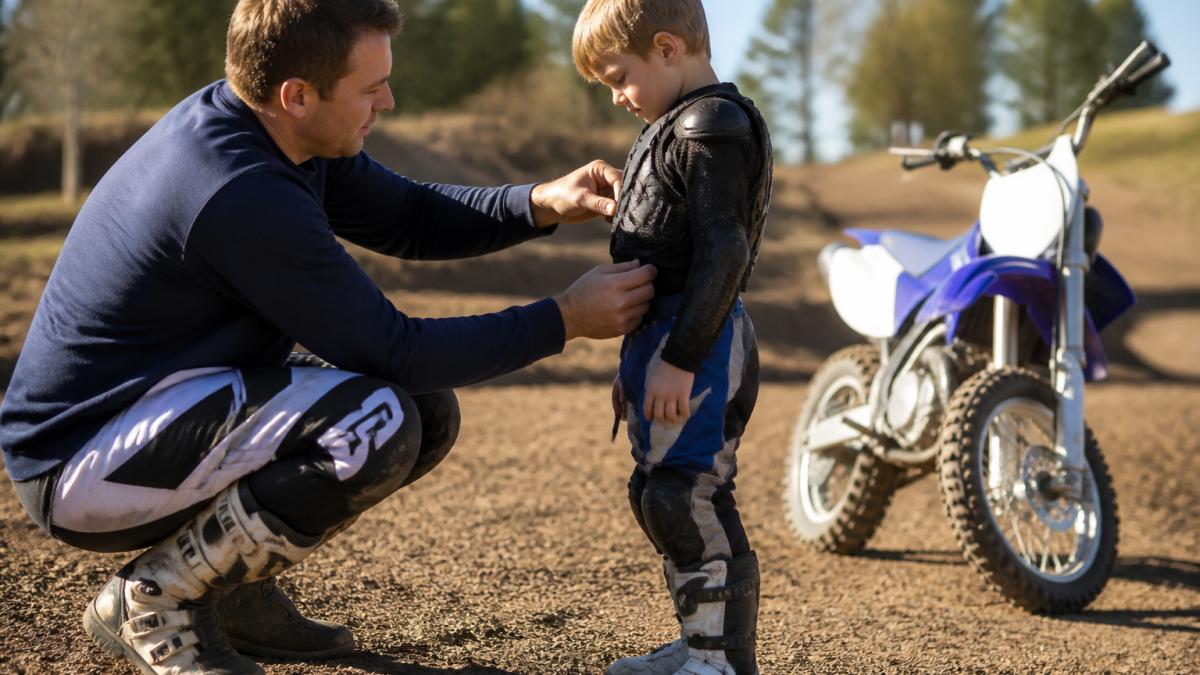
Your child cannot ride without proper protection. A DOT-approved motocross helmet is non-negotiable, not a bicycle helmet or street motorcycle helmet. Motocross helmets have a larger face shield, better ventilation for dust, and a chin bar designed for off-road impact angles. Goggles protect eyes from roost and debris. Boots with reinforced ankles and shift pads protect the foot and ankle area where injuries are common.
A chest protector and back protector shield the ribs, spine, and internal organs. Elbow and knee pads with hard shells prevent road rash and protect joints. Gloves should be motocross-specific with reinforced palms and knuckle protection. Jerseys and pants designed for motocross resist tearing and abrasion better than regular athletic wear.
Budget-Friendly Gear Options Without Compromising Safety
Quality motocross gear doesn't require spending thousands of dollars upfront. Buy safety-critical items new: helmet, goggles, boots, and chest protector. A helmet that's been in a crash is compromised even if it looks fine. For jerseys, pants, gloves, and knee pads, buying used or last-season inventory saves 40-60% without sacrificing protection. Many local motocross shops have clearance sections or can order previous-year models at reduced prices.
| Gear Item | Budget Option | Premium Option | Replacement Frequency |
|---|---|---|---|
| Helmet | $150-250 | $400-600 | Every 3-5 years or after crash |
| Boots | $80-120 | $200-300 | Every 2-3 seasons |
| Goggles | $30-50 | $80-120 | Every season or as needed |
| Chest Protector | $60-100 | $150-250 | Every 2-3 seasons |
| Jersey & Pants | $100-150 (used) | $250-400 (new) | Every 1-2 seasons |
| Gloves | $30-50 | $80-120 | Every season |
Body Positioning and Riding Posture for Beginners
How your child sits on the bike determines everything that comes next. A rider should sit toward the back third of the seat, giving room to move forward when accelerating and backward when braking. The knees should grip the tank firmly enough that the bike and rider move as one unit. Elbows should be up and out, not tucked against the body, for better visibility and control.
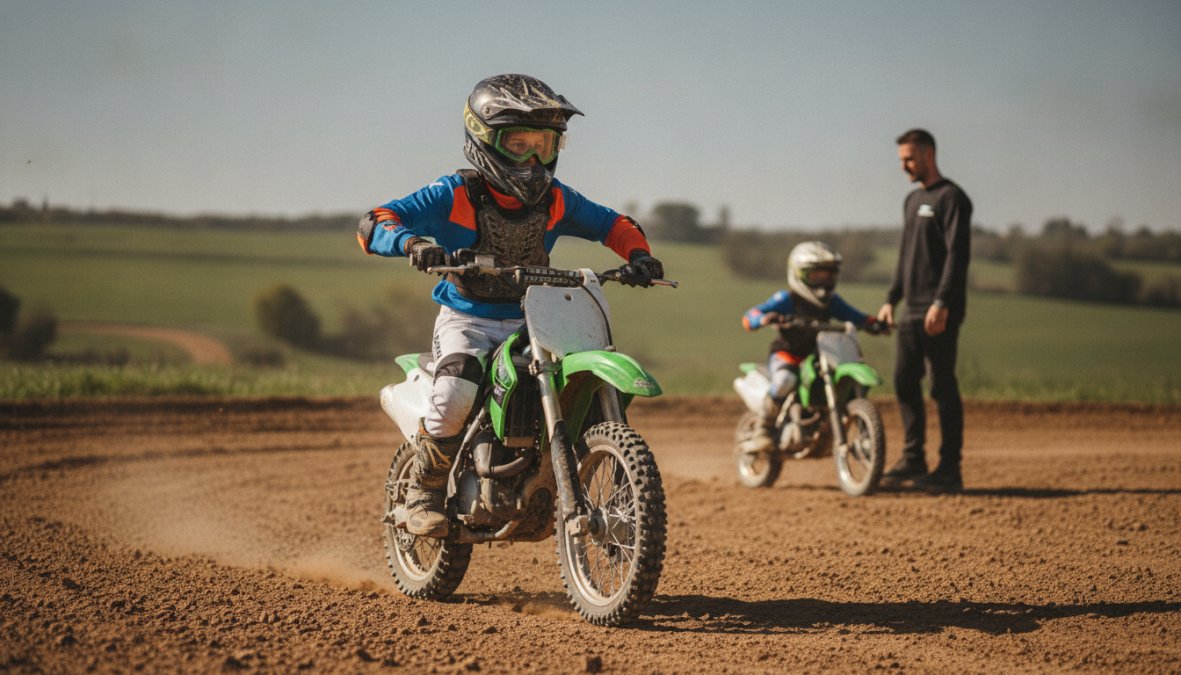
The upper body should be relaxed, tension in the shoulders and arms makes every movement jerky and exhausting. The head should look ahead to the next section of track, not down at the front wheel. Feet on the pegs should be on the balls of the feet, not the arches or heels.
Elbows Up and Gripping the Tank: Building Muscle Memory
Elbows up and gripping the tank are the most important beginner habits to establish. Start in a stationary position with the bike parked. Have your child sit and practice the position without the engine running for 30 seconds, repeated multiple times.
Once the position feels natural stationary, practice it while riding slowly. A figure-eight drill at walking speed is perfect for this. The rider focuses entirely on maintaining the position while the bike moves. Speed doesn't matter; maintaining the position does. Practice the position for 5-10 minutes every single ride.
Throttle Control and Clutch Engagement Basics
Smooth throttle control separates kids who feel confident from kids who feel out of control. The throttle is twisted smoothly, like turning a volume knob on a stereo, not grabbed like a doorknob. The movement should take 1-2 seconds to go from closed to full throttle.
Clutch engagement requires feeling the sweet spot where the clutch is partially engaged and power transfers smoothly. Start by practicing the throttle motion with the engine off. Once the motion feels natural, practice small clutch releases while the throttle stays at idle. Only after the motion feels automatic should you move to more complex riding.
Progressive Drills for Smooth Acceleration and Shifting
Set up a straight line 50-75 feet long. Have your child accelerate smoothly from one end to the other, focusing entirely on rolling the throttle gradually. Repeat 5-10 times per session.
For shifting, practice the motion without the engine running first. Sit on the bike and practice closing the throttle, pulling the clutch, shifting up, releasing the clutch, and rolling the throttle back on. Do this 10 times without starting the engine. Then practice the motion at slow speed in a straight line. Build the skill piece by piece instead of trying to manage everything at once.
How to Corner on a Dirt Bike for Kids: Lean Angle and Technique
Lean angle is how much the bike tips into the turn. Beginners should start with shallow leans of 10-15 degrees and progress gradually as they build confidence. The rider moves their hips toward the inside of the turn, not their shoulders, keeping the bike more upright while the rider's weight is inside the turn for better tire grip.
The outside elbow should stay up. The rider looks through the turn to the exit, not at the apex. Entry speed matters more than lean angle, a kid who enters at the right speed can lean the right amount and accelerate through the exit.
Figure Eight Drills for Cornering Confidence
Set up two cones 50 feet apart and have your child ride figure eights around them, focusing on smooth lean angles and consistent speed. Start at walking speed, then gradually increase speed over multiple passes. Do figure eights for 10-15 minutes every session, it's the single most effective drill for building cornering skills and confidence.
Motocross Training Drills for Kids: Backyard Practice Routines
Not every kid has access to a motocross track multiple times per week. Backyard drills teach fundamentals without needing a full track. Set up a simple course using cones or markers in about 50 feet of open space. Start with a straight line drill, then add turns to make an L-shape, then a rectangle, then a figure eight.
Backyard drills should happen 2-3 times per week for 20-30 minutes per session. Kids learn better with frequent short sessions than with rare long sessions.
Beginner Drills You Can Use at Home
Have your child sit on the parked bike and practice body position for 2-3 minutes before every ride. Throttle control drills can happen in a parking lot, mark a start and end line 30 feet apart and have your child accelerate smoothly between them 5-10 times. Braking drills teach smooth stopping by accelerating toward a marked line, then braking smoothly to a stop. Balance drills help nervous kids by having them ride in a large circle at walking speed, gradually leaning more with each lap.
Braking Fundamentals and Balance Development
Smooth braking is what gives control. The front brake does about 70% of the stopping power; the rear brake provides stability. A beginner should learn to use both brakes together with slightly more pressure on the front. Smooth braking means applying pressure gradually over 1-2 seconds, not squeezing hard immediately.
As the bike slows, the rider's weight shifts forward naturally. The rider should move forward slightly on the seat to stay balanced with the bike's weight transfer. Practice braking drills regularly by accelerating to a comfortable speed, then braking smoothly to a stop, repeated 10 times.
Choosing the Right Beginner Dirt Bike for Your Child
Seat height is the primary consideration. Your child should sit on the seat with both feet touching the ground, ideally with about 1-2 inches of ground clearance on each side. A 110cc bike is appropriate for kids 7-10 years old; a 125cc bike works for kids 10-14; a 250cc bike is for teenagers and advanced riders.
Quality of components matters more than engine size. A 110cc bike with good suspension, good brakes, and a reliable engine is better than a 125cc bike with cheap suspension and poor brakes. Pit bikes are excellent for kids 4-8 years old as a stepping stone to full-size dirt bikes.
Start with a bike from an established brand, Honda, Yamaha, Kawasaki, KTM, or Suzuki, for reliable engines, good parts availability, and resale value. Test ride multiple bikes if possible and have your child feel which one fits best.
Getting your child started in motocross requires consistent practice of the fundamentals. The techniques covered here have helped hundreds of young riders build confidence and skill. Start with the fundamentals, practice consistently, and watch your child progress faster than you expected.
Frequently Asked Questions
What age should a child start learning beginner motocross riding techniques?
Most children can begin beginner motocross riding techniques between ages 4-7, depending on physical size, coordination, and maturity. Smaller children may benefit from starting on training-wheel equipped bikes or mini dirt bikes with lower seat heights. Always prioritize safety gear and professional instruction regardless of age. Consider your child's interest level and physical ability before starting.
What youth motocross safety gear is absolutely essential for beginners?
Essential youth motocross safety gear includes a DOT-approved helmet, goggles, chest protector, gloves, boots, and long sleeves. A neck brace is also recommended. Budget-friendly options exist, many brands offer starter gear packages under $300. Never skip the helmet or protective gear, even for short practice sessions. Quality gear prevents serious injuries and builds confidence in young riders learning beginner techniques.
How do I teach my child to corner on a dirt bike for beginners?
Start with figure eight drills in flat, open spaces to teach lean angle and body positioning. Have your child practice slow-speed cornering before progressing to faster turns. Emphasize keeping elbows up, gripping the tank, and looking through the corner. Use cones or markers to create visual targets. Progress gradually from wide turns to tighter corners as confidence builds. Professional coaching accelerates learning safely.
What motocross training drills for kids can I practice in my backyard?
Backyard drills include figure eights for cornering practice, straight-line acceleration and braking exercises, throttle control drills using cones, and balance exercises at low speeds. Set up simple obstacle courses with cones or chalk lines. Start in a small, flat area and gradually increase difficulty. These drills build muscle memory for throttle engagement, clutch control, and body positioning without requiring a full track, making them ideal for beginners.
This article was written using GrandRanker