 blog
blog
Dirt Bike Coloring Books for Toddlers: A Parent's Guide
Table of Contents
- Why Dirt Bike Coloring Books Matter for Toddlers
- Printable Dirt Bike Coloring Pages: Free Options and Setup
- Easy Motorcycle Coloring Pages: Design Features That Work
- Toddler Coloring Books With Large Pictures: Size and Simplicity
- Paid Coloring Books vs. Free Printables: What You're Really Getting
- Dirt Bike Coloring as a Birthday Party Activity
- How to Keep Your Toddler Engaged With Coloring
- Frequently Asked Questions
Last Updated: October 4, 2026
Why Dirt Bike Coloring Books Matter for Toddlers
Dirt bike coloring books for toddlers build fine motor skills, hand-eye coordination, and focus while connecting children to the sport they love.
Young riders won't settle for generic animal coloring pages, they want dirt bikes, riders, and motocross action. That specificity keeps them engaged longer and makes the activity personally relevant.
Coloring requires sustained attention and teaches patience. For a 2-year-old, 10 minutes of focus is genuine progress. For a 4-year-old, it becomes a tool for managing emotions between riding sessions.
Printable Dirt Bike Coloring Pages: Free Options and Setup
Free printable dirt bike coloring pages exist across several platforms, but quality varies widely and finding toddler-appropriate designs requires knowing where to look and what to evaluate.
Where to Find Free Printable Options
Free sources include general coloring sites (Crayola.com, SuperColoring.com), Pinterest, teacher resource sites (TeachersPayTeachers, Education.com), Etsy free samples, and Reddit communities. Quality varies; teacher sites and Etsy samples tend to be higher quality than generic sites.
What to Evaluate Before Downloading
Before downloading, assess: Line weight, thin lines disappear when colored over; skip blurry previews. Design complexity, a simple dirt bike with rider and ground works; avoid clutter. Coloring area size, aim for spaces at least the size of a quarter. Print quality, check resolution (150+ dpi ideal) and file size; test-print a sample if resolution isn't listed.
Setting Up a Sustainable Printable System
Create a folder system organized by complexity level. Batch print weekly (8-10 pages) and store in a folder for easy access. Use cardstock (24-80 lb) for durability. Laminate favorites for reuse with dry-erase markers. Track what works and bookmark those sources.
The Real Trade-Off: Time vs. Cost
Free printables demand ongoing effort: sourcing, downloading, organizing, and printing. For families coloring multiple times weekly, this adds up to 3-4 hours per month. Paid books eliminate this by arriving ready to use, which is why many families combine both: free pages for travel, paid books for regular home use.
Easy Motorcycle Coloring Pages: Design Features That Work
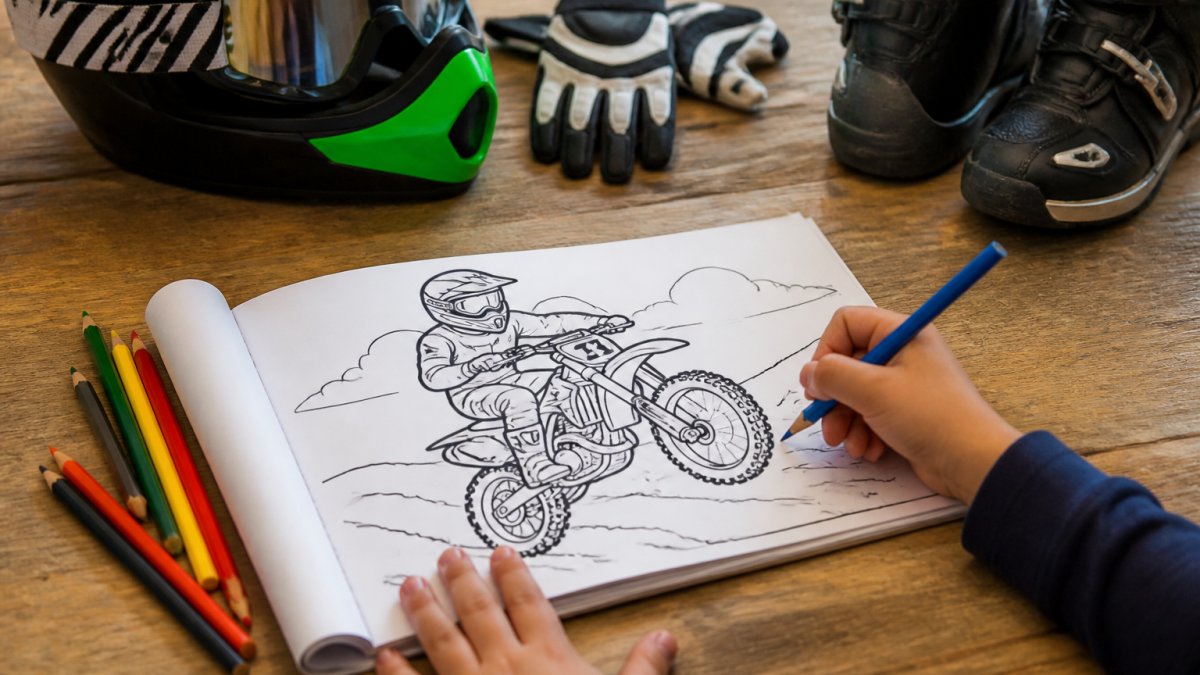
Effective pages feature: Bold outlines (thin lines disappear when colored), simple shapes (wheels, handlebars, seat, rider), large coloring areas (at least 2-3 inches), and limited color palettes (3-4 colors). Include recognizable motocross elements like dirt bikes mid-jump and riders in racing gear to connect the activity to real riding.
Toddler Coloring Books With Large Pictures: Size and Simplicity
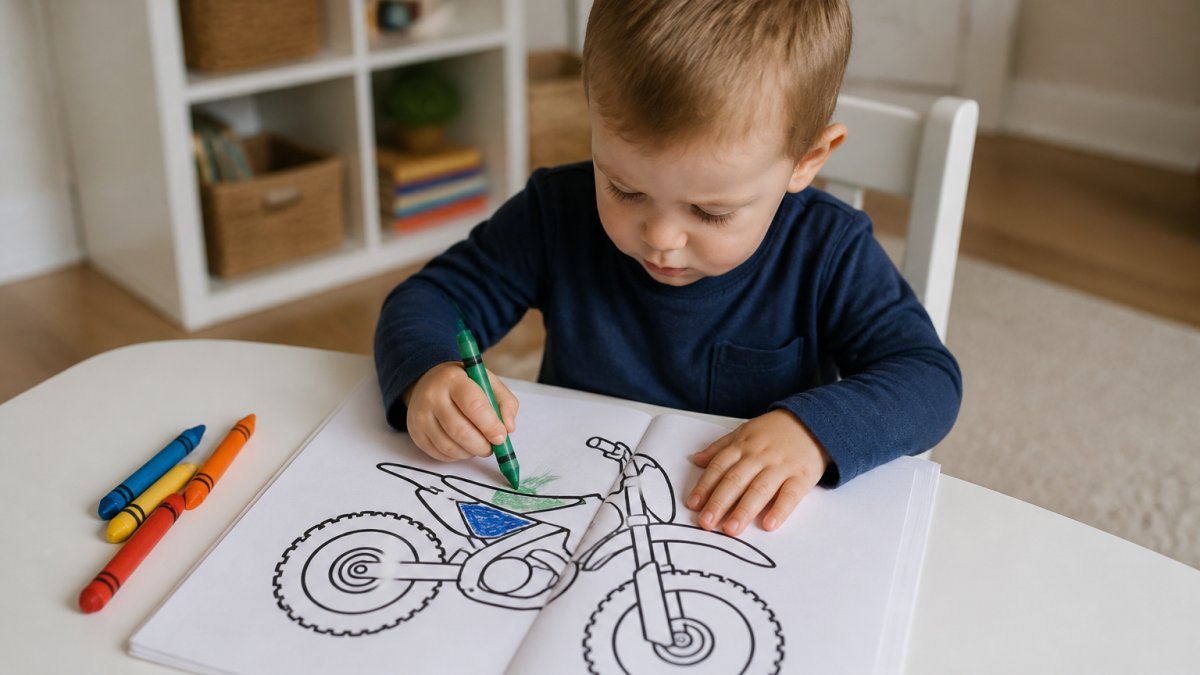
A standard 8.5 x 11-inch page is ideal for toddlers. Smaller pages feel cramped; larger pages are harder to manage and store.
What Makes Designs Toddler-Friendly
Illustrations should take up at least 60% of the page. A dirt bike with rider and basic ground detail works for ages 2-5; avoid crowds, obstacles, or busy backgrounds. Use heavier cardstock (80-100 lb) to prevent tearing and marker bleed-through.
Age Suitability: 2-Year-Olds Through 5-Year-Olds
Ages 2-3: Very large coloring areas, instantly recognizable designs, 10-15 pages. Ages 3-4: Slightly smaller areas, more detail, 20-30 pages. Ages 4-5: Multiple elements, intricate designs, 40-50 pages. Books marketed for ages 2-5 typically progress from simple to complex, keeping the book relevant across the range.
Paid Coloring Books vs. Free Printables: What You're Really Getting
The choice between paid coloring books and free printables involves more than just price. Understanding the real differences in format, durability, design quality, and total cost of ownership helps parents make a decision that fits their family's needs.
Format Options and What Each Offers
Paperback ($8-15, 30-50 pages): portable and affordable, but pages tear easily and spines weaken. Spiral-bound ($12-18): pages lie flat and can be removed; thicker paper (80-100 lb); more durable. Hardcover ($15-25): built to last; protects pages; good for keepsakes. Digital PDF ($3-8): cheapest but requires printing; you control paper quality.
Design Quality and Illustration Differences
Paid books from established publishers are illustrated by designers who understand toddler motor skills and attention spans. Illustrations are typically:
- Bold outlines (2-3 mm thick) that remain visible even when colored over
- Simplified shapes that toddlers recognize instantly
- Large coloring areas (minimum 2-3 inches across) that feel satisfying to fill
- Consistent style throughout the book, so pages feel cohesive
- Progressive complexity, with early pages simpler than later ones
Free printables often lack this intentionality. Many are scanned from older books, compressed through multiple downloads, or created by non-designers. Result: thin lines, cluttered compositions, tiny coloring areas, and inconsistent quality across pages.
To judge a paid book before buying, look for preview images or sample pages. Most publishers post 2-5 sample pages on their website or on retail sites. Zoom in and assess line weight, coloring area size, and visual clutter. If you can't find previews, check customer reviews; parents often mention whether pages are toddler-friendly.
Paper Quality and Durability
This is where paid books earn their cost. Quality matters for toddler use.
Paper weight is measured in pounds (lb). Standard copy paper is 20 lb. Coloring books typically use 60-100 lb cardstock.
- 60-80 lb: Adequate for occasional use; shows marker bleed-through; tears if pressed hard
- 80-100 lb: Durable; resists tearing; minimal bleed-through; feels substantial in hand
- 100+ lb: Premium; feels like card stock; very durable; minimal bleed-through
Toddlers press hard with crayons. Thicker paper prevents tears and frustration. A book with 40 pages of 80 lb cardstock will survive weeks of heavy coloring. A book with 40 pages of 60 lb paper may show wear after a few weeks.
Paper finish also matters. Matte finish (uncoated) is standard for coloring books; it grips crayons and colored pencils well. Glossy finish is rare in coloring books because it resists coloring tools. Some premium books use slightly textured paper, which adds tactile interest.
Price Comparison: Real Numbers
Here's what you actually pay, accounting for all costs:
Free printables:
- Design/download: $0
- Paper: $0.05-0.10 per page (standard copy paper) or $0.15-0.25 per page (cardstock)
- Ink: $0.02-0.05 per page (depends on coverage and printer efficiency)
- Your time: 5-10 minutes per batch of 10 pages
- Total per page: $0.07-0.40 (plus your time)
- For 50 pages over a month: $3.50-20, plus 25-50 minutes of your time
Paid paperback coloring book ($10-12, 40 pages):
- Cost per page: $0.25-0.30
- Paper quality: 70-80 lb cardstock (better than most home printing)
- Design quality: Professional illustrations
- Your time: Zero (arrives ready to use)
- Durability: 4-8 weeks of regular use
Paid spiral-bound book ($15-18, 50 pages):
- Cost per page: $0.30-0.36
- Paper quality: 80-100 lb cardstock (premium)
- Design quality: Professional illustrations
- Your time: Zero
- Durability: 8-12 weeks of regular use; pages removable for reuse
Digital download ($5, 30 pages, you print on cardstock):
- Download cost: $5
- Paper: $0.15-0.25 per page (cardstock)
- Ink: $0.02-0.05 per page
- Your time: 15-20 minutes to print and organize
- Total: $9.50-13.50 for 30 pages
- Cost per page: $0.32-0.45
Which Format Makes Sense for Your Family
Choose free printables if:
- You color occasionally (once or twice per week)
- You have time to source and print
- You want to test designs before committing money
- You have access to a good printer and cardstock
- You're willing to laminate for reuse
Choose paid paperback if:
- You color regularly (3+ times per week)
- You want designs tested for toddler suitability
- You value convenience and don't want to manage printing
- You're okay with pages being used once and discarded
- You want a book that feels like a finished product
Choose paid spiral-bound if:
- You color very regularly (daily or near-daily)
- You want maximum durability
- You want pages to lie flat
- You might remove and laminate favorite pages for reuse
- You're willing to spend more for a book that lasts months
Choose digital download if:
- You want to preview designs before committing
- You have premium cardstock at home
- You want to print selectively (only pages your child likes)
- You're comfortable with the printing workflow
- You want the lowest upfront cost
Most families use a combination: a paid book for regular home use, free printables for travel or backup, and occasionally a digital download to test a new illustrator's style. This approach balances cost, convenience, and sustainability.
Dirt Bike Coloring as a Birthday Party Activity
Coloring books are underrated as party activities. They work for mixed age groups, require no setup, and keep kids engaged without screens.
For a dirt bike or motocross-themed birthday party, coloring fits naturally. Set up a coloring station with individual coloring books, crayons, and colored pencils. Kids can color before the main activities, during downtime, or as a wind-down activity at the end.
The advantage is flexibility. Kids who want to participate in high-energy games can. Kids who prefer quieter activities have an option. Shy kids often relax while coloring, making it a good icebreaker.
For party favors, individual coloring books work well. They're inexpensive, on-theme, and useful. A child takes it home and uses it for weeks, which extends the memory of the party. That's better than most party favors that get forgotten in a week.
Dirt bike coloring books for toddlers also work as thank-you gifts. If you're hosting a riding event or small gathering, a coloring book is a thoughtful, practical gift that parents appreciate.
How to Keep Your Toddler Engaged With Coloring
Engagement drops when coloring feels like a chore. Here's how to keep it fun and sustainable.
Rotate the books. If you have two or three coloring books available, rotate which one is "active." After a week with one book, put it away and bring out another. When you return to the first book a month later, it feels fresh again.
Color together sometimes. Sit down with your child and color a page alongside them. You don't have to be good at it. Your participation signals that the activity is worth your time, which matters to toddlers. It also gives you a chance to model focus and patience.
Keep crayons accessible. If the coloring supplies are easy to reach, kids use them more. A basket of crayons in the living room beats crayons locked in a closet.
Celebrate the finished pages. Display coloring pages on the fridge or in a folder. Acknowledge the effort. For toddlers, this recognition is motivating. They'll want to color more to earn that praise.
Mix media occasionally. Crayons are standard, but colored pencils, markers, and watercolor pencils add variety. Different tools feel like a new activity, even if the coloring book is the same.
Connect it to riding. Talk about the pages while your child colors. "That's a dirt bike like the ones at the track." "The rider is wearing gear like you wear." These connections deepen the activity beyond just filling in spaces.
Dirt bike coloring books for toddlers bridge the gap between your child's passion for motocross and their need for developmentally appropriate activities.
Frequently Asked Questions
What should I look for in a dirt bike coloring book for toddlers?
Look for bold outlines, large pictures, and simple designs that won't frustrate young hands. Pages should feature one main illustration per page rather than busy scenes. The paper should be thick enough that markers or crayons won't bleed through. Check that the coloring book shows age suitability, toddlers ages 2-3 need larger images than 4-5 year-olds. Avoid books with tiny details, intricate patterns, or designs that require precision.
Are dirt bike coloring books suitable for 2-year-olds?
Most traditional coloring books are designed for ages 3 and up. Two-year-olds benefit from extra-large pictures with very thick outlines and minimal detail. At this age, toddlers are still developing hand control, so choose books with only one image per page and plenty of white space. Consider oversized board books or printable pages you can enlarge, these work better than standard coloring books for the youngest riders.
How can coloring help toddlers build fine motor skills?
Coloring strengthens the small muscles in toddlers' hands and fingers, which supports writing readiness later. Holding crayons and staying within lines (even loosely) improves hand-eye coordination and grip control. The repetitive motion of coloring also builds focus and patience. For young motocross fans, pairing coloring with their passion for dirt bikes makes the activity more engaging and naturally motivates them to practice longer.
What's the difference between printable dirt bike coloring pages and bound coloring books?
Printable pages are free or low-cost, customizable, and easy to reprint for multiple children or practice sessions. Bound coloring books offer durability, professional design quality, and the tactile experience of a real book. Printables work well for testing interest or birthday party activities. Bound books are better for building a collection and keeping as keepsakes. Many families use both, printables for frequent use and books as gifts.