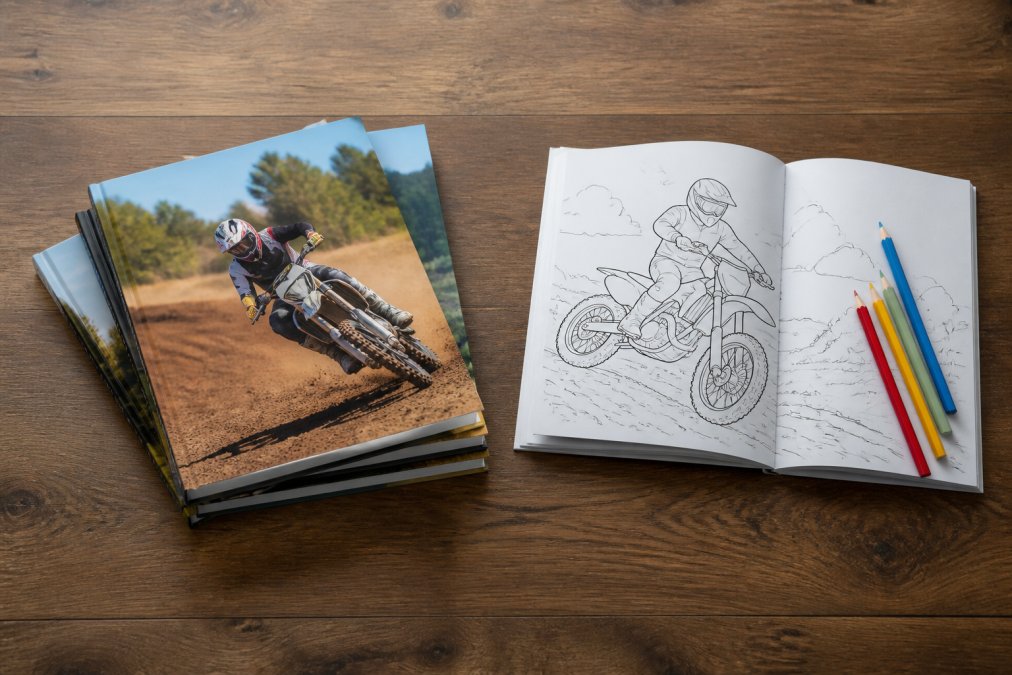
 comparison
Motocross Books vs Coloring Books for Young Riders
Table of Contents
- Motocross Books vs Coloring Books: A Quick Comparison
- Developmental Benefits of Motocross Books for Young Riders
- How to Get Kids Excited About Reading with Dirt Bike Stories
- The Best Dirt Bike Books for Kids: What to Look For
- Motocross Educational Resources for Young Riders
- Coloring Books and Fine Motor Skills: What Parents Should Know
- How to Choose Based on Age and Skill Level
- Conclusion
- Frequently Asked Questions
Last Updated: September 21, 2026
Motocross Books vs Coloring Books: A Quick Comparison
Choosing between motocross books and coloring books for a young rider comes down to what you want the activity to build. Motocross books develop reading skills, race knowledge, and emotional resilience through story. Coloring books build fine motor control, focus, and creative expression through art. Most motocross families end up using both, but for different moments in a child's week.
Here is the short version:
| Factor | Motocross Books | Coloring Books |
|---|---|---|
| Primary skill | Reading, comprehension, race knowledge | Fine motor skills, hand-eye coordination |
| Best age range | 3-9, depending on reading level | 3-8 |
| Engagement style | Story-driven, character-led | Hands-on, self-paced |
| Screen-free | Yes | Yes |
| Reusability | High, reread many times | Single-use pages |
| Best for | Building confidence and vocabulary | Building focus and dexterity |
Developmental Benefits of Motocross Books for Young Riders
Motocross books give young riders a way to stay connected to the sport when they are not on the bike. That connection matters. A child who reads about riders facing a tough jump, a muddy track, or a lost race learns that the sport is about more than speed.
The benefits go beyond entertainment:
- Vocabulary tied to bike mechanics, track terms, and race day routines
- Emotional lessons about perseverance, sportsmanship, and responsibility
- Confidence built through characters who face and overcome challenges
- A bridge between practice days, keeping the sport present all week
Cognitive Development vs. Creative Expression
This is the split most parents miss. Motocross books lean toward cognitive development: sequencing events, following a plot, building cause-and-effect thinking, and absorbing factual detail about how a dirt bike works. Coloring books lean toward creative expression: color choices, spatial decisions, and open-ended interpretation.
How to Get Kids Excited About Reading with Dirt Bike Stories
The fastest way to get a reluctant rider reading is to hand them a story about the thing they already love. A child who would rather be outside on the bike will read about a character who is also outside on the bike.
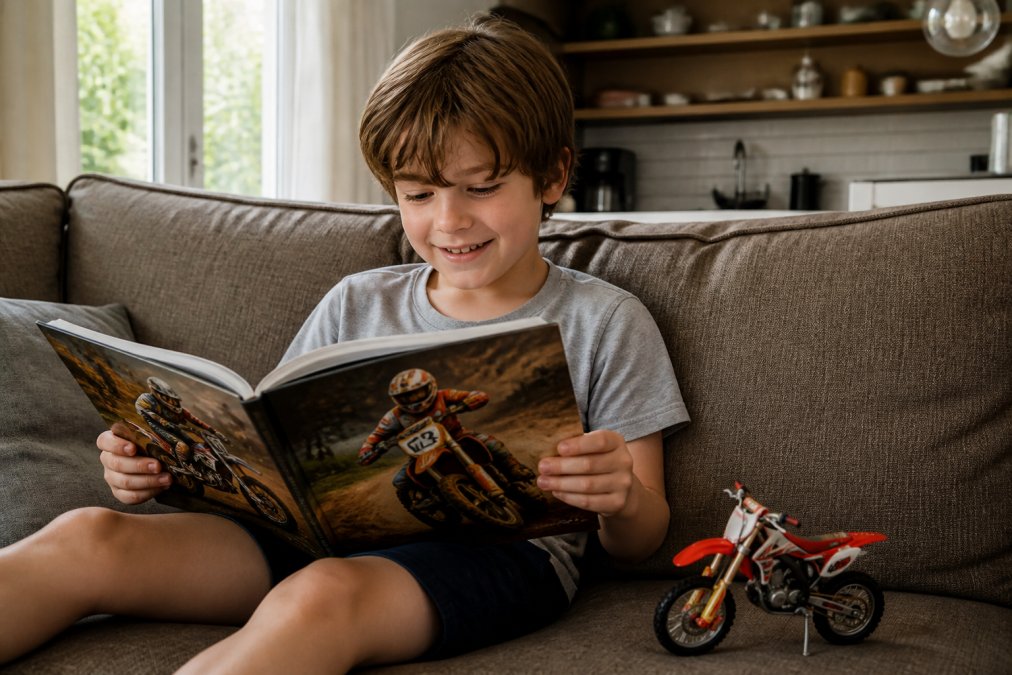
A few approaches that work in practice:
- Let the child pick the book, even if it means rereading the same one five times
- Read together and pause to ask what the rider should do next
- Connect the story to real life: "Remember when you stalled on the hill? Ryder did too."
- Keep books in the truck or trailer for track weekends
The Best Dirt Bike Books for Kids: What to Look For
The best dirt bike books for kids share a few traits: age-appropriate language, real motocross detail, and a character worth following. Look for stories that treat the sport seriously instead of watering it down.
Checklist for evaluating a dirt bike book:
- Reading level matches your child, not their age on paper
- Motocross terms are accurate, not generic "motorcycle" filler
- The story teaches something without preaching
- Illustrations show real bikes, riders, and track scenes
- The character faces a real challenge and works through it
Motocross Educational Resources for Young Riders
"Educational" is doing a lot of work in most motocross book listings. A book is educational when it teaches something a child can use, a track rule, a gear check, a way to read a situation. The format matters less than whether the content does that job.
What books can teach that coloring cannot
A story can walk a child through a sequence they will face on race day: sign-in, gear check, sighting lap, gate drop, cool-down. Because the character experiences the sequence in order, the child absorbs the routine as a narrative, not a checklist. That is a real mechanism, procedural memory built through story.
Look for books that:
- Show the full race-day sequence, not just the race itself
- Name real gear (helmet, goggles, chest protector, boots) instead of saying "safety gear"
- Include a character who makes a mistake and corrects it, a missed gate, a stalled bike, a wrong line
- Use accurate track vocabulary: gate, rut, berm, whoops, flagger, checkered flag
What coloring books can teach that stories cannot
Coloring is not passive. Choosing a color for a helmet, deciding where the track line goes, and controlling pressure to stay inside a berm all require the child to make spatial decisions. That is the same decision-making loop a rider uses when picking a line, just slowed down and made safe.
Look for coloring books that:
- Show a rider in correct body position (elbows up, eyes forward, standing on the pegs)
- Include track features a child will recognize: a starting gate, a flagger, a pit area
- Offer variety across pages so the child is not coloring the same jump ten times
- Use one-sided pages so markers do not bleed through and ruin the next scene
Using books as a teaching tool with your child
The highest-value use of either format is not solo. It is a five-minute conversation. A few prompts that work:
Ryder's First Motocross Race →
- "What should the rider check before the gate drops?" (gear, bike, gate position)
- "Why is the rider standing on the pegs here instead of sitting?" (bumps, control, line choice)
- "What color would you make the flagger's vest so riders can see it?" (visibility, safety)
- "What would you do if you stalled right here?" (restart, move off the line, signal)
Pairing at-home resources with real programs
The American Motorcyclist Association's youth rider resources offer guidance on youth programs and safety, which pairs well with at-home learning. A book or coloring page can preview what a child will see at a sanctioned youth event, which lowers first-day nerves.
Coloring Books and Fine Motor Skills: What Parents Should Know
Coloring books do real developmental work. Staying inside the lines, choosing colors, and controlling pressure all build the small hand muscles and hand-eye coordination that young riders need for throttle and brake control.
What to look for in a motocross coloring book:
- One-sided pages so markers do not bleed through
- Full-page scenes with bikes, riders, and tracks
- Variety: jumps, race day crowds, pit scenes, and off-road trails
- Age-appropriate line detail, not so fine that a 4-year-old gets frustrated
How to Choose Based on Age and Skill Level
Most parents searching this topic are not asking "which is better?" They are asking "which one, right now, for this kid?" That is a decision, not a debate. The framework below treats books and coloring books as tools you pick by developmental stage, not by preference.
The three questions that decide it
Before you buy anything, answer these in order:
- What is the child's current reading stage? Pre-reader, beginning reader, early chapter reader, or fluent reader. This is the single biggest filter.
- What does the child need more of this month, language reps or motor reps? Reading builds vocabulary, sequencing, and comprehension. Coloring builds grip strength, hand-eye coordination, and sustained focus. Whichever is lagging gets the new purchase.
- Where will the activity happen? A coloring book with loose crayons is a poor fit for a bumpy truck ride to the track. A chapter book is a poor fit for a 10-minute waiting window between motos.
Stage-by-stage decision matrix
| Age | Reading stage | Primary pick | Secondary pick | Why this order |
|---|---|---|---|---|
| 3-4 | Pre-reader | Coloring book (large shapes) | Read-aloud storybook | Grip and pressure control develop before letter recognition; read-alouds build listening vocabulary |
| 5-6 | Beginning reader | Learn-to-read book (phonics-based) | Simple coloring pages | Letter-sound mapping is the priority skill; coloring reinforces pencil grip for writing |
| 7-8 | Early chapter reader | Storybook with real motocross detail | Activity book (mazes, word finds) | Comprehension and stamina matter more than motor drills at this stage |
| 9-11 | Fluent reader | Longer story or rider journal | Detailed coloring or design pages | Goal-setting and self-tracking habits form here; coloring becomes a wind-down tool |
| 12+ | Independent reader | Rider journal, mechanic guides | Freeform sketch or design books | Identity and ownership of the sport drive engagement more than either format alone |
When to switch formats
A common pattern parents report: a child who resists reading will happily color a motocross scene, and a child who resists coloring will happily read a story about a rider. Use the format the child already reaches for as the on-ramp, then introduce the other one alongside it. Do not force the swap.
Two signals it is time to change:
- Boredom with the current format, the child finishes pages in seconds or abandons books halfway. Move up a level or across formats.
- Frustration with the current format, the child presses too hard, tears pages, or refuses to start. Move down a level or across formats.
The mistake that costs the most
Buying above reading level because the topic is exciting. A 6-year-old who loves dirt bikes still cannot decode a chapter book written for a 9-year-old. The topic match does not compensate for the skill mismatch. When in doubt, go one level easier and let the child climb. A slightly easy book that gets finished beats a perfect-level book that gets abandoned.
Conclusion
The real challenge is not picking a side in the motocross books vs coloring books debate. It is keeping a young rider learning and engaged on the days they are not on the bike.
Frequently Asked Questions
What are the benefits of reading motocross-themed books for children?
Motocross-themed books build reading skills while fueling a child's passion for the sport. They improve vocabulary, comprehension, and focus, and can boost confidence by showing characters who face challenges and persevere. For young riders, seeing their hobby in stories makes reading feel relevant and exciting, which can increase motivation to read independently.
How do coloring books help develop fine motor skills in young riders?
Coloring requires controlled hand movements, which strengthen the small muscles in fingers and hands. This improves hand-eye coordination and grip strength, both useful for holding handlebars and using tools later. Tracing lines and staying within borders also builds concentration and patience, skills that transfer to riding and bike maintenance.
What age is appropriate for introducing dirt bike storybooks versus activity books?
Storybooks with simple text and bright pictures work well for ages 3 to 6, while early readers ages 5 to 8 enjoy books with short chapters and familiar words. Activity books, including coloring and puzzles, suit ages 4 to 9, depending on difficulty. For beginners, start with storybooks to build interest, then add activity books to reinforce skills.
How can parents use motocross literature to get kids excited about reading?
Connect books to real riding experiences. After a practice day, read a story about a rider overcoming a challenge. Let your child pick books featuring dirt bikes or racing. Ask questions about the characters and relate them to your child's own riding. This links reading to a beloved hobby, making it feel like fun rather than a chore.
Are there educational motocross books that teach bike maintenance?
Yes, some motocross-themed books introduce basic bike parts and simple maintenance tasks in a child-friendly way. Look for titles that label parts like wheels, handlebars, and chains, or that show characters doing safety checks. These books can spark curiosity about how bikes work and encourage kids to help with age-appropriate tasks, building responsibility.