 ultimate-guide
Dirt Bike Sizing Chart for Kids: 2026 Guide
Quick Summary
A dirt bike sizing chart for kids works best as a starting point, matching age to height and inseam rather than birthday alone. The most reliable check is inseam against seat height: a beginner's seat should sit at or slightly below the child's inseam so both feet plant flat.
- Measure inseam twice against a wall and record it for every bike you consider.
- For a first bike, seat height should be at or slightly below the child's inseam.
- A confident rider can sit about 1 to 2 inches above inseam, with balls of both feet down.
- Check that the child can reach the front brake with one or two fingers.
- Choose engine size after fit and weight checks pass, not from age alone.
Table of Contents
- Why a Dirt Bike Sizing Chart for Kids Starts With More Than Age
- Dirt Bike Size Chart by Age: What the Ranges Really Mean
- Dirt Bike Size Chart by Height and Weight
- Measuring Inseam and Seat Height for a Kids Dirt Bike
- Engine Size, 50cc vs 110cc, and Electric Options
- Kids Dirt Bike Test Ride Checklist
- Booking Your Child's Fit Check Before You Buy
- Frequently Asked Questions
Why a Dirt Bike Sizing Chart for Kids Starts With More Than Age
Choosing the right dirt bike for a child depends on far more than a birthday.
Sizing guidance has moved toward combining age with physical measurements and rider ability.
Sizing resources also now cover both gas-powered and electric youth bikes. Some charts list 50cc or kids' electric options for young children, while others show 24V to 60V electric models (Empire Cycle's dirt bike sizing guide).
A sizing chart answers the first question. The rest of this guide explains how to check the others.
Dirt Bike Size Chart by Age: What the Ranges Really Mean
Age charts are a useful reference, but they are not a rule. Published bands vary from source to source, which is a good reason to read them as averages.
For example, one popular chart lists an average height of 48 to 52 inches and an inseam of 20 to 23 inches for an eight-year-old (DirtMotoBikes' kids dirt bike size chart).
Use the age band as a rough first filter, then check height and inseam before you commit.
Dirt Bike Size Chart by Height and Weight
Height and weight tell you more about fit than age does. Charts that group riders by height give a clearer picture of whether a bike's frame and seat will suit a child's body.
Height bands are most useful when paired with inseam. A child who is tall for their age may fit a larger frame, but a short inseam can still make a bike hard to control.
Think of height and weight as checks that confirm or challenge what age suggests.
Measuring Inseam and Seat Height for a Kids Dirt Bike
Inseam and seat height are the two measurements that decide whether a bike fits, and they are the only ones you can check before your child throws a leg over the bike. Get these right and most of the sizing decision is already made.
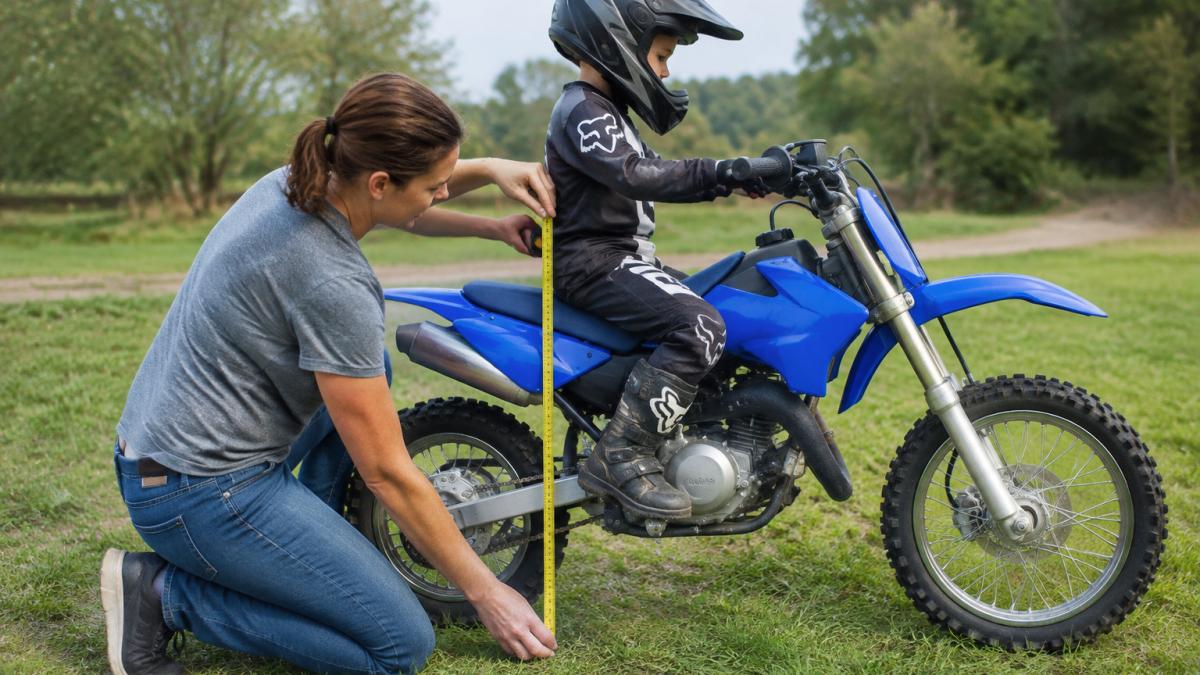
How to measure inseam accurately
Have your child stand against a wall in socks, feet about shoulder-width apart, back flat. Place a book or a flat ruler between their legs, snug against the crotch the way a bicycle seat would sit, and mark the wall at the top edge of the book. Measure from the floor to that mark. Do it twice, kids shift, and a half-inch error changes the recommendation.
The seat-height rule that actually works
Seat height is measured from the ground to the top of the seat with the bike upright and the suspension at rest. The practical test is a ratio, not a single number:
- Beginner / first bike: seat height should be at or slightly below the child's inseam, so both feet can plant flat with knees bent. This is the pass/fail line for a rider who is still learning to balance, stop, and start.
- Confident rider: seat height can sit roughly 1 to 2 inches above inseam, so the rider gets the balls of both feet down and one foot flat when stopped. This is the range most youth motocross bikes are designed around.
- Too tall: if the child cannot touch the ground with at least the balls of one foot while seated, the bike is oversized regardless of what the age chart says.
A common pattern is parents measuring only standing height and then discovering the bike is 3 inches too tall at the seat. Inseam is the number that matters, because it is what determines whether the rider can reach the ground at a stop.
The three-point fit check
Once you have inseam and seat height, run three checks in order. If any one fails, drop to a smaller bike or a model with an adjustable seat.
- Ground reach. Seated, can the rider plant both feet (beginner) or the balls of both feet (experienced) with knees slightly bent? Flat-footed with straight, locked knees means the bike is too small; tiptoes only means it is too big.
- Control reach. With hands on the grips in a normal riding position, can the rider cover the front brake lever with one or two fingers without stretching or rolling the wrist? Can they reach the rear brake pedal or lever through its full travel? Levers that require a full-hand stretch are a control problem, not a preference.
- Standing clearance. Standing on the pegs in the riding position, is there a few inches of clearance between the rider and the seat, and can they grip the bike with their knees? A rider who is crammed against the bars or cannot stand up on the pegs will fatigue quickly and lose control on rough ground.
Watch out: a bike can pass the seat-height test and still fail the control-reach test, especially on models with wide frames or non-adjustable levers, check both before you buy.
Why seat height alone is not enough
Seat height tells you about stopping. It says nothing about whether the rider can hold the bike up, reach the bars, or work the controls at low speed. Ecoleap Bike's selection guide also lists handlebar reach, brake access and overall bike weight as factors to check in person (Ecoleap Bike's guide to choosing a kids' dirt bike). Treat seat height as the gate and the three-point check as the confirmation.
Common fit problems and what they mean
- Feet cannot reach the ground while seated: bike is too tall, go down a size or look for a lowering link or adjustable seat.
- Handlebars force a stretch or a hunch: bar height or reach is wrong, adjustable bar mounts or a different bend can fix it, but a smaller frame is often the real answer.
- Brake levers hard to reach with one or two fingers: lever reach is not adjustable on many youth bikes, so this is a reason to choose a different model.
Measure inseam once, record it, and recheck it every season. Children grow in spurts, and a bike that passed the three-point check in spring may fail it by fall.
The table below sums up the three checks that decide whether a bike fits your child.
| Check | Target | Note |
|---|---|---|
| Seat height, beginner | At or slightly below inseam | Both feet plant flat with knees bent |
| Seat height, confident rider | 1 to 2 inches above inseam | Balls of both feet down, one foot flat |
| Ground reach | Balls of both feet, knees slightly bent | Flat-footed with locked knees means too small |
| Control reach | Front brake covered with one or two fingers | Full-hand stretch means a control problem |
| Standing clearance | A few inches between rider and seat | Rider can grip the bike with their knees |
| Inseam measurement | Measure twice, book against wall | Record it and recheck every season |
Engine Size, 50cc vs 110cc, and Electric Options
Engine size should follow rider size and experience, not the other way around. Displacement tells you how much power the bike can make and how much it weighs, and both of those decide whether a child can control it.
What 50cc, 110cc, and the sizes between actually mean
- 50cc class: the smallest gas youth bikes. Light, low seat heights, and modest power, typically the right starting point for young beginners who are still learning throttle and brake control. Many are speed-limited or have adjustable throttle stops.
- 65cc to 85cc class: the step up for riders who have outgrown a 50cc and can handle a taller seat, more weight, and a manual clutch on some models. This is where fit and control start to matter more than age.
- 110cc and up: larger youth and small adult bikes. More weight, taller seats, and enough power that a rider who cannot flat-foot the bike or work the controls smoothly is at real risk. These suit older, experienced kids who have already learned low-speed control.
The displacement number is a proxy for power and weight, not a fit measurement. A 110cc bike with a low seat can fit a smaller rider than a tall 85cc, so always check seat height and weight against the rider before the cc number.
How electric youth bikes change the sizing conversation
Electric dirt bikes are sized differently from gas bikes, and the voltage number on the spec sheet is not a direct substitute for cc. Compare each bike's actual specifications rather than assuming a voltage equals a displacement.
Three differences matter for sizing:
- Weight distribution. Batteries sit low and centralized, which can make an electric bike feel more stable at low speed than a gas bike of similar power, but the total weight can still be high, so check the curb weight against the rider.
- Power delivery. Electric motors deliver torque immediately from a standstill. That instant response can surprise a beginner, so look for models with adjustable power modes or a throttle limiter.
- No clutch, no kick start. Fewer controls to manage can make an electric bike easier for a young rider to learn on, but it also means the rider does not build clutch skills that transfer to a gas bike later.
Check weight and low-speed control, not just voltage, since a child who fits the seat height may still struggle to lift or hold a bike upright.
Matching engine size to rider size and experience
Use this order of checks:
- Fit first. Seat height and the three-point fit check decide whether the bike is the right size at all.
- Weight second. Can the rider lift the bike off the ground and hold it upright at a stop? If not, the bike is too heavy regardless of cc or voltage.
- Power third. Can the rider control the throttle and brakes smoothly at low speed on a flat surface? If the bike lurches or the rider is afraid of the throttle, drop to a smaller engine or a lower power mode.
- Experience last. A rider moving up from a smaller bike can usually handle more power than a first-timer of the same size, but only after the fit and weight checks pass.
Whatever the engine type, check the manufacturer's rider recommendations for that specific model. General charts can point you toward a size range, but the bike's own specifications, seat height, curb weight, and power, decide the final match.
Kids Dirt Bike Test Ride Checklist
Before buying, arrange a test ride or a supervised fit check. Use this checklist to judge the bike on your child's terms:
- Can your child sit on the seat with both feet flat or near-flat on the ground?
- Can your child reach the handlebars and both brake levers comfortably?
- Does your child feel able to lift or hold the bike upright?
If the answer to any of these is no, keep looking at smaller models. Confidence matters more than the bike's top speed or engine size.
Booking Your Child's Fit Check Before You Buy
Charts and checklists work best when they are backed by a real measurement and a real ride. If you want to confirm the right size for your child, we recommend booking a fit check before you buy.
Once you have a fit in mind, keep the bike's specifications and your child's measurements together so you can revisit them as your child grows.
Frequently Asked Questions
What size dirt bike should I get for my child?
Start with your child's height and inseam, then check the manufacturer's seat height and weight specifications for the model you are considering. Age charts give a rough starting point, with averages such as 48 to 52 inches in height and a 20 to 23 inch inseam for an 8-year-old, but they are not fixed rules. A tall, experienced 8-year-old may be ready for a larger bike, while a cautious beginner often does better starting smaller. Confirm the choice with a test ride before buying.
Should a child be able to touch the ground on a dirt bike?
Yes, in most cases a child should be able to sit on the seat and get the balls of both feet on the ground, or at least one foot comfortably. Seat height matters for control, especially when stopping and starting at low speed. If your child cannot reach the ground at all, the bike is likely too tall for safe low-speed handling, even if the age chart suggests it is the right size. Check this during a test ride rather than relying on the listed numbers alone.
What does 50cc or 110cc mean for a kids' dirt bike?
Engine size, measured in cubic centimeters (cc), indicates the engine's displacement and generally its power output. Smaller engines such as 50cc are common for young beginners, while 110cc and 125cc models suit older or more experienced riders. Engine size should be matched to your child's size, confidence and skill level, not chosen for speed alone. Some families also consider electric youth bikes, which have different power characteristics and should be sized using the same height, inseam and seat height checks.
How can I tell if a dirt bike is too big for my child?
Signs that a bike is too big include a child who cannot reach the ground, struggles to reach the handlebars and brake levers comfortably, or cannot hold the bike upright when stopping. Your child may also feel unsteady at low speeds or unable to control the throttle and brakes confidently. If the bike feels overwhelming during a test ride, choose a smaller model. Sizing up for growth is common, but a bike that is too large is a safety risk and should be avoided.
How do you measure a child's inseam for a dirt bike?
Have your child stand with feet about shoulder-width apart, with a book or firm object pressed between the legs at crotch height. Measure from the top of the book down to the floor, in inches, which gives the inseam length. Compare this number with the seat height listed by the manufacturer, and use it alongside height and weight. Inseam is one of the most useful checks because it shows how a child's legs will reach the seat and footpegs.
What should I check during a kids dirt bike test ride?
Use a simple checklist: confirm your child can reach the ground, comfortably reach the handlebars and brake levers, operate the throttle smoothly, and stop safely at low speed. Watch balance while walking the bike, turning slowly and riding in a small circle. Note whether your child seems confident or anxious, and whether the bike feels easy to control. Ask the seller or manufacturer about model-specific weight and seat height before you commit to a purchase.
How much room should a child have to grow into a dirt bike?
Some families buy slightly larger to allow for growth, but the bike should still fit the rider safely right now. A bike that is too big will be harder to control, more tiring to ride and more likely to cause a fall. Consider adjustable seat height and the rider's current skill before sizing up. Revisit the fit as your child grows, since measurements such as inseam and seat height change over time.
Where can I find current prices for kids dirt bikes and gear?
Pricing depends on the model, quantity, dates and delivery, so there is no standard price to quote here. Check the manufacturer or retailer website for current prices and availability. For books, journals and other Nelmgerian MX products, visit the Nelmgerian MX website for current prices or to request a quote.