 ultimate-guide
How to Explain Motocross Concepts: A Beginner's Guide
Table of Contents
- How to Explain Motocross Concepts: Breaking Down the Basics
- Why Clear Explanations Matter for New Riders
- Motocross Terminology Explained: Essential Vocabulary for Beginners
- Motocross Track Features: Describing the Course Layout
- Motocross Riding Techniques: Teaching Body Position and Control
- Motocross Rules and Etiquette: Making Sense of Race Governance
- How to Explain Motocross Concepts Using Real-World Examples
- Building Confidence Through Structured Training Progression
- Conclusion: Inspiring the Next Generation of Riders
- Frequently Asked Questions
Last Updated: July 17, 2026
How to Explain Motocross Concepts: Breaking Down the Basics
Learning to explain motocross concepts clearly transforms how young riders understand the sport and build confidence. Whether you're a parent, coach, or mentor, breaking down complex ideas into digestible pieces makes all the difference. At Nelmgerian MX, we've worked with hundreds of families discovering motocross and learned that clear explanations unlock genuine passion for the sport.
The real challenge isn't lacking knowledge about motocross, it's translating that knowledge into language beginners understand. Riders need to grasp not just what to do, but why. A rider who understands throttle control at a mechanical level develops better habits than one who simply mimics hand movements.
Why Clear Explanations Matter for New Riders
Effective teaching builds confidence faster than any other factor. A rider who understands body position will self-correct in the next corner. One who doesn't will repeat the same mistake lap after lap, becoming frustrated and losing motivation.
Clear explanations also reduce injury risk. When riders understand why protective gear matters, they wear it consistently. When they understand proper braking technique, they brake earlier and smoother, reducing stress on their bodies and bikes. Knowledge directly translates to safer riding decisions.
The motocross community thrives on shared passion. Riders who can articulate what they're learning become better mentors to other beginners, ask better questions, progress faster, and stay engaged longer.
Motocross Terminology Explained: Essential Vocabulary for Beginners
Understanding motocross terminology in plain language removes intimidation and helps beginners fully engage with the sport. Most terms describe something concrete and visual, once you understand what a term means, you can see it happening on the track.
Core Riding Terms
Throttle control is the smooth, progressive application of engine power. Instead of twisting the throttle wide open instantly, riders gradually increase power based on traction and track conditions. Smooth pressure gets better results than abrupt movements.
Body position refers to where the rider sits during different track sections. Riders move forward during acceleration, back during braking, and outside the bike during corners. This weight distribution keeps the bike balanced and maximizes traction.
Clutch management involves using the clutch lever to control power delivery, especially during starts and technical sections. A smooth clutch release gets the bike moving without wheelies or stalling. Riders also use clutch control to navigate tight corners where the bike would normally stall at low speeds.
Cornering is maintaining speed and control through turns. Motocross riders lean the bike more aggressively than street riders, requiring precise throttle control and body positioning. The faster the corner, the more the bike leans; the tighter the corner, the more the rider needs to slow down beforehand.
Braking fundamentals start with understanding that motocross brakes work differently than car brakes. Riders use both front and rear brakes, with the front providing most stopping power. The best technique combines both, with more front brake pressure as the rider slows down.
Equipment and Bike Components
Protective gear includes the helmet, boots, body armor, and gloves that keep riders safe. A quality helmet is the most important purchase any rider makes. Boots protect ankles and provide better foot control on the pegs. Body armor absorbs impact and prevents abrasions.
Power valves are mechanical components that adjust exhaust timing based on RPM. At low speeds, they create back pressure for better low-end power. At high speeds, they open to let the engine breathe freely. Understanding this helps riders appreciate why their bike feels stronger in certain RPM ranges.
Suspension consists of the fork (front) and shock (rear) that absorb impacts from jumps and bumps. Properly tuned suspension keeps the tire in contact with the ground, improving traction and control. Suspension that's too soft feels wallowy; suspension that's too stiff transmits every bump to the rider's body.
Motocross Track Features: Describing the Course Layout
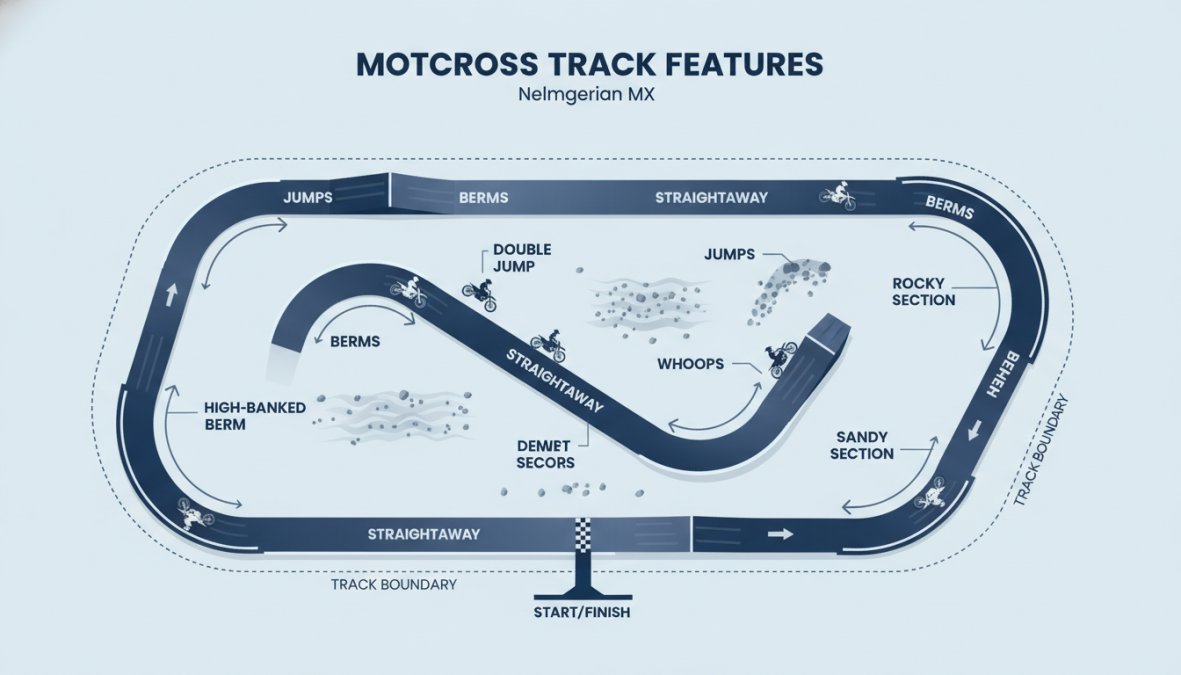
Understanding track features helps riders visualize what they'll encounter before getting on the bike. Every track is different, but they share common elements riders need to recognize and navigate.
Common Obstacles and Jumps
Jumps are the signature feature of motocross tracks. Riders accelerate toward a ramp, launch into the air, and land on a downslope. The technique requires precise throttle control in the air and proper landing position to absorb impact. Jumps range from small tabletops to massive doubles requiring significant speed to clear.
Berms are banked turns that allow riders to maintain speed through corners. The banking helps keep the bike upright and provides traction. Riders lean into the berm, using the banking to their advantage.
Whoops are a series of small, closely-spaced bumps that test rhythm and suspension setup. Riders either attack whoops by hitting every bump with precise throttle control, or skim across them with smooth, consistent speed.
Ruts are deep trenches carved by repeated passes over the same line. Shallow ruts provide a natural line; deep ruts can trap the front wheel and cause crashes if riders aren't prepared.
Rock gardens are sections with large rocks scattered across the track. Riders must pick their line carefully, using throttle control to navigate between obstacles. Rock gardens reward smooth technique and punish aggressive riding.
Water crossings appear on some tracks, especially enduro courses. Riders need to maintain momentum through water to avoid bogging down. The technique is similar to jumping, commit to the line and trust the bike's ability to push through.
Motocross Riding Techniques: Teaching Body Position and Control
Explaining motocross riding techniques requires breaking down movements that experienced riders perform instinctively. The key is helping learners understand the purpose behind each movement.
Throttle Control and Clutch Management
Smooth throttle control is the foundation of fast, safe motocross riding. Beginners often roll the throttle on and off abruptly, which unsettles the bike and reduces traction. Experienced riders make micro-adjustments, constantly feeding in power based on what the bike tells them.
Teach throttle control by having riders focus on one section of track at a time. Rather than worrying about the entire lap, ask them to master smooth throttle application through one turn or one jump. Once that section feels smooth, move to the next.
Clutch management becomes critical in technical sections where the bike would normally stall. In a tight hairpin turn, a rider can slip the clutch to keep the engine running at low speeds while maintaining control. This technique prevents stalls and keeps momentum flowing.
Cornering and Braking Fundamentals
Cornering in motocross differs dramatically from street riding. The bike leans at extreme angles while the rider's body hangs off the seat, keeping weight low and outside. This technique allows the bike to stay more upright, improving traction and allowing higher speeds.
Break cornering into phases: the approach (slowing down), the entry (rolling in smoothly), the middle (maintaining throttle), and the exit (accelerating out). Riders who understand each phase can diagnose their own problems.
Braking technique requires understanding weight transfer. When a rider brakes hard, their weight shifts forward, loading the front tire and increasing grip. This is why the front brake provides most stopping power. However, brake too hard and the front tire loses grip, causing a crash.
Motocross Rules and Etiquette: Making Sense of Race Governance
Understanding motocross rules and etiquette helps riders become responsible community members. Racing has specific rules that keep riders safe and competitions fair. Etiquette goes beyond rules, it's about respect for other riders, the track, and the sport.
Racing Classes and Categories
Motocross racing categories divide riders by age, skill level, and bike size. Youth classes typically start at age 4-5 with 50cc bikes and progress through 65cc, 85cc, 125cc, and 250cc bikes. Adult classes include 125cc, 250cc, 450cc, and open classes.
Skill-based classes (Beginner, Intermediate, Advanced, Expert) allow riders to race against competitors at similar levels. Racing in the appropriate class builds confidence and allows meaningful progression.
The gate start is a critical moment where all riders line up behind a gate that drops at the start signal. Getting a good start requires practice and bike control. Riders who launch smoothly gain positions immediately.
Passing rules vary by organization, but generally riders must pass safely without forcing other riders off the track. The best passes happen when a rider finds a better line and carries more speed through a corner.
How to Explain Motocross Concepts Using Real-World Examples
The most effective way to teach motocross concepts is through concrete examples riders can visualize and relate to their own experience.
Making Comparisons: Motocross vs. Enduro
Motocross and enduro are both off-road motorcycle sports but differ significantly in purpose, terrain, and skill emphasis. Motocross races on closed circuits with man-made jumps and obstacles, lasting 15-30 minutes per moto. Enduro races on natural terrain over several hours, covering 50+ miles per day.
A useful comparison: motocross is like sprinting, while enduro is like distance running. Both require fitness but develop different capabilities. A motocross rider excels at intensity and technical precision. An enduro rider excels at navigation and pacing.
Budget-Friendly Entry Points for Beginners
Starting motocross doesn't require massive financial investment. Used 50cc and 65cc bikes can be found for reasonable prices, and many tracks offer rental programs. A beginner's first bike doesn't need to be new or top-of-the-line. A used, well-maintained 65cc bike from a reputable brand works perfectly for learning fundamentals.
Protective gear is where budget matters less than quality. A good helmet and body armor protect against serious injury, making them non-negotiable investments. Mid-range gear from established manufacturers provides excellent protection without premium pricing.
| Entry Point | Typical Investment | Best For | Learning Focus |
|---|---|---|---|
| Rental Programs | $25-50/day | First-time riders | Basic bike control |
| Used 50cc Bike | $800-1,500 | Young beginners (4-7) | Fundamentals |
| Used 65cc Bike | $1,200-2,000 | Older beginners (7-12) | Technique development |
| Entry-Level Protective Gear | $300-600 | All riders | Safety foundation |
Building Confidence Through Structured Training Progression
The path from complete beginner to competent rider follows a predictable progression when structured properly.
Level 1: Bike Familiarity focuses on getting comfortable sitting on the bike, starting the engine, and basic throttle control. This phase typically takes 2-4 weeks.
Level 2: Basic Control introduces body positioning, smooth throttle application, and simple turns. Riders can navigate a basic track layout at slow speeds. This phase takes 4-8 weeks.
Level 3: Intermediate Technique develops cornering skills, braking precision, and small jump technique. Riders begin adjusting their approach based on track conditions. This phase takes 2-3 months.
Level 4: Advanced Skills introduces aggressive jumps, rhythm sections, and race-pace riding. Riders develop the fitness and mental toughness needed for competitive racing. This phase takes 3-6 months.
Level 5: Race Readiness combines all previous skills with race-specific tactics like starts, passes, and pacing. Riders are ready to compete in organized races. This phase takes 1-2 months.
Resources like Nelmgerian MX's rider training journals support this progression by providing structured activities and confidence-building exercises that keep young riders engaged between track sessions.
Conclusion: Inspiring the Next Generation of Riders
The ability to explain motocross concepts clearly is a gift you give to young riders. It transforms confusion into understanding, fear into confidence, and curiosity into genuine passion for the sport.
The motocross community thrives when experienced riders invest time in teaching newcomers. That investment starts with clear, patient explanations that meet learners where they are. Nelmgerian MX supports this mission through educational resources designed specifically for young riders and their families. With proper guidance and structured learning tools, any young rider can develop the skills, understanding, and passion to thrive in motocross.
Getting started with structured motocross education makes all the difference in how quickly young riders progress and how deeply they connect with the sport. Nelmgerian MX provides the educational foundation through training journals, engaging storybooks, and family-focused resources that build confidence alongside technical skills. Start with clear explanations, support learning with quality educational materials, and watch young riders transform into confident, knowledgeable motocross enthusiasts.
According to American Motorcyclist Association safety resources, structured instruction reduces beginner injury rates by prioritizing foundational knowledge before high-speed riding. Research from Sports psychology studies on youth athletic development demonstrates that riders who understand the concepts behind their techniques develop faster and maintain engagement longer than those who learn through repetition alone. The Motorcycle Industry Council youth participation report shows that families investing in proper instruction and educational resources report significantly higher satisfaction with their motocross experience.
Frequently Asked Questions
What are the most important motocross terminology terms beginners should know?
Key terms include: moto (individual race), holeshot (leading into the first turn), berm (banked turn), tabletop (jump with a flat top), and whoop (series of small bumps). Understanding power-valves, selector forks, and suspension components also helps explain how dirt bikes work. Learning this vocabulary helps beginners follow races and understand coaching feedback during training.
How do you explain motocross track features to someone new to the sport?
Start by describing the circuit as a complete loop with different sections. Explain that jumps test airtime control, berms are banked turns for speed, whoops require rhythm and body position, and straightaways allow throttle application. Use visual demonstrations or video content showing riders navigating these features. Comparing track layouts to familiar concepts (like a roller coaster) helps beginners visualize the challenge.
What are the basic motocross riding techniques that need explaining?
Essential techniques include throttle control (smooth acceleration), clutch management (smooth launches and gear transitions), proper body position (moving weight forward and back), cornering (leaning with the bike), and braking (controlled deceleration). Explain that these techniques work together, good body position enables better throttle control, which improves cornering speed. Step-by-step instruction with video demonstrations makes these concepts clearer.
How do you explain motocross rules and racing classes to newcomers?
Explain that motocross has multiple racing classes based on age, skill level, and bike displacement (like CRF450R or KTM models). Rules cover safety requirements (helmet, boots, body armor), track conduct (passing etiquette), and race formats (motos determine final standings). Emphasize that rules protect riders and ensure fair competition. Comparing amateur racing to professional racing helps illustrate progression opportunities and the moto lifestyle community.
This article was written using GrandRanker