 how-to
How to Improve Child Motocross Cornering: 7 Essential Drills
Table of Contents
- Why Cornering Technique Matters for Young Riders
- Dirt Bike Body Position for Corners: The Foundation
- Throttle Control and Entry Speed for Smooth Turns
- Braking Techniques: Front Brake vs Rear Brake Strategy
- Motocross Cornering Drills for Kids: 7 Progressive Exercises
- Drill 1: Slow-Speed Balance and Line Choice
- Drill 2: Apex Recognition and Vision Training
- Drill 3: Body Position Repetition in Flat Turns
- Drill 4: Berm Riding and Lean Angle Progression
- Drill 5: Counter-Steering Awareness Exercises
- Drill 6: Rut Navigation and Traction Management
- Drill 7: Exit Speed and Acceleration Timing
- Common Motocross Riding Mistakes Young Riders Make
- Building Rider Confidence Through Progressive Training
- Equipment Setup and Bike Adjustments for Smaller Riders
- Frequently Asked Questions
How to Improve Child Motocross Cornering: 7 Essential Drills
Last Updated: July 5, 2026
Young riders often struggle with cornering because they approach turns reactively instead of proactively. At Nelmgerian MX, we've worked with hundreds of young riders, and the difference between those who master cornering and those who plateau comes down to deliberate practice and understanding the mechanics behind each movement. Below are seven progressive drills that build confidence, body awareness, and consistency on the track.
Why Cornering Technique Matters for Young Riders
Cornering is where races are won and lost. A rider with superior cornering skills maintains momentum through technical sections and exits turns at higher speeds. Cornering isn't intuitive, children must overcome their natural instinct to lean away from turns and instead shift body weight inside while the bike leans outside. This counterintuitive movement requires specific coaching and repetition.
Many young riders develop bad habits in their first season that become difficult to break later. Early intervention with structured drills prevents poor patterns from becoming ingrained.
Dirt Bike Body Position for Corners: The Foundation
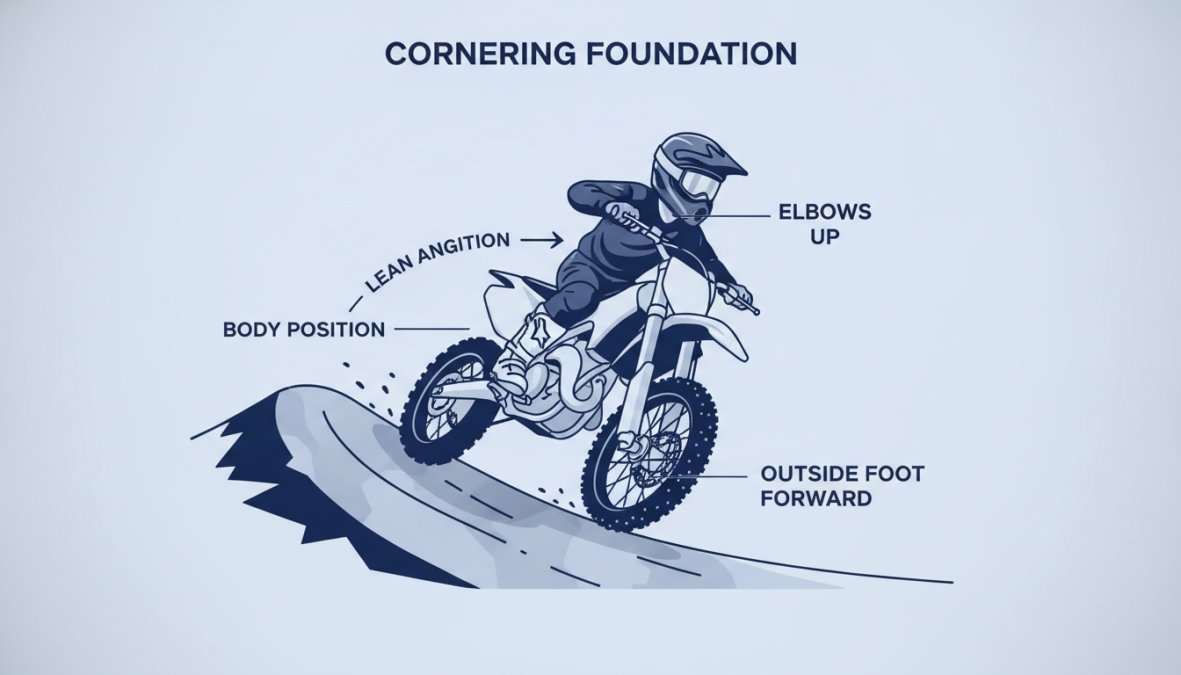
Body position is the foundation of effective cornering. The ideal position involves four key elements: elbows up, outside foot forward, weight shifted inside, and eyes looking through the turn.
Elbows Up and Outside Foot Placement
Elbows up is the most fundamental body position cue for young riders. When elbows are raised to shoulder height, the rider's center of gravity shifts and the upper body moves freely with the bike. Low elbows restrict movement and force reliance on arm strength rather than body positioning.
The outside foot should be forward on the footpeg during cornering. If turning left, the right foot moves forward. This positioning allows the rider to shift their hip inside the turn while maintaining contact with the bike.
Teach this positioning with slow-speed drills first. Have your child practice figure-eights in an empty parking lot at walking speed, focusing only on moving their elbows up and shifting their outside foot forward.
Weight Distribution and Center of Gravity
Weight distribution determines how much traction the tires have and how the bike responds to steering inputs. The optimal position for most young riders is slightly forward of center, roughly where the rider's hip is over the seat.
Center of gravity is lowered when the rider moves inside the turn. This inside movement comes from the hip and upper body, not from leaning the head. A child who leans their head inside without moving their hip creates an unstable position and increases crash risk.
Throttle Control and Entry Speed for Smooth Turns
Entry speed is the single most important variable in cornering. A child who enters too fast will either run wide, brake mid-turn, or crash. A child who enters too slowly loses the opportunity to exit fast.
The correct entry speed depends on turn radius, available grip, and rider skill level. For young riders, the rule is simple: enter slower than you think you need to. Teach them to brake before the turn, not during it. Once brakes are released and the bike is turning, the throttle should be steady or gradually increasing toward the exit.
Throttle control during the turn requires smoothness and progressiveness. Abrupt throttle inputs upset the bike and cause the rear tire to slide or the front to wash. The correct approach is to maintain steady throttle through the middle of the turn, then progressively increase throttle as the bike stands up toward the exit.
Braking Techniques: Front Brake vs Rear Brake Strategy
Braking before a turn is essential for controlling entry speed. Front brake provides roughly 70% of stopping power, while the rear brake contributes 30% and helps stabilize the bike.
Teach front brake usage by having your child practice braking in a straight line first. They should feel the front tire grip as they squeeze the brake lever, learning how much pressure is needed to stop effectively without locking the wheel. Once comfortable, introduce braking before turns, starting with gentle braking into wide, flat turns.
The rear brake should be used in conjunction with the front, not as the primary stopping tool. During cornering, the rear brake can be used lightly to help settle the bike and control speed, but aggressive rear braking while turning will cause the rear tire to slide.
Motocross Cornering Drills for Kids: 7 Progressive Exercises
These seven drills are designed to build cornering skills progressively. Start with Drill 1 and progress through the sequence only after your child demonstrates mastery of the previous drill.
Drill 1: Slow-Speed Balance and Line Choice
Duration: 10-15 minutes per session Frequency: 2-3 times per week Objective: Build confidence and basic line awareness at speeds where fear is minimized
Set up a series of cones in a wide circle, spaced 20-30 feet apart. Have your child ride around the cones at walking speed, focusing on smooth steering inputs and maintaining a consistent line. Encourage them to ride the same line multiple times, developing muscle memory for smooth steering inputs.
At this slow speed, they should practice looking ahead to the next cone, not at the ground directly in front of them. This teaches vision discipline, critical for faster riding.
Drill 2: Apex Recognition and Vision Training
Duration: 12-18 minutes per session Frequency: 2-3 times per week Objective: Develop the ability to identify the apex of a turn and look through to the exit
Mark the apex of each turn with a bright cone or marker. Have your child focus on hitting the apex with their front tire. Looking through the turn means the rider's eyes are already focused on the exit before reaching the apex. Teach them: "Your eyes should reach the exit before your bike reaches the apex."
Drill 3: Body Position Repetition in Flat Turns
Duration: 15-20 minutes per session Frequency: 2-3 times per week Objective: Develop muscle memory for proper elbows-up, outside-foot-forward positioning
Ride a series of flat, wide turns and focus exclusively on body position. Have your child exaggerate the movement: elbows up high, outside foot very forward, hip shifted inside. Use a video camera to record sessions and review playback together, allowing your child to see their own positioning.
Drill 4: Berm Riding and Lean Angle Progression
Duration: 20-25 minutes per session Frequency: 2-3 times per week Objective: Build confidence with lean angle and develop feel for traction limits
Berms are banked turns that provide natural support for the bike's lean angle. Start on shallow berms at moderate speeds, focusing on smooth steering inputs and steady throttle. Progress to steeper berms and gradually increase speed. As confidence builds, transition back to flat turns.
Drill 5: Counter-Steering Awareness Exercises
Duration: 15-20 minutes per session Frequency: 1-2 times per week Objective: Develop intuitive understanding of counter-steering mechanics
Counter-steering is the slight forward pressure on the inside handlebar that initiates a turn. Ride a series of turns and have your child focus on the feeling of pushing the inside handlebar slightly forward to initiate the turn. Use verbal cues: "Push the inside bar to turn left" or "Feel the pressure on your left hand."
Drill 6: Rut Navigation and Traction Management
Duration: 20-30 minutes per session Frequency: 1-2 times per week Objective: Develop traction awareness and learn to manage the bike in variable conditions
Create a course with ruts running in various directions. Have your child ride through these ruts at moderate speeds, learning to feel how the bike responds when a wheel is in a rut versus on flat ground. The goal is to remain smooth and calm.
Drill 7: Exit Speed and Acceleration Timing
Duration: 20-25 minutes per session Frequency: 2-3 times per week Objective: Develop the ability to progressively increase throttle as the bike exits the turn
Set up a course with multiple turns. Have your child focus on progressive throttle application as the bike exits each turn. The throttle should be off or minimal at the apex, then gradually increase as the bike stands up. Record lap times to provide objective feedback.
| Drill | Duration | Focus | Progression |
|---|---|---|---|
| Slow-Speed Balance | 10-15 min | Smooth steering, line consistency | Tighter circles, faster speeds |
| Apex Recognition | 12-18 min | Vision training, apex hitting | Higher speeds, tighter turns |
| Body Position | 15-20 min | Elbows up, outside foot forward | Increased speed, tighter turns |
| Berm Riding | 20-25 min | Lean angle confidence | Steeper berms, faster speeds |
| Counter-Steering | 15-20 min | Handlebar pressure feel | Higher speeds, sharper turns |
| Rut Navigation | 20-30 min | Traction management | Variable rut angles and depths |
| Exit Speed | 20-25 min | Throttle progression | Lap time improvement |
Common Motocross Riding Mistakes Young Riders Make
Young riders typically make the same mistakes repeatedly. Braking too late is the most common mistake, a child enters a turn too fast and brakes mid-turn, losing momentum. The fix is consistent coaching: "Brake before the turn, not during it."
Looking down instead of ahead is the second most common issue. Young riders naturally focus on the ground directly in front of them, which causes them to miss the apex and exit. Constant reminders to look ahead are necessary.
Rolling off the throttle mid-turn causes the bike to stand up and run wide. Young riders often do this because they're nervous. Teach them that once braking is finished, the throttle should be steady or increasing, never decreasing.
Not moving their hip inside is related to body position. Young riders who sit upright and don't shift their hip inside must lean the bike much further to achieve the same lean angle, increasing crash risk.
Building Rider Confidence Through Progressive Training
Confidence is the foundation of skill development. Progressive training builds confidence by ensuring the child is always slightly challenged but never overwhelmed.
Age-Specific Physiological Considerations
Young children (ages 6-8) have limited neck strength and tire easily. Sessions should be shorter (20-30 minutes of active riding) with frequent breaks. Focus on basic balance and smooth steering inputs.
Older children (ages 9-12) develop better balance and have more neck and upper body strength. Sessions can be longer (45-60 minutes of active riding), and the focus can shift to more advanced techniques like throttle control and lean angle management.
Physical strength matters for motocross. Ensure the bike size matches the child's height and strength.
Parent-Led Coaching Strategies
Effective parent coaching requires clear communication and structured practice. Start each session with a specific objective: "Today we're working on apex recognition" or "Today we're focusing on smooth throttle application."
Use positive reinforcement. Praise specific improvements: "I noticed you looked ahead through that turn, great job" or "Your throttle application was much smoother that lap." Record video and review it together. Set realistic expectations, skill development is not linear, and plateaus are normal.
Equipment Setup and Bike Adjustments for Smaller Riders
A properly set up bike makes learning easier. Seat height should allow the child to touch the ground with their toes while sitting on the seat. Throttle response should be manageable for small hands, adjustable throttle cables can soften aggressive response. Suspension should be set for the child's weight, as stock suspension is typically too stiff for young riders. Handlebars should be positioned for comfortable arm extension.
At Nelmgerian MX, we understand that young riders need more than just instruction. Our rider training journals help young riders track their progress, set goals, and reflect on their sessions. Combined with our children's storybooks that feature motocross characters and adventures, we create an educational ecosystem that keeps young riders engaged and motivated both on and off the track.
Building cornering skills takes time, consistency, and the right approach. Young riders who master these techniques early will have a foundation that carries them through their entire motocross careers. Start with Drill 1, progress systematically, and watch your child transform into a confident, skilled rider.
Frequently Asked Questions
What is the correct body position for motocross cornering?
Proper body position involves keeping elbows up and wide, positioning your outside foot forward on the pegs, and shifting your weight toward the outside of the bike. Your head and eyes should look through the turn to the apex and exit. For children, this requires practice to develop muscle memory. Keep the inside leg extended slightly for balance, maintain a relaxed grip on the handlebars, and distribute weight through the footpegs and seat for optimal traction and control through the corner.
How do you teach a child to corner faster on a dirt bike using progressive drills?
Start with slow-speed balance drills in flat turns, then progress to berm riding where natural banking helps. Use apex recognition exercises to teach line choice, then gradually increase entry speed and lean angle. Practice counter-steering awareness and throttle control separately before combining them. Each drill builds confidence and muscle memory. Progress only when your child consistently executes the current skill, rushing progression leads to crashes and lost confidence. Use a rider training journal to track improvement over weeks.
What are the most common cornering mistakes young motocross riders make?
Young riders often brake too late, enter corners too fast, and lack proper body positioning. They may grip the handlebars too tightly, restricting natural counter-steering. Many riders look down instead of through the turn, missing the apex and exit. Throttle control issues, either chopping the throttle abruptly or accelerating too early, cause loss of traction. Improper weight distribution and elbows-down positioning reduce lean angle capability. Poor vision and line choice waste momentum. Address these systematically through drills rather than correcting all at once.
How can I help my child build confidence in motocross corners as a parent coach?
Start by creating a safe, low-pressure training environment where mistakes are learning opportunities. Use positive reinforcement and celebrate small improvements. Break cornering into manageable components, body position, then braking, then throttle control, rather than overwhelming them with everything at once. Age-appropriate expectations matter; younger riders have different physiological capabilities. Demonstrate the techniques yourself or use video references. Keep training sessions short and fun. Use a rider training journal to track progress visually, which builds confidence by showing tangible improvement over time.
This article was written using GrandRanker