 how-to
Teach Phonics With Dirt Bikes: A Step-by-Step Guide
Table of Contents
- Why Dirt Bikes Work for Teaching Phonics
- Getting Started: Age-Appropriate Phonics Activities for Kids
- Teaching Letter Sound Activities for Preschoolers
- Mastering Digraph Activities for Kids
- Using Dirt Bike Books for Kids to Build Reading Confidence
- Structured Lesson Plans: From First Lesson to Fluency
- Adapting Dirt Bike Phonics for Children Who Don't Ride
- Tracking Progress and Maintaining Motivation
- Frequently Asked Questions
Last Updated: October 6, 2026
Why Dirt Bikes Work for Teaching Phonics
Learning to teach phonics dirt bikes creates a powerful learning tool. Kids who love motocross stay engaged longer with reading activities built around their passion.
The connection taps into genuine interest.
Screen-free activities matter too: dirt bike-themed lessons keep children engaged with books and hands-on learning instead of screens.
Getting Started: Age-Appropriate Phonics Activities for Kids
Start with your child's current reading level, not their age.
For ages 3-4, focus on letter recognition through play: point to letters on dirt bike book covers, say the letter name and sound together, and let your child trace letters while saying the sound aloud.
Ages 7-8 can handle blending, simple sentences, digraphs, and word families, start with words from dirt bike stories they love.
Keep sessions short: 10-15 minutes for younger children, 15-20 for older ones. Five minutes daily beats one long weekly session.
Teaching Letter Sound Activities for Preschoolers
Letter sound activities for preschoolers work best when playful and hands-on.
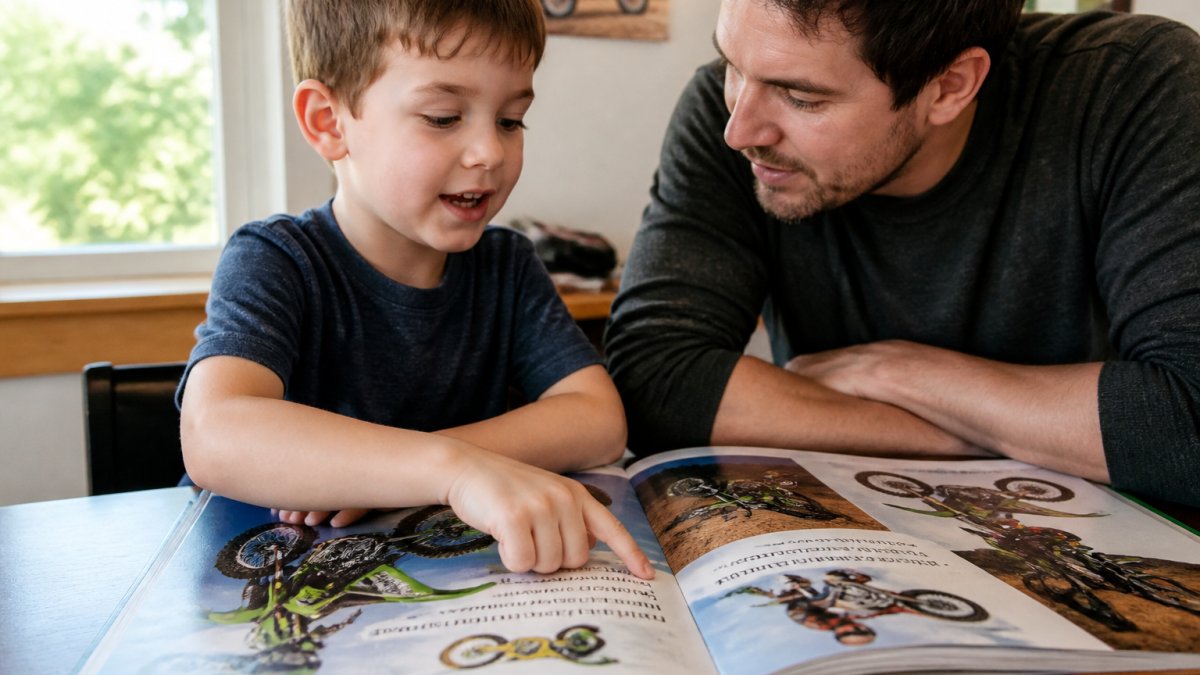
To teach phonics dirt bikes effectively, start with the sounds your child hears most in dirt bike words: /b/ for bike, /d/ for dirt, /r/ for race, /j/ for jump.
Use these activities to reinforce each sound:
- Sound matching: Say a sound and have your child point to the matching letter on a page
- Picture sorting: Show pictures of dirt bikes, dogs, and ducks; have them group by first sound
- Echo games: You say a word, they repeat the sound at the start
Praise effort, not just correct answers, celebrating a hard attempt builds confidence and keeps children practicing.
Mastering Digraph Activities for Kids
Digraphs are two letters that make one sound. Introduce them after your child masters basic letter sounds, usually around age 5-6.
Digraph activities for kids work best when you show the connection clearly: write the two letters together, say the sound, then use it in a dirt bike word.
SH, CH, and TH Digraphs in Motocross Words
Start with /sh/ because it appears in words kids know: "shift," "shop," "shell." Write "sh" together, make the sound, have your child repeat it, then show how "sh" appears in "shift," a key motocross word.
Create digraph activities for kids using these motocross words:
- SH words: shift, shell, shock (as in shock absorbers)
- CH words: champ, check, choice
- TH words: throttle, the, that
Use a simple approach: point to the digraph, say the sound, read the word together, one digraph per week. Make it physical: jump for /sh/, clap for /ch/, stomp for /th/.
WH, PH, and CK Digraphs
Introduce these less common digraphs only after your child is solid on sh, ch, and th.
WH words (the /w/ sound): "wheel," "when," "where," "what"
PH words (the /f/ sound): "phone", less common in motocross but useful for general reading
CK words (the /k/ sound): "track," "back," "kick," "truck," "quick"
The CK digraph is especially important for motocross learners because it appears in "track," "truck," and "kick." Use the same method, point, say, repeat, use in context, then move to sentences like "The truck is on the track," having your child read aloud and circle the digraph words.
Using Dirt Bike Books for Kids to Build Reading Confidence
Dirt bike books for kids work because they combine genuine interest with literacy instruction.
Choose books that match your child's reading level, too hard frustrates, too easy builds no new skills. Look for:
- Clear, large print
- Pictures that support the words
- Motocross themes your child recognizes
Read together first, pointing to words and letting your child repeat phrases, then have them read to you.
Celebrate every attempt: praise the effort of decoding, not just getting it right, to build confidence and willingness to tackle harder books.
Structured Lesson Plans: From First Lesson to Fluency
What follows is a scope-and-sequence you can run for a full school year, with mastery criteria at each stage. It follows structured literacy order, sounds before letters, blending before digraphs, decodable text before leveled text. You don't need a teaching degree, just 10-15 minutes a day, five days a week, and the discipline not to skip ahead when your child guesses correctly once.
The Scope-and-Sequence at a Glance
| Stage | Weeks | New Skill | Mastery Check |
|---|---|---|---|
| 1 | 1-2 | 5 continuous consonant sounds: /b/, /d/, /r/, /j/, /t/ | Says each sound in isolation on 4 of 5 tries, two days in a row |
| 2 | 3-4 | Short /a/ and /i/; blending two sounds | Blends 8 of 10 two-sound pairs without a model |
| 3 | 5-6 | CVC words with known letters | Reads 10 of 12 CVC words cold (no preview) |
| 4 | 7-8 | Short /o/, /u/, /e/; word families -at, -it, -ot, -un | Reads 12 of 15 CVC words mixing all five vowels |
| 5 | 9-11 | Digraphs sh, ch, th, ck | Reads 10 of 12 digraph words; sorts sh/ch/th by sound with 90% accuracy |
| 6 | 12-14 | Blends (st, tr, fl, gr) and the -ck ending in longer words | Reads two-syllable words like "kickstand" and "helmet" |
| 7 | 15-18 | Silent e (a_e, i_e, o_e) | Reads 10 of 12 silent-e words; explains why "bike" has a long /i/ |
| 8 | 19-22 | Vowel teams (ai, ee, oa) and r-controlled vowels (ar, or, er) | Reads a 40-word decodable passage with 95% accuracy |
| 9 | 23-26 | Fluency: repeated reading of the same passage | Reads a 60-word passage at 40-60 words per minute with expression |
That's roughly a school year. Some children move faster; some need two weeks on a single stage. The sequence is the point, not the calendar.
Stage 1-2: Sounds Before Letters
Don't start with the alphabet. Start with the sounds your child already hears at the track: /b/ in "bike," /d/ in "dirt," /r/ in "race," /j/ in "jump," /t/ in "track."
- Day 1-2: Introduce /b/. Say it. Have your child say it. Find three things in the room that start with /b/. No letters yet.
- Day 3-4: Add /d/. Mix with /b/. "Which one starts 'dirt'? Which starts 'bike'?"
- Day 5-7: Add /r/, /j/, /t/ one at a time. By day 7, your child should hear all five sounds and pick them out of spoken words.
Stage 3-4: Blending and the Vowel Shift
Blending is where reading clicks. Teach it explicitly: "/b/, /a/, /t/. Blend them: bat." Model slowly, then let your child try, never ask them to guess.
For the vowel shift in weeks 7-8, use minimal pairs so the change is audible:
- bat → bit → bet → bot → but
- pin → pan → pen → pun
- hit → hot → hut
Have your child read down the column: the pattern teaches that the middle letter controls the vowel sound, a concept many struggling readers miss.
Stage 5: Digraphs With a Physical Cue
Digraphs are two letters, one sound. Introduce them only after CVC words are solid.
- sh: shift, shell, shock, shut
- ch: champ, check, chain, chest
- th: throttle, thin, that, then
Assign a movement to each: jump for /sh/, clap for /ch/, stomp for /th/. The movement gives the brain a second pathway to store the sound.
Stage 6-8: Blends, Silent E, and Vowel Teams
Once digraphs are automatic, add consonant blends: st, tr, fl, gr, sp, bl, two sounds you can still hear separately, unlike digraphs.
Silent e comes next. Show the pair: kit → kite, rid → ride, hop → hope.
Vowel teams and r-controlled vowels are the last decoding pieces: ai (rain), ee (speed), oa (road), ar (start), or (fork), er (rider).
Stage 9: Fluency and Decodable Text
Fluency isn't speed, it's reading accurately, at a natural pace, with expression. The method is repeated reading: the same short passage, three times across three days.
- Day 1: You read it aloud. Your child follows with a finger.
- Day 2: Your child reads it. Count errors. Do not correct mid-sentence unless they are stuck for more than three seconds.
- Day 3: Your child reads it again. Compare error count to day 2.
A 40-60 word passage is plenty. Choose text where at least 90% of words follow the phonics rules your child has learned, that's what "decodable" means, and it's the difference between building decoding confidence and learning to guess from pictures.
Where to Get Decodable Passages
You don't need to buy a curriculum. Free decodable passages organized by phonics skill are available from public and nonprofit literacy organizations, and many are printable. Look for passages labeled by skill ("short a," "digraph sh," "silent e") rather than grade level, grade-level labels tell you almost nothing about which phonics rules a passage practices.
Adapting Dirt Bike Phonics for Children Who Don't Ride
Not every child in a motocross family rides dirt bikes. Some are too young. Others prefer different activities.
Focus on the story and characters, not the riding. Ryder, Pepper, and Wheelie are interesting regardless of whether a child rides, and motocross culture appeals to kids who watch races, attend events, or have family members who ride.
Use dirt bike books for kids as read-aloud stories.
Create activities that connect to motocross without riding. A child can:
- Color pictures of dirt bikes while you practice letter sounds
- Sort motocross-themed flashcards by sound
- Trace letters on pictures of dirt bikes
The key is keeping the motocross connection alive while teaching phonics. The theme is the hook. The phonics instruction is the skill being built.
Tracking Progress and Maintaining Motivation
A checklist that says "mastered" tells you almost nothing. You need a way to measure retention and a rule for when to move on. Here's a simple system that takes about two minutes per session.
The Three-Data-Point Rule
A skill is mastered when your child uses it correctly on three separate days, in three different contexts, without a model or prompt.
Track it like this:
| Skill | Date Introduced | Day 1 | Day 2 | Day 3 | Status |
|---|---|---|---|---|---|
| /b/ sound | 10/6 | ✓ | ✓ | ✓ | Mastered |
| Blending /b/+/a/ | 10/13 | ✓ | ✗ | ✓ | In progress |
| sh digraph | 10/20 | ✓ | ✓ | , | In progress |
| CVC word reading | 10/27 | ✓ | ✓ | ✓ | Mastered |
A checkmark means a correct response without help; a blank means you didn't test that day; an ✗ means they needed a prompt or got it wrong.
Measuring Decoding Accuracy, Not Just Correct Answers
Accuracy is the percentage of words your child reads correctly on the first try, without sounding out letter by letter.
8 out of 10 or better means the skill is solid enough to build on. 6 or 7 out of 10 means more practice at the same level. 5 or fewer means it was introduced too early, go back a stage.
Do this check once a week, not every day. Daily testing creates pressure and turns practice into a quiz.
Tracking Retention Over Time
Skills fade. A child who read digraphs perfectly in week 10 may struggle in week 14 if they haven't appeared in practice. Build review into every session:
- New skills: practice daily for the first week.
- Recently mastered skills (1-4 weeks old): review twice a week.
- Older mastered skills (1-3 months old): review once a week.
The easiest way to review old skills is decodable passages that mix them, a passage with sh, ch, and silent-e words reviews three skills at once without feeling like a drill.
A Simple Weekly Progress Note
Once a week, write two sentences in a notebook: what your child read accurately this week, and what still needs work. Over a school year, those notes become a record of real progress, far more useful than a chart of checkmarks.
Keeping Motivation High Without Bribes
External rewards, stickers, candy, screen time, work for a few weeks, then stop. What sustains practice is competence: children keep doing what they're good at.
Three things build competence fast:
- Keep the success rate high. Aim for 80-90% correct during practice. If half the words are wrong, the material is too hard and motivation will drop.
- Vary the format, not the skill. The same digraph can be practiced with flashcards, a whiteboard, a sand tray, a word hunt, or a decodable passage.
- Let your child see progress. Show them a word they couldn't read three weeks ago and have them read it now. That "I couldn't do this before and now I can" moment is the engine of motivation.
Connecting Practice to the Track
If your child rides or watches races, point out words they already know in real contexts. Track signage, gear labels, and race programs are full of decodable words: "pit," "start," "stop," "fast," "win," "track," "shift." When your child reads a sign at the track without help, write it down, it's the same skill you've practiced at the table, showing up in the real world.
Frequently Asked Questions
What age should a child start learning phonics with dirt bikes?
Children ages 4-8 benefit most from phonics activities tied to dirt bikes. Preschoolers (ages 3-4) can begin with letter sounds and picture recognition using motocross words. Younger riders (ages 5-6) are ready for blending simple words like 'bike' and 'ride.' By ages 7-8, children can handle digraphs and word families. Start with what excites your child most, if they love dirt bikes, that enthusiasm drives reading progress.
How do I teach phonics with a dirt bike storybook?
Read the story aloud first to keep it fun, then go back and isolate letter sounds in motocross words. Point to words like 'Ryder,' 'track,' and 'throttle' and have your child repeat the sounds. Use the story's pictures to reinforce meaning. Ask questions: 'What sound does 'sh' make in 'shift'?' or 'Can you find the word that rhymes with 'bike'?' This ties reading directly to the story your child loves.
What dirt bike words work best for teaching digraphs?
Motocross vocabulary offers natural digraph practice: SH (shift, shock, splash), CH (choke, chain, check), TH (throttle, the), WH (wheel, wheelie), CK (track, kick, quick), and NG (riding, racing, jumping). These words are part of a young rider's world, so they stick. Start with the most common ones (SH, CH, TH) before moving to less frequent digraphs.
How can I keep a child engaged if they'd rather ride than read?
Make reading a reward for riding practice or a preparation activity before heading to the track. Use short sessions (10-15 minutes) with motocross books. Let your child choose which dirt bike story to read. Connect the book to real riding: 'Ryder learned balance in the book, now you practice balance on the bike.' Combine screen-free dirt bike activities with reading to build a complete learning experience that feels like fun, not schoolwork.
Teaching phonics with dirt bikes works because it meets children where their passion is. When kids care about the content, they engage with the instruction. Start with letter sounds, move through digraphs, and build to simple reading. Track progress, celebrate wins, and keep practice short and consistent. Your child will be reading confidently in weeks, not months.