 how-to
How to Improve Kid Dirt Bike Speed Safely
Table of Contents
- Why Speed Matters, And Why Safety Comes First
- Essential Safety Gear for Young Riders
- Master Dirt Bike Body Positioning for Beginners
- Progressive Dirt Bike Riding Drills for Kids
- Adjusting Speed Settings and Throttle Limiters
- Building Rider Confidence and Managing Fear
- Terrain Awareness and Speed Management
- Track Your Progress and Stay Safe
Last Updated: August 17, 2026
Why Speed Matters, And Why Safety Comes First
Speed is a skill built on throttle control, body positioning, braking modulation, and tactical decision-making, not just twisting the throttle. Young riders who develop controlled acceleration early build the foundation for cornering confidence, terrain awareness, and the mental discipline that separates riders who plateau from those who progress.
The critical mistake: treating speed as the goal. Speed is the byproduct of mastering fundamentals. Push speed before those basics are solid, and you get a scared or injured kid. This guide breaks down the exact framework to help your child ride faster while staying protected and confident.
Essential Safety Gear for Young Riders
Your child's safety gear is the first line of defense. A quality helmet meeting Department of Transportation (DOT) standards is non-negotiable; it should fit snugly without movement and sit level on the head. Check fit regularly as young riders outgrow helmets within a season or two.
Body armor protecting the chest, back, and shoulders should be standard equipment. Elbow and knee pads prevent road rash and build confidence, kids ride better when they know they're protected. Gloves designed for dirt biking provide reinforced palms and knuckle protection while improving throttle control and grip.
Motocross boots protect ankles and shins; sneakers leave ankles vulnerable to twisting injuries and offer no protection if the bike falls on the foot. Jersey and pants designed for dirt biking offer abrasion resistance and full range of motion. Check your child's gear fit before each riding session, protective equipment only works if it fits properly and stays in place.
Master Dirt Bike Body Positioning for Beginners
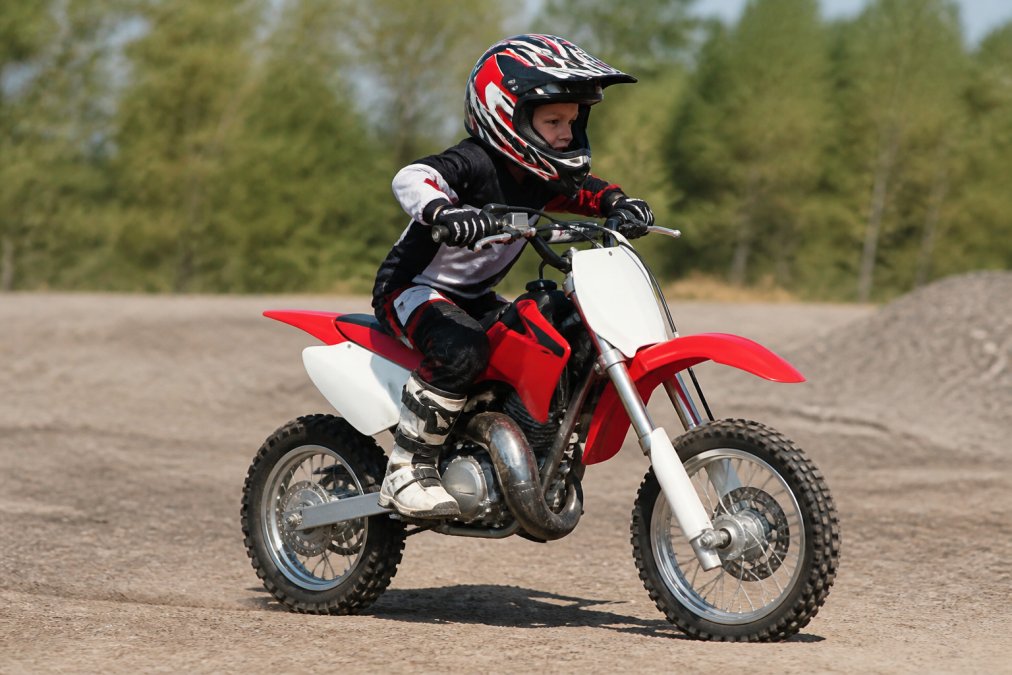
Body positioning is where most young riders lose speed potential. A child sitting upright like they're on a bicycle will fight the bike at every turn and lack stability for smooth acceleration. Proper positioning transfers weight efficiently, improves balance, and makes throttle control feel natural.
The foundation: your child's body should be engaged with the bike, not just sitting on it. This means knees gripping the tank, elbows up and out, and head positioned ahead of the handlebars. This posture keeps the center of gravity low and forward, exactly where it needs to be for controlled speed.
Weight Distribution and Balance
Weight distribution determines how the bike responds to throttle and steering inputs. When a rider sits too far back, the front wheel becomes light and twitchy. When they sit too far forward, the rear wheel loses traction. The sweet spot is slightly forward of center, with weight balanced between both wheels.
For young riders, this means sitting toward the front of the seat with a slight forward lean. During acceleration, the rider should stay with the bike rather than sliding backward, keeping weight on the rear wheel for traction while maintaining front-wheel grip for steering. Teach your child to feel where their weight is by practicing weight shifts while stationary, noticing how the bike responds. This body awareness transfers directly to smooth speed control.
Knee and Elbow Placement
Knees gripping the tank is the most important body positioning element for young riders learning kid dirt bike speed control. When knees lock around the tank, the rider's lower body becomes part of the bike, creating a stable platform for the upper body to move independently, essential for cornering and maintaining throttle control through rough terrain.
Elbows should point outward at roughly 45 degrees from the body, creating space for movement and preventing the elbows from hitting the handlebars during aggressive steering. Head position is critical: the rider's head should be up and forward, looking through the turn rather than down at the front wheel. This improves line choice, confidence, and throttle modulation.
Practice these positions off the bike first. Have your child sit on the stationary bike and lock in the posture: knees in, elbows out, head up. Then practice transitions, moving from standing to seated and shifting weight forward and back. This builds muscle memory before speed is introduced.
Progressive Dirt Bike Riding Drills for Kids
Drills turn theory into skill. A young rider who understands body positioning intellectually but hasn't drilled it won't perform under pressure. These four drills build the specific skills that unlock controlled speed improvement.
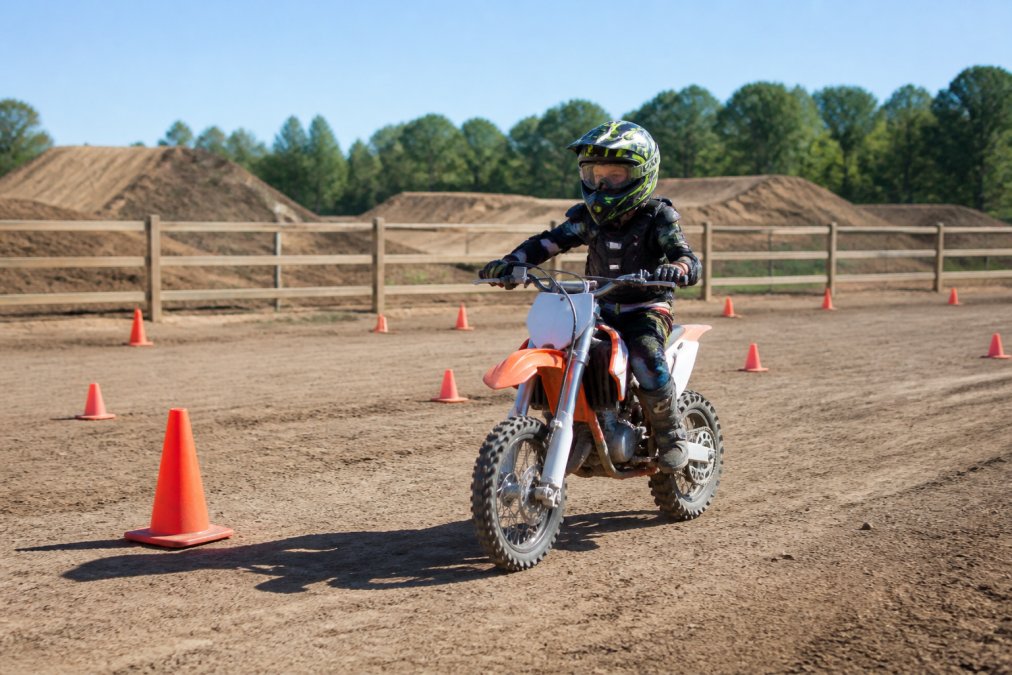
Drill 1: Throttle Control in Straight Lines
Set up a straight line on flat ground marked with cones. Have your child ride the length at a consistent, moderate speed around 15-20 mph for a 50cc bike, maintaining that speed without accelerating or decelerating. This teaches the throttle position that holds steady speed.
Then add variation: accelerate smoothly from 15 to 25 mph over the course length, then decelerate back to 15. The key is smooth transitions, not abrupt throttle changes. Real throttle control is gradual, not binary. Practice this drill for 10-15 minutes per session; most kids show noticeable improvement within 3-4 sessions.
Drill 2: Braking Modulation and Emergency Stops
Set up a straight line and have your child accelerate to moderate speed, then brake smoothly to a stop. The front and rear brakes should work together; too much front brake and the rear wheel lifts; too much rear and the bike skids. Young riders should practice feeling the balance point.
Then add emergency stops. From moderate speed, have them brake as hard as possible without locking the wheels. This builds confidence and muscle memory for situations where stopping quickly matters. Most young riders are afraid of braking hard; a controlled emergency stop drill shows them the bike won't flip or slide uncontrollably.
Drill 3: Cornering Speed and Lean Angle
Start this drill at very low speed, 10-15 mph, and gradually increase. Set up cones in a figure-eight pattern and have your child ride through at steady speed, focusing on smooth body positioning through the turns. The bike should lean, not the rider. Many young riders try to lean their body instead of letting the bike lean, which actually makes cornering slower and less stable.
As confidence builds, gradually increase speed. The bike will naturally lean more as speed increases. The rider's job is to maintain consistent throttle, keep knees locked on the tank, and stay smooth on the bars. Most young riders brake too much into corners, then accelerate hard after the apex. Smoother riders maintain more consistent throttle through the turn and accelerate gradually after the apex.
Drill 4: Acceleration Control and Gear Shifting
Start in a straight line at low speed. Have your child gradually roll on throttle while maintaining body position. The bike should accelerate smoothly without wheelies or loss of traction.
For bikes with manual clutch engagement, practice shifting by maintaining momentum through the gear change: brief throttle off, shift, smooth throttle back on. Young riders often make abrupt shifts that kill momentum. Repeat this drill until acceleration feels smooth and controlled, not jerky.
Adjusting Speed Settings and Throttle Limiters
Many youth dirt bikes come with adjustable throttle limiters or speed governors. A throttle limiter restricts how far the throttle can open, capping top speed. Start with the limiter set conservatively, maybe 50% throttle opening. This forces your child to focus on smooth inputs rather than raw speed. As skills improve, gradually increase the limiter setting.
The benefit is safety without sacrifice. Your child can practice all the skills, throttle control, braking, body positioning, cornering, within a controlled speed envelope. Many young riders make faster progress with a limiter because they're not overwhelmed by speed and can focus on technique. As your child progresses, gradually remove or adjust these limiters.
Building Rider Confidence and Managing Fear
Speed and confidence are inseparable. A child who's afraid makes hesitant inputs, leading to poor throttle control and increased crash risk. A confident child makes smooth, deliberate decisions.
Distinguish between healthy caution and limiting anxiety. Healthy caution makes a rider respect the bike and focus on technique. Limiting anxiety freezes the rider and prevents progress. Start every session with skills review before pushing speed, reminding your child of drills they've mastered. Then introduce one new element, a slightly faster speed, a tighter turn, a longer ride, rather than changing everything at once.
Celebrate small wins. If your child maintained consistent throttle for the first time, that's worth acknowledging. Have your child keep a simple riding journal, writing down what went well and what felt difficult after each session. This builds the habit of reflection that separates riders who improve from those who plateau.
Terrain Awareness and Speed Management
Speed isn't absolute; it's contextual. A safe speed on smooth, flat ground is reckless on rocky terrain or near obstacles. Different terrain demands different approaches: smooth dirt allows higher speeds and more aggressive throttle inputs, while rocky terrain requires smoother, more deliberate throttle control and more frequent braking.
Before riding new terrain, walk it with your child and point out rough sections, obstacles, and areas where traction might be compromised. A key principle: speed through terrain should match the rider's ability to see and react to obstacles. If your child can't see far enough ahead to stop safely, they're going too fast.
Teach your child to read the terrain while riding. Rocks, ruts, and soft spots change how the bike handles. A rider who notices these changes and adjusts throttle and body position accordingly will be safer and faster than one who rides with a fixed throttle.
Track Your Progress and Stay Safe
Keep simple records: date, session duration, what drills were practiced, what felt good, what felt difficult. Over weeks and months, patterns emerge showing improved throttle control, increased cornering confidence, and smoother emergency braking.
Regular video is powerful. Film your child riding every few weeks to document smoother body positioning, more controlled speed, and better lines. Safety should improve alongside speed. A young rider improving kid dirt bike speed safely should show better awareness, smoother inputs, and more deliberate decision-making. If speed is increasing but safety is decreasing, more crashes, more hesitation, more fear, you're pushing too fast.
The goal is to develop a young rider who understands their bike, respects the sport, and has the skills to ride progressively faster while staying in control.
Building a young rider's skills takes consistency and the right approach. The drills and techniques in this guide work because they build skill progressively, starting with fundamentals and adding complexity only when your child is ready. Nelmgerian MX was created by motocross enthusiast Shaun Nelms to support families on this exact journey, with rider training journals that help young riders track progress, storybooks that build passion for the sport, and a community of families committed to developing safe, skilled riders. As you work through these drills with your child, consider pairing hands-on practice with the educational tools that keep young riders engaged and motivated between sessions.
| Drill | Focus Area | Duration | Frequency |
|---|---|---|---|
| Throttle Control in Straight Lines | Smooth acceleration and deceleration | 10-15 minutes | 2-3x per week |
| Braking Modulation and Emergency Stops | Controlled stopping and confidence | 10-15 minutes | 2-3x per week |
| Cornering Speed and Lean Angle | Turning technique and lean management | 15-20 minutes | 2-3x per week |
| Acceleration Control and Gear Shifting | Power delivery and momentum | 10-15 minutes | 2-3x per week |
According to the American Academy of Pediatrics guidance on youth sports injury prevention, proper protective equipment and progressive skill development significantly reduce serious injury rates in youth motorsports. This aligns with the framework outlined above: gear first, skills second, speed third.
Research on motor skill development shows that children develop fine motor control and coordination progressively through structured practice, which is why the drill-based approach to building kid dirt bike speed works better than simply letting kids ride.
For parents seeking additional resources, the Motorcycle Safety Foundation's youth rider curriculum provides evidence-based training principles that align with the progressive approach described in this guide.
Frequently Asked Questions
How fast should a 10-year-old dirt bike go?
Speed depends on the child's experience level and bike size. Beginners on 50cc bikes typically ride 15-25 mph during supervised practice. As skill improves over weeks and months, speeds can gradually increase to 30-40 mph. Always prioritize throttle control and braking modulation over raw speed. Start slow, build confidence, and let speed increase naturally as your child masters body positioning and terrain management.
What's the best way to help my child gain confidence on a dirt bike?
Build confidence through progressive skill drills rather than pushing speed. Start with basic throttle control in straight lines, then add braking and cornering. Use a throttle limiter on your child's bike to control maximum RPM, removing the pressure to go fast before they're ready. Supervised practice on familiar terrain, positive feedback after each session, and celebrating small improvements (better balance, smoother turns) all reinforce rider confidence and reduce fear.
How does proper body positioning affect dirt bike speed?
Body positioning directly impacts speed, control, and safety. Correct posture, knees gripping the tank, elbows up, head up and forward, improves weight distribution and traction. This lets your child accelerate smoothly, brake modulate better, and lean into corners with confidence. Poor positioning wastes energy, reduces control, and increases crash risk. Kids with solid body positioning naturally ride faster and safer because their movements are efficient and their bike responds predictably.
What emergency stop training should young riders practice?
Teach the 12-second rule: at any speed, a rider should be able to stop safely within 12 seconds using proper braking technique. Practice braking drills in a safe, flat area. Start at low speeds and gradually increase. Teach your child to squeeze the brakes smoothly (not jab), shift weight back slightly, and keep the bike upright. Repeat this drill weekly so emergency braking becomes muscle memory, not a panicked reaction when speed builds.
This article was written using GrandRanker