 how-to
How to Start Motocross Racing Kids: A Parent's Guide
Table of Contents
- How to Start Motocross Racing Kids: The Complete Roadmap
- Youth Motocross Bikes: Choosing the Right Size and Type
- Kids Dirt Bike Racing Gear: Essential Safety Equipment
- Motocross Training for Beginners Kids: Getting Started Right
- Cost of Youth Motocross Racing: Budget Breakdown and Planning
- Bike Maintenance and Race Day Preparation for Young Riders
- Common Mistakes to Avoid When Starting Kids in Motocross Racing
- Injury Prevention and Recovery for Young Motocross Athletes
- Frequently Asked Questions
Last Updated: July 31, 2026
How to Start Motocross Racing Kids: The Complete Roadmap
Learning how to start motocross racing kids requires understanding safety requirements, finding quality training, budgeting for expenses, and building your young rider's confidence. This guide breaks down everything parents need to know to set their child up for success in youth motocross, whether they're three years old on a 50cc or nine years old ready for competitive racing.
Youth Motocross Bikes: Choosing the Right Size and Type
Selecting the correct dirt bike is the foundation of your child's motocross experience. The bike must match your rider's age, height, and experience level, a machine that's too large creates frustration and safety risks, while one that's too small limits growth and progression.
New vs. Used: Making the Right Choice for Your Budget
New bikes come with manufacturer warranties and guaranteed reliability, but carry premium pricing. Used bikes offer 40-60% savings but require careful inspection for engine wear, frame cracks, and maintenance history. Have a local mechanic inspect used bikes before purchase. Budget roughly $1,500-$3,000 for a solid used 50cc or 65cc, and $3,500-$5,500 for a new entry-level machine.
Engine Displacement and Rider Age Matching
Engine displacement directly affects power delivery, weight, and rideability. Matching displacement to your child's age and experience prevents overwhelming them with too much power.
| Age Range | Recommended Displacement | Typical Bike Examples | Key Characteristics |
|---|---|---|---|
| 3-5 years | 50cc | Honda CRF50, Yamaha PW50 | Automatic clutch, low seat height, gentle power |
| 5-7 years | 65-85cc | Suzuki RM85, Kawasaki KX85 | Manual clutch option, moderate power, adjustable suspension |
| 7-9 years | 85-125cc | Honda CRF150F, Yamaha YZ125 | More aggressive power, taller seat, sport-focused geometry |
| 9+ years | 125-250cc | KTM 125 SX, Yamaha YZ250F | High power, serious racing capability, advanced technique required |
Two-stroke engines deliver power more aggressively and are lighter, making them popular for competitive racing. Four-stroke engines offer more forgiving power delivery, better fuel efficiency, and easier maintenance, ideal for beginners.
Kids Dirt Bike Racing Gear: Essential Safety Equipment
Protective gear separates minor injuries from serious ones in motocross. Quality gear absorbs impact, prevents road rash, and protects vital organs.
Helmet Certification and Fit Standards
The helmet is non-negotiable and deserves the largest portion of your gear budget. A proper helmet protects against traumatic brain injury, skull fractures, and facial trauma. The helmet must meet safety standards set by the Department of Transportation (DOT) or the Snell Memorial Foundation.
Look for the DOT sticker on the back of any helmet. Snell-certified helmets exceed DOT standards and offer additional protection for off-road riding. Many sanctioning bodies, including the American Motorcyclist Association (AMA), require DOT certification at minimum for organized racing.
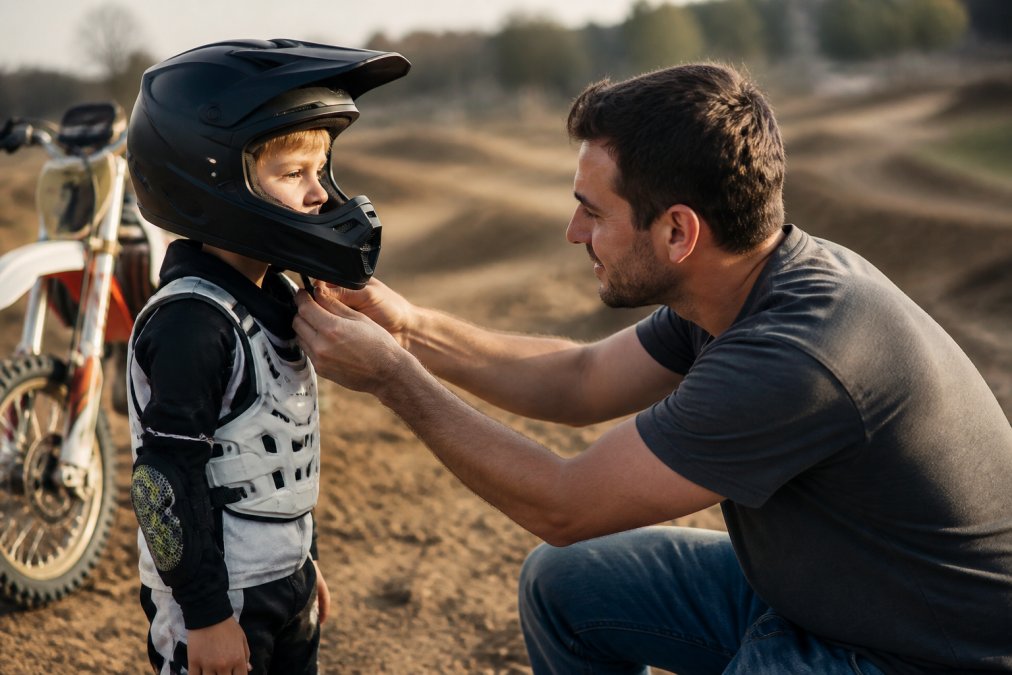
Fit matters as much as certification. A helmet should feel snug but not painfully tight, with one finger fitting between the cheek pad and your child's cheek. Replace helmets every five years or immediately after any significant impact. Budget $150-$400 for a quality youth motocross helmet from brands like Bell, Fox, and Shoei.
Protective Gear Checklist: Chest Protectors, Boots, and Goggles
A chest protector shields ribs, collarbone, and shoulders from impact. Look for protectors with foam padding and hard plastic shells that distribute impact force.
Motocross-specific riding boots protect ankles, which absorb tremendous force during jumping and cornering. Proper moto boots have reinforced ankle cups, shift pads on the inner leg, and oil-resistant soles.
Goggles protect eyes from roost, UV rays, and flying insects. Choose goggles with anti-scratch, anti-fog coatings and UV protection.
Complete protective gear checklist:
- DOT or Snell-certified helmet
- Chest protector with roost deflector
- Motocross-specific riding boots
- Goggles with UV protection
- Gloves with reinforced palms and knuckle protection
- Long-sleeve jersey
- Riding pants with knee protection
- Neck brace (optional but increasingly recommended)
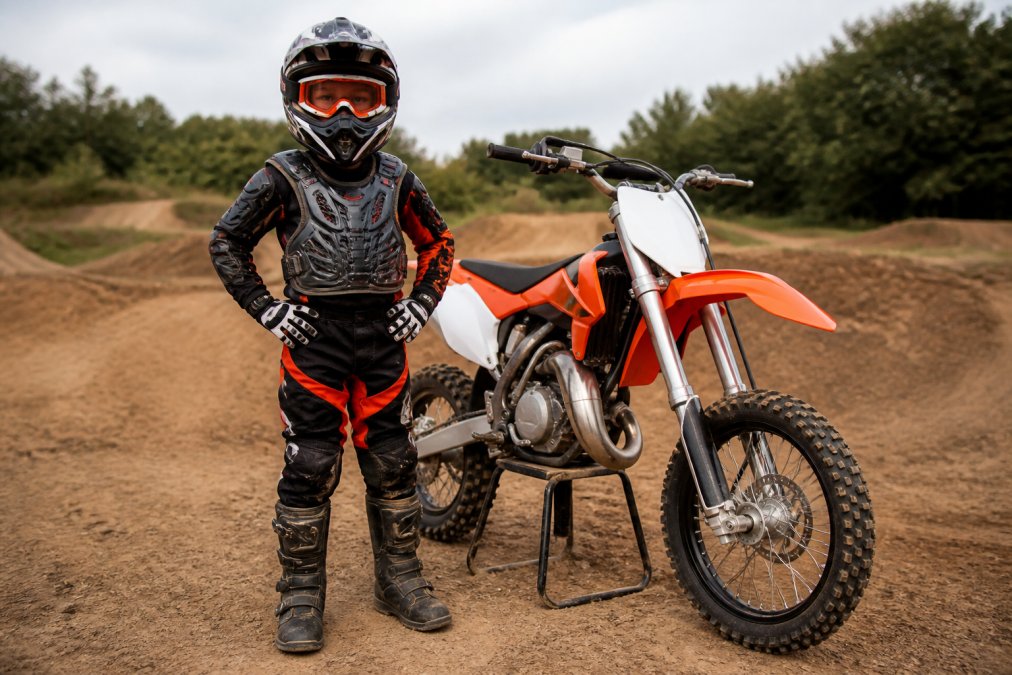
Total gear investment ranges from $400-$800 for a beginner setup, scaling up to $1,200-$1,800 for premium equipment. Budget for annual upgrades as your child grows.
Motocross Training for Beginners Kids: Getting Started Right
Proper instruction accelerates skill development and builds confidence faster than trial-and-error learning. A qualified coach teaches body positioning, throttle control, clutch management, and mental techniques that transform a nervous beginner into a capable rider.
Finding Local Tracks, Motocross Schools, and Practice Facilities
Most areas have multiple options for youth rider training, from open practice days at local tracks to structured motocross schools. Research local tracks through the AMA website, which maintains a directory of sanctioned facilities. Call ahead to ask about beginner programs and coaching availability. Track fees vary widely by region; expect to pay $30-$75 for a single practice day or $200-$500 for a weekend school program.
Mental Preparation and Building Rider Confidence
Fear and self-doubt limit young riders more than physical ability. Start with achievable goals that build progressively. Early goals might be "ride smoothly for 10 minutes without stalling" or "complete three laps without falling." Celebrate small wins enthusiastically, as these build momentum and positive associations with riding.
Visualization is a powerful tool often overlooked by young riders. Have your child close their eyes and mentally ride a section of track, imagining smooth throttle inputs, proper body positioning, and successful jumps. Spend five minutes before practice sessions visualizing success.
Nelmgerian MX's rider training journals help young riders track progress, set goals, and build confidence through structured reflection. These journals encourage riders to document what they learned each session, challenges they overcame, and skills they want to develop.
Cost of Youth Motocross Racing: Budget Breakdown and Planning
Understanding the true cost of youth motocross helps families plan realistically. A realistic first-year budget ranges from $3,000-$7,000 depending on how frequently your child races.
Race Entry Fees, Memberships, and AMA Licensing
Organized racing requires sanctioning through the American Motorcyclist Association (AMA). AMA membership costs roughly $100-$150 annually and provides insurance, access to sanctioned events, and eligibility for national championships.
Individual race entry fees typically range from $40-$100 per moto. Youth riders often race multiple motos in a single day, bringing daily race costs to $120-$300. Track membership programs offer discounts for frequent users, with season passes typically costing $300-$600.
Transportation and Paddock Logistics
Motocross requires a vehicle capable of towing an enclosed trailer (most youth setups require a 16-20 foot trailer costing $3,000-$8,000 to purchase or $50-$100 per day to rent). Expect 8-12 MPG when towing. Track days require full-day commitments with early arrival. Families attending 8-12 events annually typically budget $2,000-$3,500 for transportation and logistics.
Bike Maintenance and Race Day Preparation for Young Riders
Regular maintenance keeps bikes reliable and extends component lifespan. Young riders should participate in maintenance, learning to care for their equipment builds responsibility and mechanical understanding.
Basic Maintenance: Air Filter, Tire Pressure, and Suspension Setup
The air filter is the most frequently serviced component and directly affects engine performance. Check the air filter before every practice session and race day. Most filters need cleaning every 1-2 practice days and replacement every 3-4 weeks during active riding seasons.
Tire pressure dramatically affects handling, traction, and crash risk. Check tire pressure before every ride using a quality pressure gauge. Most youth bikes run 12-18 PSI front and 14-20 PSI rear, but consult your bike's manual for exact specifications.
Additional maintenance tasks include checking and tightening all bolts weekly, inspecting the chain for proper tension and lubrication, changing oil every 10-20 hours of riding, replacing spark plugs annually, and inspecting brake pads and rotors for wear.
Scrutineering and Pre-Race Checklist
Scrutineering is the official pre-race inspection where track officials verify that bikes meet safety and class specifications. Create a checklist and complete it the night before racing:
- Verify tire pressure and tread condition
- Test front and rear brakes for proper function
- Check all bolts are tight
- Inspect chain tension and lubrication
- Ensure all protective guards are secure
- Verify fuel level and check for leaks
- Test throttle for smooth, responsive action
- Check clutch engagement (if applicable)
- Inspect air filter condition
- Confirm bike number plates are secure and visible
Common Mistakes to Avoid When Starting Kids in Motocross Racing
Buying a bike that's too large is the most common mistake. Parents assume their child will "grow into" an oversized machine, but oversized bikes create fear, poor technique, and frustration. Start smaller and upgrade as your child grows.
Skipping proper instruction is equally damaging. A few sessions with a qualified coach prevent bad habits from forming and accelerate skill development dramatically. Underestimating the time commitment surprises many families, motocross requires regular practice to build skills. Families who commit to 2-3 practice days per week see rapid improvement.
Neglecting mental preparation limits young riders unnecessarily. Children who work on mental skills, confidence-building, goal-setting, and visualization consistently outperform those focusing only on physical technique.
Injury Prevention and Recovery for Young Motocross Athletes
Motocross carries inherent injury risk, but proper preparation, technique, and recovery protocols minimize serious injuries. Young riders are particularly vulnerable to growth plate injuries, making injury prevention critical.
Physical conditioning before the season starts builds strength, endurance, and injury resilience. Off-season training should focus on core strength, leg strength, and cardiovascular endurance. Young riders should complete 2-3 conditioning sessions weekly during off-season months.
Proper technique prevents many injuries. Recovery protocols prevent cumulative injury, after riding, ice any areas that feel sore or swollen for 15-20 minutes. Stretching after rides maintains flexibility. Ensure adequate sleep, young riders need 8-10 hours nightly for recovery and growth. Watch for overuse injuries, particularly in the shoulders, elbows, wrists, and knees. If your child complains of persistent pain, reduce riding volume and see a sports medicine doctor.
Starting your child in motocross is an exciting journey that builds confidence, discipline, and lifelong skills. The path from first ride to race day involves selecting appropriate equipment, finding quality instruction, understanding costs, and preparing mentally and physically. Nelmgerian MX supports families throughout this journey with rider training journals that track progress, build confidence, and keep young riders engaged with the sport. Our journals help young riders set goals, document improvements, and develop the mental resilience that separates average riders from exceptional ones. Whether your child is just discovering motocross or preparing for their first race, Nelmgerian MX provides the tools to build confidence and passion both on and off the track.
Frequently Asked Questions
What age can a child start motocross racing?
Children can begin motocross training as early as age 3-4 on small 50cc bikes with proper instruction and safety gear. Most youth classes start at age 4-5, with displacement and class divisions based on age and height. Younger riders benefit from beginner training programs that focus on balance, throttle control, and body positioning before racing competitively. Always ensure your child has appropriate protective gear and professional instruction regardless of age.
How much does it cost to start a kid in motocross racing?
The cost of youth motocross racing varies significantly based on bike choice, gear, and race frequency. Initial startup costs include a youth dirt bike, protective gear (helmet, chest protector, boots, goggles), and training. Ongoing expenses involve race entry fees, AMA memberships, fuel, maintenance, and transportation to tracks and paddock facilities. For specific pricing on training journals, storybooks, and educational resources, visit Nelmgerian MX's website for current quotes and bundle options.
What protective gear do kids need for dirt bike racing?
Essential kids dirt bike racing gear includes a DOT or Snell-certified helmet, goggles, chest protector, riding boots, gloves, and protective jersey. Helmet certification is critical for safety, look for DOT or Snell standards. A chest protector shields vital organs during falls. Riding boots provide ankle support and protection, while goggles protect eyes from dust and debris. Quality protective gear reduces injury risk significantly and is required at most tracks and racing events.
How do I find motocross training for beginners kids near me?
Start by searching for local motocross schools, track day facilities, and youth classes in your area. Many tracks offer beginner training programs and practice sessions. Contact your local AMA chapter for recommendations on certified coaches and training facilities. Look for programs that emphasize proper riding technique, body positioning, clutch control, and track etiquette. Consider resources like training journals and educational materials to reinforce skills learned at the track and build confidence between sessions.
This article was written using GrandRanker