 ultimate-guide
How to Transport a Dirt Bike Safely
Table of Contents
- Transport Methods for Dirt Bikes
- Loading a Dirt Bike Into a Truck
- Best Dirt Bike Tie-Down Straps and Securing Methods
- Using a Dirt Bike Hitch Carrier
- Safety Tips and Vehicle Compatibility
- Long-Distance vs. Short-Distance Transport
- Common Mistakes to Avoid
- Conclusion
Last Updated: August 27, 2026
Transport Methods for Dirt Bikes
Getting your dirt bike from point A to point B safely depends on your vehicle, distance, and budget. You have several options, each with real trade-offs that affect bike condition and peace of mind.
Pickup Truck Bed Transport
A pickup truck bed is the most accessible method for most riders. Check your truck's payload capacity on the door placard or owner's manual. A full-size pickup typically handles 1,500 to 3,000 pounds, easily accommodating a dirt bike (200 to 300 pounds) plus a loading ramp and padding (nhtsa.dot.gov). The real issue is suspension compression, when you load weight into the truck bed, the rear suspension compresses, changing handling and ride height on long-distance hauls.
Load the bike as far forward as possible, closer to the cab, to distribute weight toward the truck's center and reduce stress on the rear suspension. Protect the truck bed floor with plywood, foam padding, or rubber mats to cushion the bike and prevent vibration damage.
Utility and Enclosed Trailers
A utility trailer (open-bed, 4x8 or 5x10 feet) gives you dedicated cargo space at lower cost than an enclosed option. Weight capacity ranges from 1,200 to 3,000 pounds, easily handling one or two dirt bikes. Your truck's suspension doesn't compress because weight sits on the trailer's own axles. The downside: your bike is exposed to weather, road salt, and debris.
Enclosed trailers solve this completely. Your bike travels in a weatherproof box, protected from rain, salt spray, and wind. A 5x8 or 6x10 enclosed trailer gives space for gear and tools alongside your bike. The trade-off: enclosed trailers are heavier, with tongue weight running 300 to 500 pounds. Verify your vehicle's towing capacity in the owner's manual before committing.
Both trailer types require a receiver hitch on your vehicle. A Class II receiver handles most utility trailers; Class III or IV is needed for heavier enclosed trailers.
Hitch-Mounted Carriers
A hitch-mounted carrier bolts directly to your receiver hitch, extending behind your vehicle like a platform or basket. Platform carriers hold the bike upright and are more stable; hanging carriers suspend the bike from the frame but stress the frame during transport.
The appeal: simplicity, no towing, minimal setup, and visibility to monitor the bike while driving. The catch: your receiver hitch has a weight limit. Most Class II hitches are rated for 200 to 300 pounds of cargo (sae.org). A dirt bike with platform carrier might weigh 250 to 350 pounds. Check your hitch rating before buying. Hitch carriers also change aerodynamics and weight distribution, affecting braking distance and handling on long highway drives. Security is another concern, the bike is visible and accessible from behind, making it an easy theft target.
Loading a Dirt Bike Into a Truck
Loading safely requires the right technique and equipment. A single mistake can damage the bike or create a safety hazard.
Using a Loading Ramp
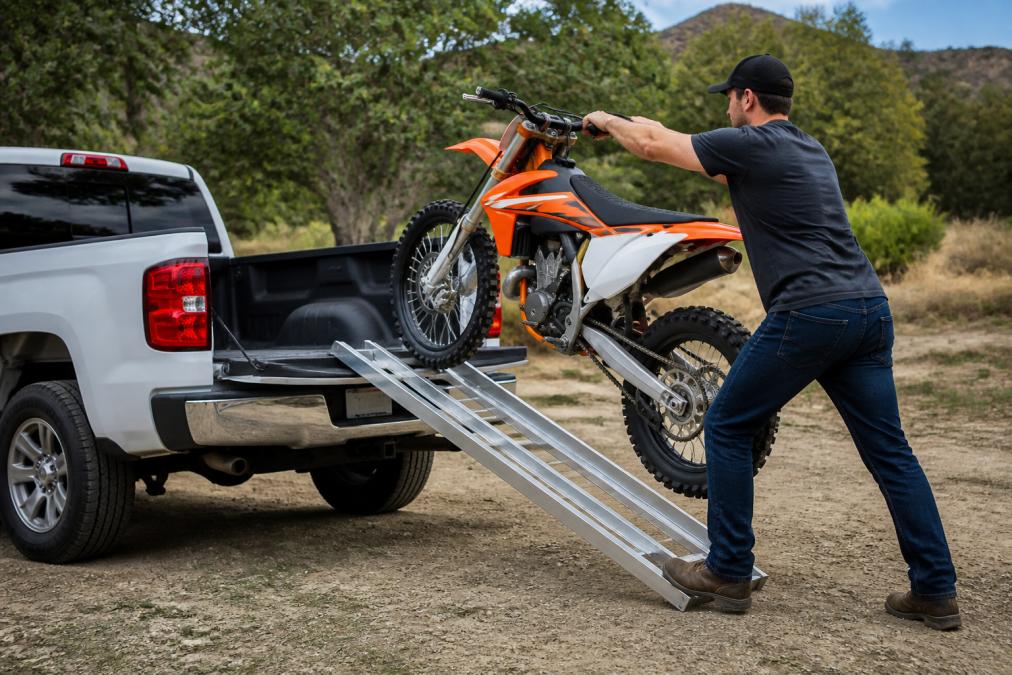
A loading ramp is essential. Aluminum or steel ramps range from 6 to 8 feet long. A 6-foot ramp creates a steep angle (25 to 30 degrees); an 8-foot ramp creates a gentler angle (around 20 degrees), making it easier to push the bike up without tipping (peer-reviewed research).
The ramp surface must have grip. Bare aluminum is slippery, especially when wet or muddy. Add grip tape, rubber strips, or textured coating to prevent tire sliding. Start the bike's engine before loading, a running bike is easier to control with throttle and engine braking. Position yourself behind the bike with feet planted firmly. Push steadily and smoothly; jerky movements cause the front wheel to bounce or handlebars to swing. Keep the bike pointed straight up the ramp. Once the front wheel reaches the truck bed, keep pushing through until the entire bike is in the bed.
If uncomfortable pushing a running bike, use a come-along winch or hand-crank winch mounted to the truck's front. Thread a strap through the handlebars or frame, attach to the winch, and crank slowly for complete control.
Positioning and Weight Distribution
Position the bike as far forward as possible, within a few feet of the truck cab, to keep weight closer to the truck's center of gravity and reduce stress on the rear suspension. The bike should sit upright, not leaning. Use a motorcycle stand or wheel chocks to keep it vertical.
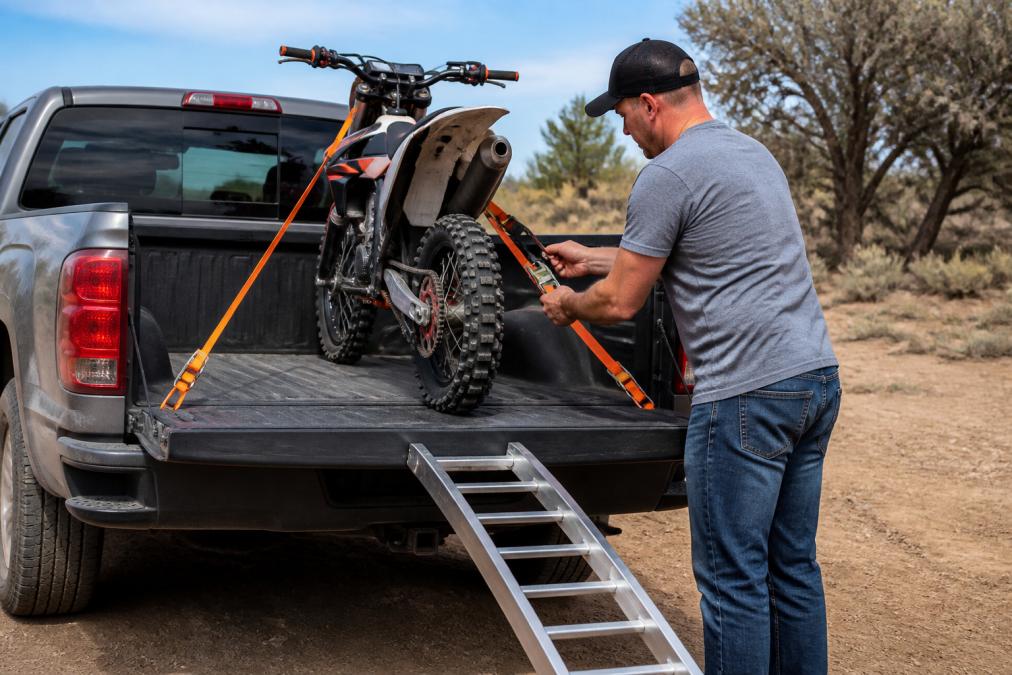
Secure the bike with tie-downs at multiple points, at least four: two at the handlebars (front) and two at the rear frame or swingarm. Set the fuel petcock to "off" or "reserve," not "on," to prevent fuel leakage from carburetor overflow tubes during transport. Check that nothing on the bike extends beyond the truck bed's sides and tuck handlebars and fold in the kickstand before securing.
Best Dirt Bike Tie-Down Straps and Securing Methods
How you secure your dirt bike determines whether it arrives in perfect condition or damaged. Poor tie-down technique causes more transport damage than any other factor.
Ratchet Straps vs. Soft-Loop Tie-Downs
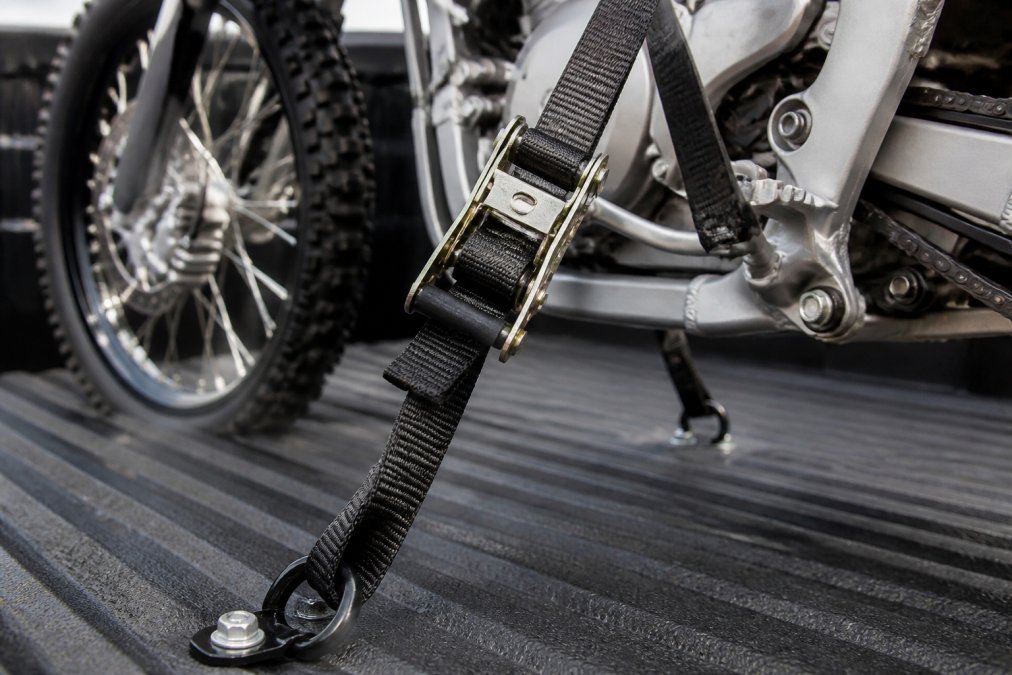
Ratchet straps are the standard choice. They feature a metal ratcheting mechanism that tightens with mechanical advantage. You pull the strap tight, flip the ratchet handle to lock it. Ratchet straps hold extremely tight and won't loosen during transport.
Soft-loop tie-downs solve the damage problem. These straps have padded loops on each end that distribute pressure and prevent damage to paint and plastic. The best approach combines both: use ratchet straps for main securing points (frame and swingarm) where straps contact bare metal, and soft-loop straps at handlebars where plastic and paint need protection. Buy straps rated for at least 1,500 pounds of breaking strength.
Proper Strapping Technique
Thread a strap through the handlebars or around fork tubes, never just around the handlebars themselves, which can twist or break under tension. Attach the other end to the truck bed's tie-down point on the same side and tighten firmly but not excessively.
Repeat on the opposite side with a second strap. Next, secure the rear by routing a strap around the frame's rear loop or swingarm, never around the seat or rear fender. Attach to a tie-down point on the truck bed's side. Add a fourth strap on the opposite rear side.
Check each strap's tightness by hand. A properly tightened strap should not move when pushed firmly. The bike itself should not shift more than an inch in any direction. For long-distance transport, check straps after the first 50 miles and every 100 to 150 miles thereafter.
Using a Dirt Bike Hitch Carrier
Verify your vehicle's receiver hitch is rated for the carrier's weight. Most hitch carriers weigh 50 to 100 pounds empty, plus another 200 to 300 pounds when loaded with a dirt bike. Your hitch rating must exceed this total.
Install the carrier according to manufacturer's instructions. Most carriers slide into the receiver and are secured with a pin or bolt. Load the bike carefully and position it centered on the carrier. Secure with at least two straps, one at the handlebars and one at the rear frame. The bike should sit upright and centered.
Adjust your driving. A loaded hitch carrier changes how your vehicle handles. The added weight behind the rear axle affects braking distance and cornering. Accelerate, decelerate, and brake more gradually than normal. Monitor the carrier and bike in your mirrors frequently. If the bike shifts or the carrier bounces, pull over immediately and check the straps. For long trips, consider using a trailer instead. Hitch carriers work well for weekend trips under 100 miles.
Safety Tips and Vehicle Compatibility
Payload Capacity and Tongue Weight
Your vehicle's payload capacity is the maximum weight it can carry in the bed or cargo area. Find it in the owner's manual or on the door placard. Subtract the weight of any permanent cargo to determine available payload for your dirt bike and transport equipment.
Tongue weight applies to trailers. It's the downward force the trailer's tongue exerts on your hitch. Tongue weight should be 10 to 15 percent of the trailer's total weight. Too little and the trailer can sway; too much and your truck's rear suspension compresses excessively. Verify your vehicle's towing capacity, the maximum weight it can safely tow, including the trailer and all cargo inside it.
Suspension Protection During Transport
A dirt bike's suspension is designed for track impacts, not constant highway vibration. Before loading, set suspension to a slightly softer setting if your bike has adjustable compression damping. Use padding under the bike in the truck bed, plywood and foam create a shock-absorbing layer that reduces vibration transmission.
On very long trips (over 8 hours), consider using a trailer instead of a truck bed. After arriving, inspect the suspension for visible damage or leaking fluid and bounce it gently to ensure smooth movement.
Insurance and Liability
Transporting a dirt bike creates liability exposure. If the bike falls off your vehicle or trailer and damages another vehicle or property, you're liable. Check your vehicle's insurance policy to understand what's covered during transport. Many policies cover the bike during transport as part of auto coverage, but some require a separate rider. Call your insurance agent before your first transport trip.
Long-Distance vs. Short-Distance Transport
Short-distance transport (under 100 miles, one to two hours) is straightforward. A pickup truck with proper tie-downs works fine. A hitch carrier is quick and convenient. Weather exposure is minimal and suspension stress is limited.
Long-distance transport (over 200 miles, 4+ hours) requires more consideration. Weather exposure becomes real, a bike sitting uncovered in a truck bed for 6 hours collects dust, road salt, and moisture. Suspension stress accumulates and tire pressure can change due to temperature fluctuations. For long-distance hauling, an enclosed trailer is worth the cost. It protects the bike completely and isolates it from road vibration.
Mid-range transport (100 to 200 miles) is the gray zone. A truck bed works if weather is clear. A hitch carrier is acceptable if your vehicle is rated for the weight. A utility trailer offers good protection without the cost of an enclosed trailer. Consider the season, winter transport exposes the bike to salt spray and moisture, accelerating corrosion. Summer brings heat and UV exposure.
Common Mistakes to Avoid
Overloading the truck bed. Exceeding payload capacity stresses the suspension and changes handling unpredictably. Check the placard.
Using a single tie-down strap. One strap can't secure a bike safely. Use at least four straps, two at the front and two at the rear.
Loading the bike too far back in the truck bed. A bike near the tailgate puts all weight on the rear suspension, compressing it excessively. Load forward, closer to the cab.
Forgetting to turn off the fuel petcock. Fuel leaks from carburetor overflow tubes during transport. Always switch to "off" or "reserve."
Strapping the handlebars directly. Handlebars can break under strap pressure. Strap through the fork tubes or around the fork itself.
Neglecting to check straps during long trips. Vibration loosens straps over time. Stop every 100 miles and re-tighten.
Transporting in extreme heat without ventilation. In an enclosed trailer on a hot day, temperature can exceed 120 degrees, damaging fuel lines, melting plastic, and stressing the engine. Ensure ventilation or transport during cooler hours.
Using damaged or frayed straps. Old straps can break under stress. Inspect before each trip and replace worn straps.
Ignoring hitch weight limits. A hitch carrier exceeding your hitch's rating will fail, potentially dropping your bike on the road. Know your hitch rating and respect it.
Leaving the kickstand down. A kickstand can catch on obstacles while loading or unloading. Fold it in before securing the bike.
Transporting a dirt bike safely combines the right equipment, proper technique, and attention to detail. Whether using a pickup truck, trailer, or hitch carrier, secure the bike at multiple points, protect the suspension from excessive stress, and verify that your vehicle is rated for the load.
Safe transport ensures the bike arrives ready to ride and the experience is stress-free.
| Transport Method | Best For | Setup Time | Weather Protection | Cost |
|---|---|---|---|---|
| Pickup Truck Bed | Short trips, weekend use | 10-15 minutes | Minimal | Low |
| Utility Trailer | Single or dual bikes, moderate distance | 20-30 minutes | Moderate | Medium |
| Enclosed Trailer | Long-distance, maximum protection | 20-30 minutes | Excellent | High |
| Hitch Carrier | Quick, single-bike transport | 5-10 minutes | Minimal | Medium |
For more information on preparing young riders for transport and track days, visit Nelmgerian MX and explore our rider training journals and motocross storybooks designed to build confidence and knowledge between practice sessions.
Frequently Asked Questions
Q: What is the best way to transport a dirt bike?
A: The best method depends on your vehicle and distance. A pickup truck with a loading ramp and tie-down straps works well for short trips. For longer distances or multiple bikes, an enclosed trailer offers better weather protection and security. Hitch carriers are convenient for single bikes and fit most vehicles. Choose based on your payload capacity, the bike's value, and how often you transport.
Q: How do I secure a dirt bike with tie-downs?
A: Use ratchet straps or soft-loop tie-downs rated for your bike's weight. Attach straps to the frame (never the handlebars or suspension) and secure them to fixed tie-down points on the truck bed or trailer. Tighten evenly on both sides to prevent tilting. The bike should have minimal movement when you push on it. Check straps every 50 miles on long trips, as vibration can loosen them.
Q: Do I need a ramp to load a dirt bike?
A: A ramp makes loading safer and easier, especially for heavier bikes or less experienced riders. A 7-9 foot aluminum or steel ramp works for most pickup trucks. Without a ramp, you risk dropping the bike or injuring yourself. If you transport frequently, a ramp is a worthwhile investment. Some trailers have built-in ramps, eliminating the need for a separate one.
Q: Can you lay a dirt bike down for transport?
A: Laying a dirt bike on its side is not recommended. It can damage the engine, fuel system, and plastics, and complicates securing it safely. Always transport upright using proper tie-downs. The only exception is if your bike is damaged and cannot stand upright, in which case use extra padding and secure it very carefully to prevent further damage.
This article was written using GrandRanker