 comparison
Motocross vs Enduro for Young Beginner Riders
Table of Contents
- Motocross vs Enduro: Key Differences for Young Riders
- Engine Characteristics and Power Delivery
- Suspension Setup and Handling Differences
- Best Dirt Bike for 10 Year Old Beginner Riders
- Dirt Bike Safety Gear for Children
- Youth Dirt Bike Sizing Guide
- Choosing the Right Bike for Your Young Rider
- Frequently Asked Questions
Last Updated: August 6, 2026
Motocross vs Enduro: Key Differences for Young Riders
Choosing between a motocross and enduro bike for your young rider can feel overwhelming. Both are off-road machines, but they're built for fundamentally different purposes, and that difference shapes everything from how they handle to how much maintenance they'll need. At Nelmgerian MX, we work with families navigating this exact decision, and the answer depends less on which bike is "better" and more on what your child will actually be doing with it.
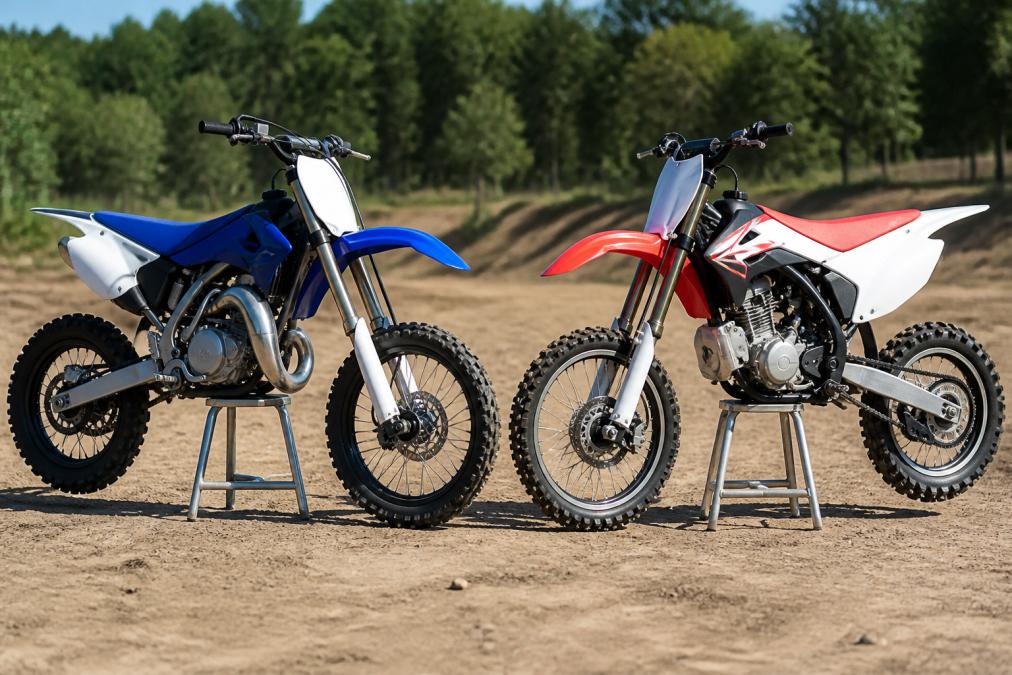
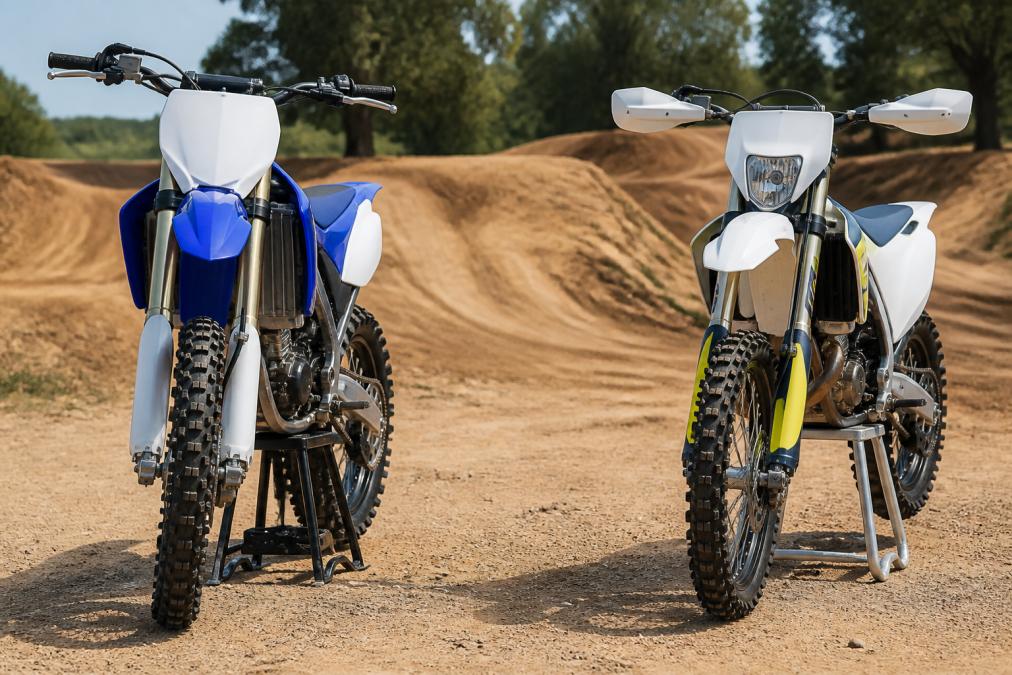
Motocross bikes are purpose-built for closed-course racing on manicured tracks with jumps, berms, and tight corners. They're aggressive machines designed to deliver power quickly and handle high-speed directional changes. Enduro bikes, by contrast, are built for long-distance trail riding across varied terrain, rocks, logs, stream crossings, elevation changes. They prioritize durability, fuel range, and the ability to handle anything nature throws at them.
For a 10-year-old beginner, this distinction matters enormously. A motocross bike will feel twitchy and demanding on a trail. An enduro bike will feel sluggish and overbuilt on a track. Understanding where your child will spend most of their time is the first step toward making the right choice.
Engine Characteristics and Power Delivery
The engine is where the two philosophies diverge most sharply. Motocross bikes typically run high-revving two-stroke or four-stroke engines designed to hit peak power at higher RPMs. This creates a sharp, responsive throttle feel that rewards aggressive riding. A beginner on a motocross bike needs to learn how to manage that snappy power delivery.
Enduro bikes, by contrast, favor lower-end torque and a broader powerband. A two-stroke enduro engine develops usable power across a wider RPM range, making it more forgiving for inconsistent throttle input. This is why enduro bikes feel more approachable for young or less experienced riders, you don't need perfect throttle control to move forward smoothly.
For young beginners, this difference is significant. A four-stroke motocross bike with an adjustable throttle limiter (like the Honda CRF50F with its controllable throttle stop) bridges the gap, but even then, the engine's character is performance-first. An enduro bike's broader powerband and lower seat height make it more naturally suited to a child who's still learning basic throttle modulation and body positioning.
The fuel requirements differ too. Motocross bikes typically run on standard unleaded fuel. Many enduro bikes, especially two-stroke models, require premixed fuel (oil and gasoline combined). For parents, this means extra steps in preparation, something worth factoring in if convenience matters.
Suspension Setup and Handling Differences
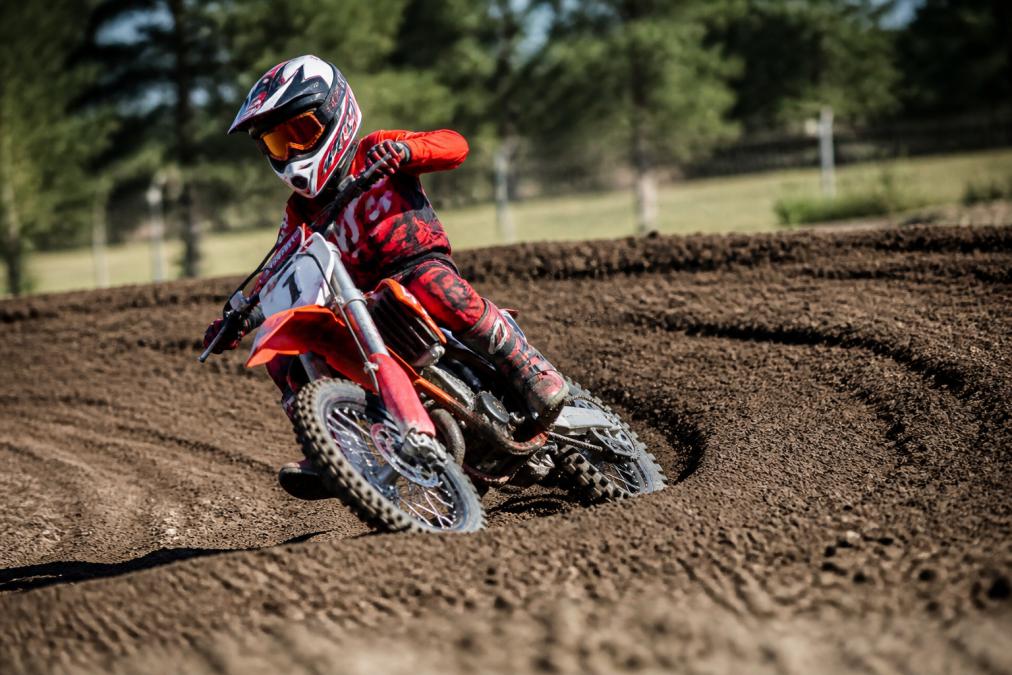
Motocross suspension is tuned for speed and precision. Forks are typically shorter-travel (meaning less vertical movement), with stiffer springs and damping designed to keep the bike responsive and planted through quick direction changes. The chassis geometry is aggressive, steep fork angles and compact wheelbase make the bike nimble and eager to turn.
Enduro suspension is built for absorption and compliance. Longer-travel forks and rear shocks soak up rocks, roots, and ruts without throwing the rider off balance. The geometry is more relaxed, with a slacker fork angle and longer wheelbase that prioritizes stability over agility. This makes enduro bikes feel planted and predictable across unpredictable terrain.
For a young beginner, this distinction affects how the bike feels day one. A motocross bike requires more active rider input, you're steering with intention, managing weight shifts, and making deliberate throttle adjustments. An enduro bike is more forgiving. It absorbs mistakes and terrain changes without punishing the rider.
The handling characteristics also influence confidence. A child who's still building muscle memory will feel more secure on an enduro bike's stable, predictable platform. A motocross bike rewards precision but punishes sloppiness, which can be discouraging for someone still learning the fundamentals.
Best Dirt Bike for 10 Year Old Beginner Riders
At age 10, most young riders fall into the intermediate beginner category, they've spent some time on smaller bikes and are ready for something with more capability. The best choice depends on what they'll be doing, but several bikes stand out for this age group.
The Honda CRF50F remains one of the most versatile entry-level options. Its automatic clutch eliminates the learning curve of manual shifting, and the adjustable throttle limiter lets parents control speed as their child develops skills. At 21.6 inches seat height, it fits most 10-year-olds without requiring a boost. The four-stroke engine is forgiving and reliable, and the low maintenance demands make it practical for families new to dirt biking.
The Kawasaki KLX110R L is the next step up. With a 112cc four-stroke engine and optional manual clutch, it bridges the gap between beginner bikes and more serious machines. The electric start is a quality-of-life improvement over kickstarting, and the longer-travel suspension handles rougher terrain better than the CRF50F. At 28.7 inches seat height, it suits taller 10-year-olds or those with room to grow.
For families committed to motocross specifically, the KTM 50 SX Mini is the performance choice. Its liquid-cooled two-stroke engine and adjustable automatic clutch deliver responsive power, while WP suspension and hydraulic disc brakes give it genuine track capability. The trade-off is price, it costs significantly more than recreational alternatives, and maintenance demands are higher.
The Yamaha PW50 remains unbeatable for the absolute youngest beginners. Its fully automatic transmission and ultra-low 18.7-inch seat height make it nearly impossible to stall, and the shaft drive requires minimal maintenance. For a 5-7 year old just starting out, it's the easiest entry point into dirt biking.
The right choice depends on your child's size, experience level, and intended use. A 10-year-old who's been riding for a year and wants to explore trails? The KLX110R L. A 10-year-old with competitive aspirations? The KTM 50 SX Mini. A 10-year-old just starting out? The CRF50F hits the sweet spot of capability, affordability, and forgiving power delivery.
Dirt Bike Safety Gear for Children
Safety gear is non-negotiable, and it needs to fit properly. Oversized gear shifts during crashes and leaves gaps where impact happens. Undersized gear restricts movement and discourages your child from riding.
Helmet is first priority. A youth motocross helmet should have DOT or Snell certification, a proper fit (snug but not painful), and good ventilation to prevent overheating during rides. Brands like Bell, Fox, and Shoei make youth-specific models.
Chest protector and roost guard protect the ribs and collarbone from impact and roost (flying dirt and rocks kicked up by other riders). Youth-sized options from brands like EVS and Alpinestars fit properly and won't slip during riding.
Goggles are essential for visibility and eye protection. Youth goggles should fit under the helmet without pressure points and offer good peripheral vision. Look for models with tear-off lenses for easy visibility maintenance during rides.
Gloves protect hands during falls and improve grip in wet conditions. Youth motocross gloves from Fox, Alpinestars, or Thor are designed for smaller hands.
Boots need to support the ankle and provide grip on foot pegs. Proper dirt bike boots (not street motorcycle boots) have reinforced heel cups and ankle support. Youth sizes are available from most major brands.
This is an investment worth making, proper gear prevents serious injuries and builds confidence.
Youth Dirt Bike Sizing Guide
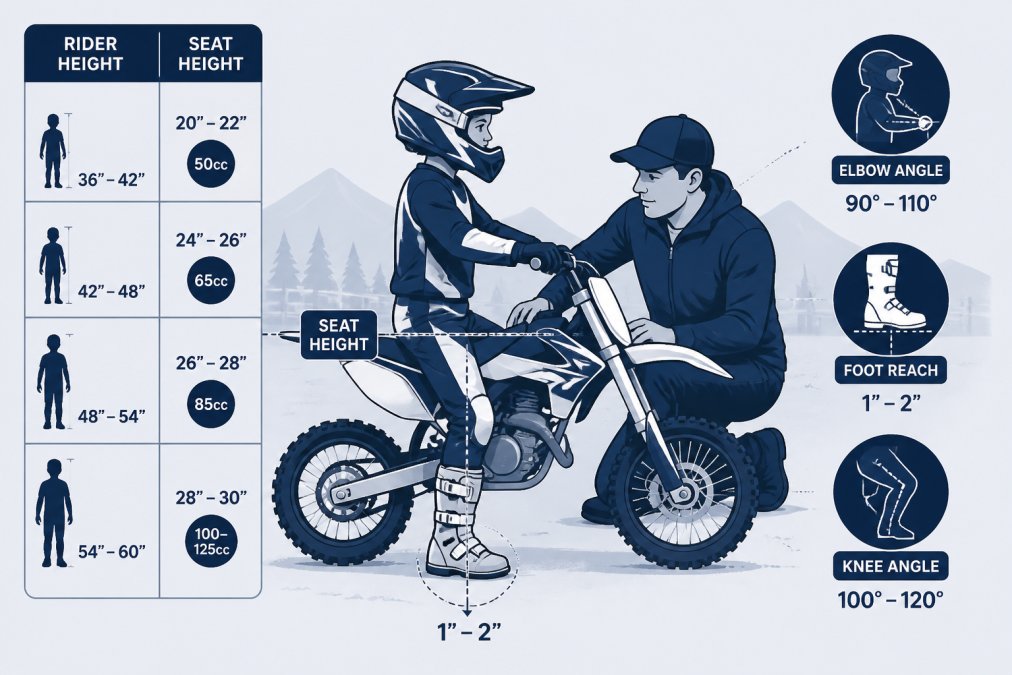
Proper sizing is critical for safety and confidence. A bike that's too large forces your child to stretch and compromises control. A bike that's too small will be outgrown quickly and may feel unstable.
Seat height is the primary measurement. Your child should sit on the bike with both feet nearly flat on the ground, ideally with just the toes touching. This allows them to plant their feet firmly when stopped and maintain balance during slow-speed maneuvers. If they're on their tiptoes, the bike is too tall. If their legs are bent significantly, it's too short.
Inseam measurement is the most reliable predictor. Have your child stand in bare feet with legs slightly apart, and measure from the crotch to the floor. Compare this to the bike's seat height specifications. Most manufacturers list seat height for their models.
Reach to handlebars matters too. Your child should be able to grip the bars without fully extending their arms. A slight bend in the elbows is ideal. If they're reaching or stretching, the geometry is wrong.
Weight capacity is often overlooked. Dirt bikes have minimum and maximum rider weight recommendations. A child who's undersized for the bike may not have enough mass to compress the suspension properly, affecting handling and comfort.
At age 10, most children fit bikes in the 110cc range with 26-28 inch seat heights. However, individual variation is significant, a tall, athletic 10-year-old might be ready for a 150cc bike, while a smaller child might do better on a 110cc with a lower seat.
Plan for growth. A bike your child will outgrow in two years is cheaper than one they can't ride safely for five. However, oversizing for growth is a common mistake that makes learning harder and less enjoyable.
Choosing the Right Bike for Your Young Rider
The decision ultimately comes down to three factors: intended use, physical size, and learning goals.
For trail riding and exploration, an enduro-oriented bike like the Kawasaki KLX110R L makes sense. Its suspension handles rough terrain, the broader powerband is forgiving, and the longer fuel range lets your child explore without constant refueling. Trail riding builds foundational skills in a less demanding environment.
For motocross racing or track riding, a purpose-built motocross bike like the KTM 50 SX Mini is the right choice. Yes, it costs more and requires more maintenance, but it's designed for the environment where your child will be riding. The responsive power delivery and track-focused suspension teach the skills needed for competitive riding.
For versatility and ease of use, the Honda CRF50F remains the best all-around beginner choice. It handles both tracks and trails adequately, the automatic clutch removes a learning variable, and the low maintenance demands make it practical for families new to the sport.
Consider also the long-term commitment. Motocross requires access to closed courses, which often means membership fees or track rental costs. Trail riding can happen on public land with proper permits. The bike you choose should align with where your family will actually ride.
Nelmgerian MX helps families think through this decision by connecting young riders with resources that build confidence both on and off the track. Our rider training journals help young riders track their progress and set goals, while our storybooks and educational materials keep kids engaged with the sport year-round. The right bike is just the beginning, building a young rider's passion and knowledge is what sustains their growth in motocross.
| Bike Model | Engine Type | Seat Height | Best For | Key Strength |
|---|---|---|---|---|
| Yamaha PW50 | 49cc two-stroke | 18.7" | Ages 5-7, absolute beginners | Fully automatic, easiest to learn |
| Honda CRF50F | 49cc four-stroke | 21.6" | Ages 7-10, trail/beginner | Automatic clutch, throttle limiter, versatile |
| Kawasaki KLX110R L | 112cc four-stroke | 28.7" | Ages 9-12, trail-focused | Manual clutch option, electric start, durable |
| KTM 50 SX Mini | 49cc two-stroke | Variable | Ages 4-10, motocross-focused | Performance suspension, track capability |
Choosing between motocross and enduro for a young rider isn't about picking the objectively "better" bike, it's about matching the machine to your child's size, experience, and where they'll spend their time. The Honda CRF50F and Kawasaki KLX110R L remain the most practical choices for most 10-year-old beginners because they handle both environments reasonably well and don't demand advanced maintenance skills. If your child has competitive ambitions, a dedicated motocross bike like the KTM 50 SX Mini is worth the investment. Either way, pair the right bike with proper safety gear, realistic expectations about the learning curve, and resources that keep your young rider engaged. At Nelmgerian MX, we believe the best dirt bike is the one your child will actually ride, and the best young riders are those who stay connected to the sport through education, confidence-building, and community. Start with the right machine, invest in safety, and watch your child's skills and passion develop.
Frequently Asked Questions
What is the best age to start motocross or enduro riding?
Most children can begin on small-displacement bikes (49cc) between ages 4-6, starting with automatic transmission models that require no clutch operation. By age 8-10, young riders are ready for slightly larger bikes with manual clutches and more challenging terrain. Age matters less than the child's size, coordination, and interest level. Proper instruction and safety gear are essential at any age.
Is a motocross bike too aggressive for a young beginner?
Entry-level motocross bikes designed for youth (like the KTM 50 SX Mini) are engineered specifically for young beginners with manageable power delivery, adjustable clutch settings, and appropriate suspension tuning. They're not aggressive if matched to the rider's size and skill level. The key is selecting a beginner-focused motocross model rather than an adult racing bike. Enduro bikes can feel heavier and more complex for the youngest riders.
Do enduro bikes require more maintenance than motocross bikes?
Enduro bikes typically require more frequent maintenance due to their complexity, longer suspension travel, larger fuel tanks, and additional components for varied terrain demand more attention. Two-stroke enduro bikes need regular oil premixing and spark arrestor cleaning. Motocross bikes, especially four-stroke models, have simpler maintenance schedules. For young riders, this means parents should factor in maintenance time and cost when choosing between the two types.
What makes motocross vs enduro bikes different for young riders?
Motocross bikes are built for closed-course racing with aggressive suspension, lightweight frames, and high-revving engines designed for short bursts of power. Enduro bikes prioritize durability and range with longer suspension travel, larger fuel capacity, and more manageable throttle response for extended off-road riding. For young beginners, motocross bikes offer nimble handling and easier control, while enduro bikes suit riders who want to explore varied terrain without refueling frequently.
This article was written using GrandRanker