 ultimate-guide
Motocross Training Tips for Beginners: Start Riding Smart
Table of Contents
- Motocross Training Tips for Beginners: The Complete Starting Point
- Essential Motocross Safety Equipment You Need Before Your First Ride
- Motocross Fitness Training: Building the Physical Foundation
- Motocross Technique Drills: Mastering the Fundamentals
- Motocross Training Routine for Endurance: A Step-by-Step Weekly Plan
- Track Etiquette and Safety: Riding Responsibly from Day One
- Getting Started: Your First Track Day and Beyond
- Common Mistakes Beginners Make (And How to Avoid Them)
Last Updated: August 16, 2026
Motocross Training Tips for Beginners: The Complete Starting Point
Motocross training tips for beginners form the foundation of a safe, sustainable riding journey. The riders who progress fastest aren't the ones with the most expensive bikes or natural talent, they're the ones who invest time in three specific areas before hitting the track: physical conditioning, protective equipment, and foundational technique.
This guide walks you through each area and addresses the real barriers that stop people from advancing: not knowing where to start, underestimating physical demands, and skipping safety steps.
Essential Motocross Safety Equipment You Need Before Your First Ride
You cannot ride responsibly without proper protective gear. Motocross crashes happen fast, and the difference between minor injury and serious harm often comes down to whether you wore the right equipment.
Helmet Certification and Standards
Your helmet is your most critical piece of safety equipment. In the United States, helmets must meet DOT (Department of Transportation) standards or Snell certification. For motocross riding, look for helmets certified by both DOT and Snell, or specifically marketed for off-road use.
Helmet fit is as important as certification. A loose helmet shifts during impacts, reducing protection. The proper fit means the helmet sits level on your head, with one or two fingers of space between your chin and the chin bar. When you shake your head side to side, the helmet should move with your head, not slide independently.
Replace your helmet every 3-5 years, or immediately after any significant impact.
Protective Gear Beyond the Helmet
Essential protective equipment includes:
- Riding boots: Specialized motocross boots protect ankles with reinforced support and oil-resistant soles.
- Gloves: Motocross gloves have padded palms and reinforced knuckles to prevent abrasion and fractures.
- Jersey and pants: Made from abrasion-resistant materials with padding at impact zones (elbows, shoulders, knees).
- Chest protector: Shields your ribs and sternum from impacts with handlebars and obstacles.
- Knee and elbow guards: Non-negotiable for practicing technique drills at speed.
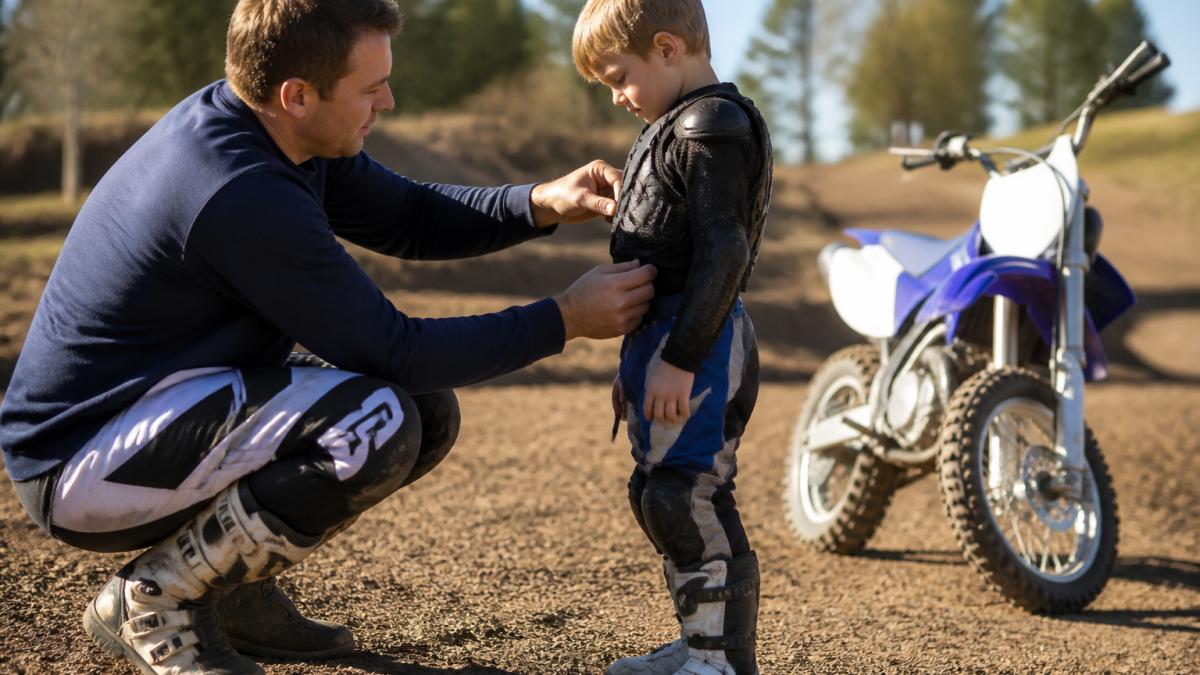
Fit matters as much as quality. Gear that's too loose shifts during impact; gear that's too tight restricts movement and causes fatigue.
Motocross Fitness Training: Building the Physical Foundation
Motocross is one of the most physically demanding sports. A 30-minute race feels like a 5-mile run at high intensity. Most beginners underestimate this demand and show up unprepared. Within 10 minutes of riding, their grip fails, their core fatigues, and their heart rate climbs beyond sustainable levels.
Physical conditioning changes this equation entirely.
Cardiovascular Endurance and Stamina
Motocross requires sustained effort at high intensity. Your cardiovascular system needs to deliver oxygen to your muscles for 20-40 minutes without dropping off.
Build this capacity through:
- Running or cycling: 3-4 sessions per week of 20-30 minute moderate-intensity cardio. Interval training mimics the intensity fluctuations of actual riding.
- Jump rope: 10-15 minute sessions improve footwork and cardiovascular conditioning simultaneously.
- Rowing machine: Combines upper and lower body work with serious cardiovascular demand.
The goal is to sustain 80-85% of your maximum heart rate for 30+ minutes. Start conservatively with 15-20 minute sessions and add 5 minutes per week until you reach 30-40 minutes. Consistency matters more than intensity at this stage.
Core Strength and Grip Power
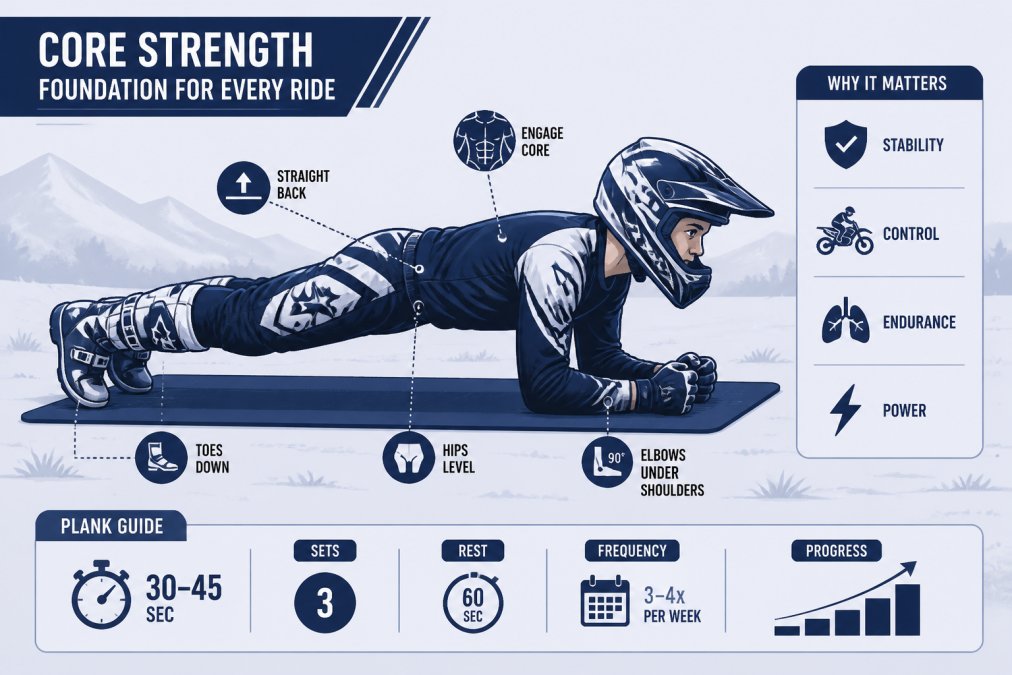
Your core stabilizes your body on the bike during cornering and acceleration. Your grip controls the bike through throttle and clutch modulation and fatigues faster than any other muscle group.
Core work should focus on functional movements:
- Planks: 3-4 sets of 30-60 second holds, 3 times per week.
- Dead bugs: Lying on your back, extend opposite arm and leg while keeping your lower back flat. 3 sets of 10 per side, 2-3 times per week.
- Bird dogs: On hands and knees, extend opposite arm and leg while bracing your core. 3 sets of 10 per side, 2-3 times per week.
- Farmer carries: Hold heavy dumbbells or kettlebells at your sides and walk 40-50 feet. 3 sets, 2-3 times per week.
Grip-specific training:
- Squeeze training: Use a hand gripper for 3 sets of 10-15 reps, 3 times per week.
- Towel hangs: Drape a towel over a pull-up bar and hang from it for as long as possible. 3 sets, 2-3 times per week.
- Wrist curls: Use light dumbbells to train wrist flexors and extensors. 3 sets of 12-15 reps, 2 times per week.
Riders with strong cores and grip endurance maintain better body positioning through fatigue and make fewer mistakes in closing minutes of a ride.
Motocross Technique Drills: Mastering the Fundamentals
Technical skill separates riders who progress from those who plateau. Technique isn't about speed, it's about efficiency, control, and safety. Master the fundamentals and speed follows naturally.
Body Positioning and Attack Position
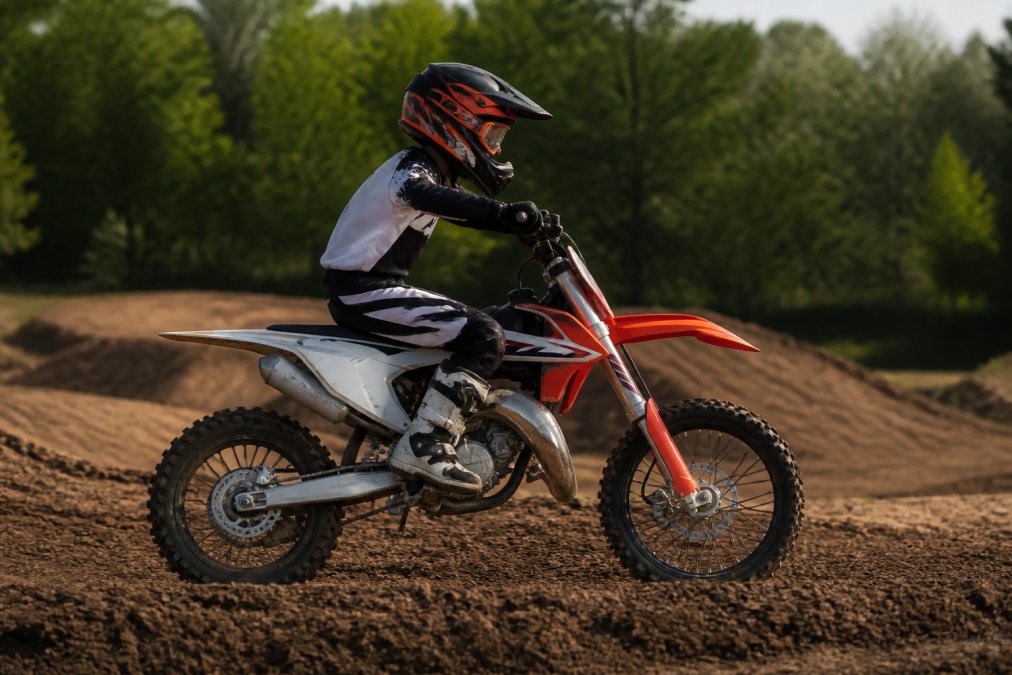
Your body position determines how the bike responds to inputs and how much control you have. The attack position is the foundation of motocross technique:
- Your elbows are up and wide, not tucked against your body.
- Your chest is forward over the handlebars, not upright.
- Your hips are slightly forward on the seat, with weight balanced between the seat and footpegs.
- Your head is over the center of the bike, eyes looking through the turn to the exit.
- Your legs grip the tank with your calves and inner thighs, not your knees.
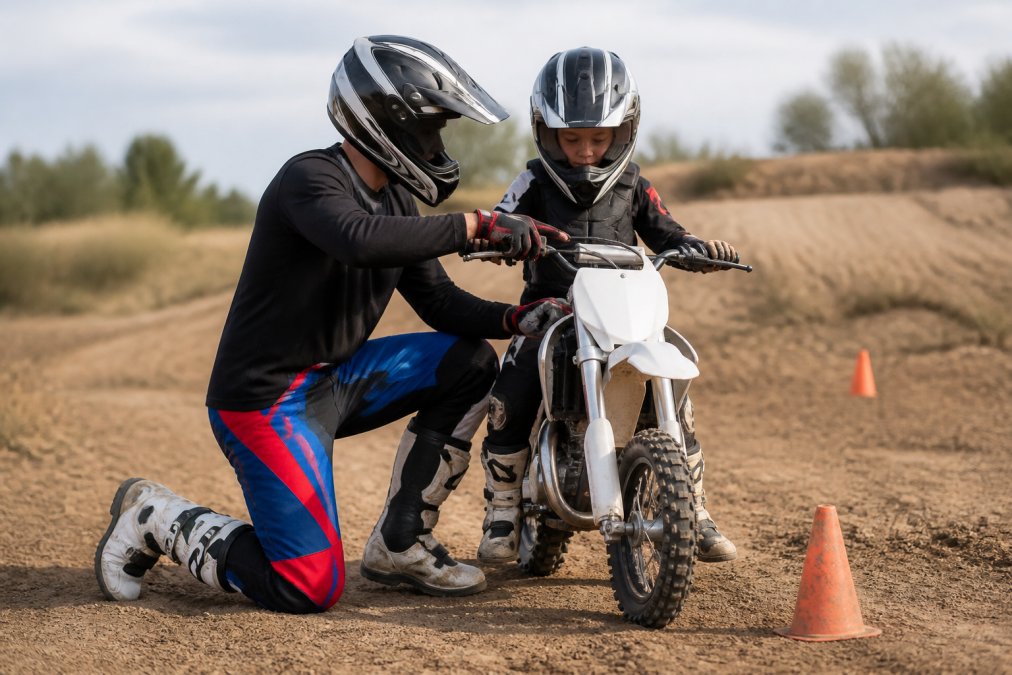
Practice this position at a standstill first for 5-10 minutes at a time, several times per week. Once stationary practice feels natural, practice at low speeds on flat ground in a large circle at 5-10 mph, focusing on maintaining the position through the turn. Do this for 10-15 minute sessions, 2-3 times per week.
Throttle Control and Clutch Modulation
Smooth throttle control separates smooth riders from jerky ones. Abrupt throttle inputs cause the rear wheel to spin, upset the bike's balance, and waste energy.
Smooth throttle control means rolling the throttle open gradually. Think of it as a dimmer switch, not an on-off switch. Practice this at low speeds in a straight line, focusing on feeling the throttle response. Do this for 10-15 minute sessions until smooth throttle control feels automatic.
Clutch modulation is equally important. Practice by starting from a stop and accelerating smoothly, releasing the clutch over 2-3 seconds while rolling the throttle open gradually. The bike should accelerate without jerking or wheel spin. Repeat this drill 20-30 times per session, 2-3 times per week.
Cornering Technique and Line Choice
Cornering is where most crashes happen. Line choice means deciding where on the track you'll position the bike through the turn:
- Tight turns: Brake early, enter wide, apex early, and exit tight to accelerate hard.
- Fast turns: Brake less, enter at consistent speed, apex late, and accelerate smoothly through the exit.
- Rhythm sections: Brake hard before the first obstacle, then modulate throttle to maintain momentum.
Practice line choice by riding the same section repeatedly and experimenting with different entry speeds and apex positions. Body positioning through corners is critical: shift your weight toward the inside of the turn by moving your hips toward the inside footpeg. Keep your elbows up and look through the turn to the exit.
Motocross Training Routine for Endurance: A Step-by-Step Weekly Plan
Consistency beats intensity for beginners. This plan assumes you're riding 1-2 times per week and training off the bike 3-4 times per week.
Monday: Cardiovascular and Grip Endurance
- 20-30 minutes of running, cycling, or jump rope at moderate intensity
- 3 sets of farmer carries: 40-50 feet per set
- 3 sets of hand gripper squeezes: 12-15 reps per set
Tuesday: Core Strength
- 4 sets of planks: 45-60 seconds per set
- 3 sets of dead bugs: 10 reps per side
- 3 sets of bird dogs: 10 reps per side
- 3 sets of wrist curls: 12-15 reps per set
Wednesday: Rest or Light Activity
- Easy walk, stretch, or recovery yoga
Thursday: Cardiovascular and Grip Endurance (repeat Monday)
Friday: Core Strength (repeat Tuesday)
Saturday or Sunday: Track Riding
- 20-30 minutes of low-speed technique drills
- 20-30 minutes of moderate-speed riding, focusing on smooth inputs
| Training Component | Frequency | Duration | Focus |
|---|---|---|---|
| Cardiovascular work | 2x per week | 20-30 min | Sustained heart rate elevation |
| Core strength | 2x per week | 30-40 min | Functional stability and endurance |
| Grip training | 2x per week | 10-15 min | Throttle and clutch control |
| Track riding | 1-2x per week | 60-90 min | Technique drills and skill building |
After 4-6 weeks of consistency, you'll notice significant improvements in fatigue resistance and technique.
Track Etiquette and Safety: Riding Responsibly from Day One
Track etiquette prevents crashes and keeps everyone safe. Key principles:
- Stay in your lane: Don't wander into faster riders' lines.
- Use hand signals: Wave slower riders past when they're coming up behind you.
- Don't block: If a faster rider is catching you, let them pass safely.
- Ride your own pace: Don't chase faster riders beyond your skill level.
- Flag awareness: Learn what flags mean at your track.
- Pre-ride walk: Walk the track before your first ride to identify hazards and plan your lines.
Pre-Ride Inspection and Bike Maintenance Basics
A mechanical failure during riding can cause a crash. Spending 10 minutes on pre-ride inspection prevents most failures.
Before every ride, check:
- Tire pressure and tread: Check pressure cold and ensure tread depth is adequate.
- Chain tension: Proper tension is about 1-1.5 inches of vertical movement at the midpoint.
- Brake fluid and pads: The brake lever should feel firm with about 1-2 inches of travel before engagement.
- Fasteners: Check that bolts on handlebars, seat, footpegs, and engine covers are tight.
- Fuel and oil: Check fuel level and oil level.
- Air filter: Replace every 20-30 hours of riding.
Finding Your Local Track and Community
Riding with others is more rewarding than riding alone. Local tracks and riding clubs provide community, coaching, and progression.
To find a local track:
- Search online for "motocross tracks near me" or "dirt bike parks near me"
- Check with local dirt bike shops
- Ask on motocross forums and social media groups
- Visit the American Motorcyclist Association website for track listings
When you find a track, visit during open riding hours before committing to a membership. Riding clubs offer another pathway, organizing group rides, sharing coaching, and creating accountability.
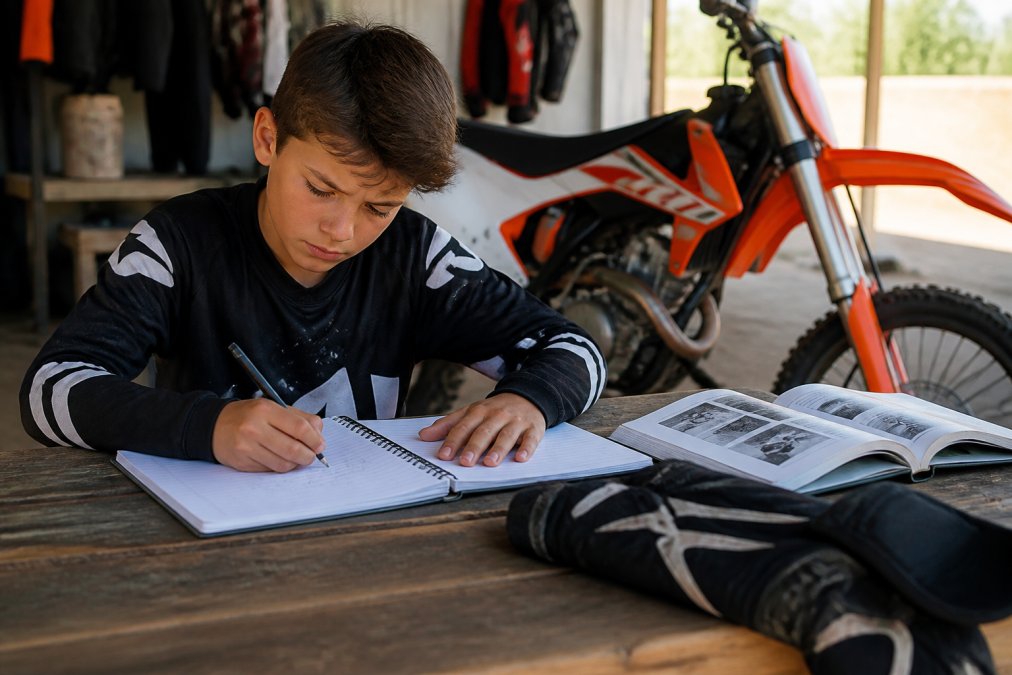
The Nelmgerian MX community offers resources that can support your journey. Our rider training journals help you track which techniques are improving and which need more work.
Common Mistakes Beginners Make (And How to Avoid Them)
Mistake 1: Buying too much gear too fast Start with essential protective gear and basic clothing. Add specialty gear after you've ridden a few times and know what feels right.
Mistake 2: Skipping physical training Physical conditioning before your first track day makes that first day dramatically better. You'll get fit by riding, but starting prepared prevents early fatigue and frustration.
Mistake 3: Comparing yourself to faster riders Focus on your own improvement, not others' speed. Progression takes time.
Mistake 4: Neglecting bike maintenance A poorly maintained bike feels unpredictable and unstable. Maintain your bike consistently and you'll feel the difference immediately.
Mistake 5: Riding beyond your fitness level Fatigue causes crashes. If you feel your grip failing or your core giving out, pull off the track and rest.
Mistake 6: Practicing the wrong technique Spend time at low speeds, focusing on smooth inputs and correct body positioning. Speed comes naturally once technique is solid.
Motocross training tips for beginners come down to three commitments: protecting yourself with proper gear, building the fitness the sport demands, and practicing technique at speeds where you can focus on form. Make these commitments before your first track day, and you'll progress faster, stay safer, and enjoy the sport more.
The gap between owning a bike and riding it confidently closes quickly when you approach it systematically. Nelmgerian MX offers resources, including rider training journals, that can help you document which techniques are improving and where you need more focus. Start with the fundamentals, build your fitness, invest in proper gear, find your community, and the rest follows naturally.
Frequently Asked Questions
How do I start motocross training as a complete beginner?
Begin by investing in proper safety equipment, especially a DOT-certified helmet and protective gear. Then focus on building cardiovascular endurance and core strength through off-bike conditioning. Once physically prepared, take lessons at a local track to learn body positioning, throttle control, and basic technique drills. Start on a smaller bike suited to your size, spend time on beginner-friendly sections of the track, and practice under supervision before advancing to more challenging terrain.
What motocross fitness training routine should I follow?
A beginner's motocross training routine should include 3-4 days per week of mixed conditioning: cardiovascular work like running or cycling for 20-30 minutes to build stamina, core strength exercises such as planks and medicine ball work, and grip and forearm training. Dedicate 1-2 days to on-bike practice focusing on technique drills like body positioning, throttle control, and cornering at controlled speeds. Include at least one full rest day weekly to allow recovery and prevent overtraining.
What are the unwritten rules of motocross track etiquette?
Key track etiquette includes: yield to faster riders by moving to the inside of the track, never block another rider's line, signal before passing, maintain consistent speed to be predictable, and respect the track marshal's instructions immediately. Avoid aggressive riding toward beginners, don't cut corners dangerously, and help fallen riders if safe to do so. Always show respect for the track, other riders, and the sport itself.
Is it too late to start motocross training as an adult?
No, many adults successfully start motocross training. The key is building fitness gradually, investing in quality safety equipment, and learning proper technique from experienced instructors. Adult beginners should focus on core strength, cardiovascular endurance, and body awareness before pushing speed. Mental approach matters too: expect a learning curve, practice consistently, and prioritize injury prevention over rapid progression.
This article was written using GrandRanker