 how-to
7 Motocross Fitness Activities for Young Kids
Last Updated: October 30, 2026
Quick Summary
Motocross fitness activities for young kids include core and balance drills like planks, bird dogs, and single-leg balance, plus off-bike games such as animal walks, Simon Says, and fast feet. These build the stability, footwork, and stamina a rider needs. Keep sessions short, play-based, and supervised, with rest days built in.
- Only 20%-28% of children ages 6-17 meet the recommended 60 minutes of daily physical activity.
- Core moves like plank and bird dog are held or repeated 3 to 4 rounds each.
- Ages 3 to 5 should do 10 to 15 minute play sessions; ages 6 to 9 can do 15 to 20 minutes.
- Stop riding or training when form slips, since tiredness is a common cause of falls.
Table of Contents
- Age-Appropriate Expectations for Kids Ages 3 to 9
- Core and Balance Exercises for Young Riders
- Off-Bike Motocross Games for Kids With No Equipment
- Building a Weekly Kids Dirt Bike Fitness Routine
- Safety, Supervision, and Protective Gear During Training
- Adapting Activities for Beginners Without a Dirt Bike
- Planning Your Child's First Fitness Week
- Frequently Asked Questions
Most parents assume a child on a dirt bike needs speed lessons first. A 2024 U.S. report card found that only 20%-28% of children ages 6-17 meet the recommended 60 minutes of daily physical activity (2024 U.S. Report Card on Physical Activity for Children and Youth).
Motocross is a physical sport, and fitness activities that build balance, grip, and stamina shape how a child handles a bump or a long moto.
Motocross is high risk, even with protective gear. A medical review of the sport describes it as high risk despite protective equipment, and notes that children as young as 3 have taken part (R. Singh, "Motocross biking for competition and for recreation"). Fitness does not remove that risk, but a stronger, more balanced rider is better prepared to react.
Here is what this guide covers:
- Realistic expectations for kids ages 3 to 9
- Core and balance drills you can do at home
- Off-bike games that need little or no equipment
- A simple weekly routine with rest days
- Safety, supervision, and protective gear
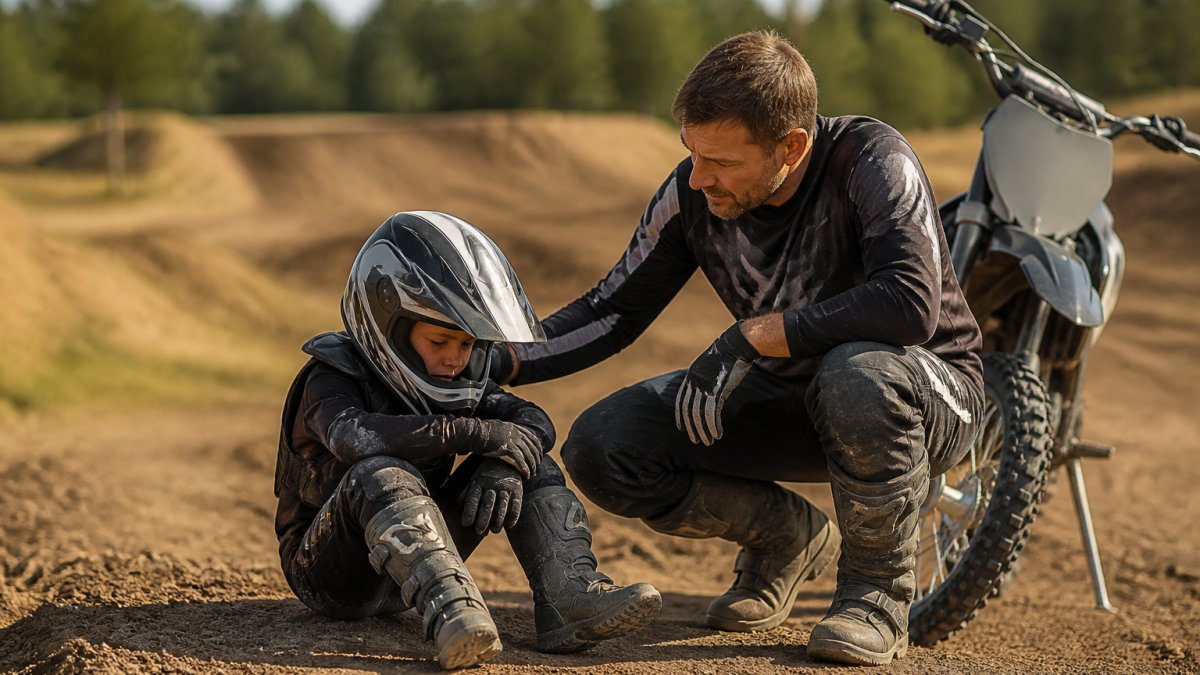
Watch out: pushing a child to ride longer or harder when they are tired is one of the fastest ways to cause a fall. Stop when form slips.
Age-Appropriate Expectations for Kids Ages 3 to 9
Young children learn motocross skills in small steps. A 5-year-old on a 50cc bike needs time to learn starting, stopping, and balance before any jumps or speed work.
Focus on these milestones first:
- Sitting balanced on the bike while stopped
- Getting feet onto the foot pegs
- Starting from a stop and braking smoothly
- Riding a straight line at walking-to-jogging pace
Most kids this age learn best in short sessions. Plan 15 to 30 minutes, with plenty of breaks.
Watch out: a 50cc bike is sized for the rider. Ask a coach to check fit before buying.
Core and Balance Exercises for Young Riders
Strong core muscles keep a rider steady over bumps. Balance drills build the body awareness a rider needs on uneven ground.
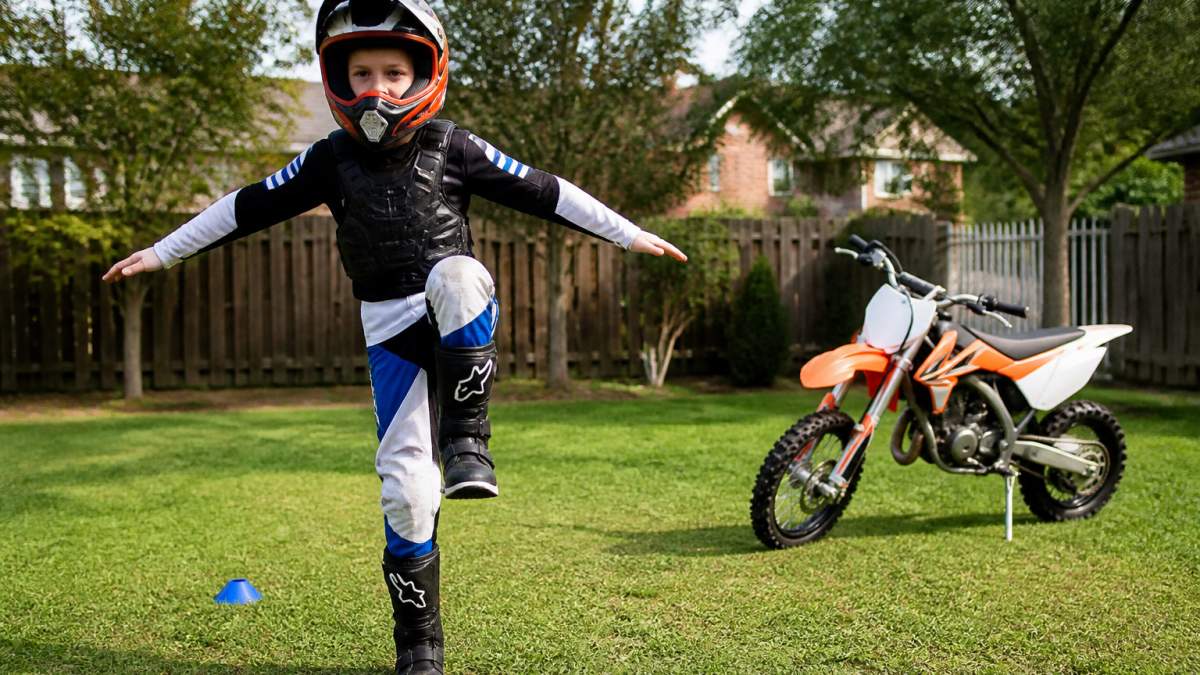
Try these simple moves, 3 to 4 rounds each:
- Plank: hold for 10 to 20 seconds
- Bird dog: alternate arm and leg, 6 per side
- Dead bug: lie on the back and move opposite arm and leg, 6 per side
- Single-leg balance: stand on one foot for 10 seconds per side
Motocross fitness guides for kids often include these same bodyweight moves, along with front and side bridges (10 Motocross Fitness Exercises for Kids). Stretching matters too. Gentle lower-back and chest stretches help a child stay loose after riding.
Off-Bike Motocross Games for Kids With No Equipment
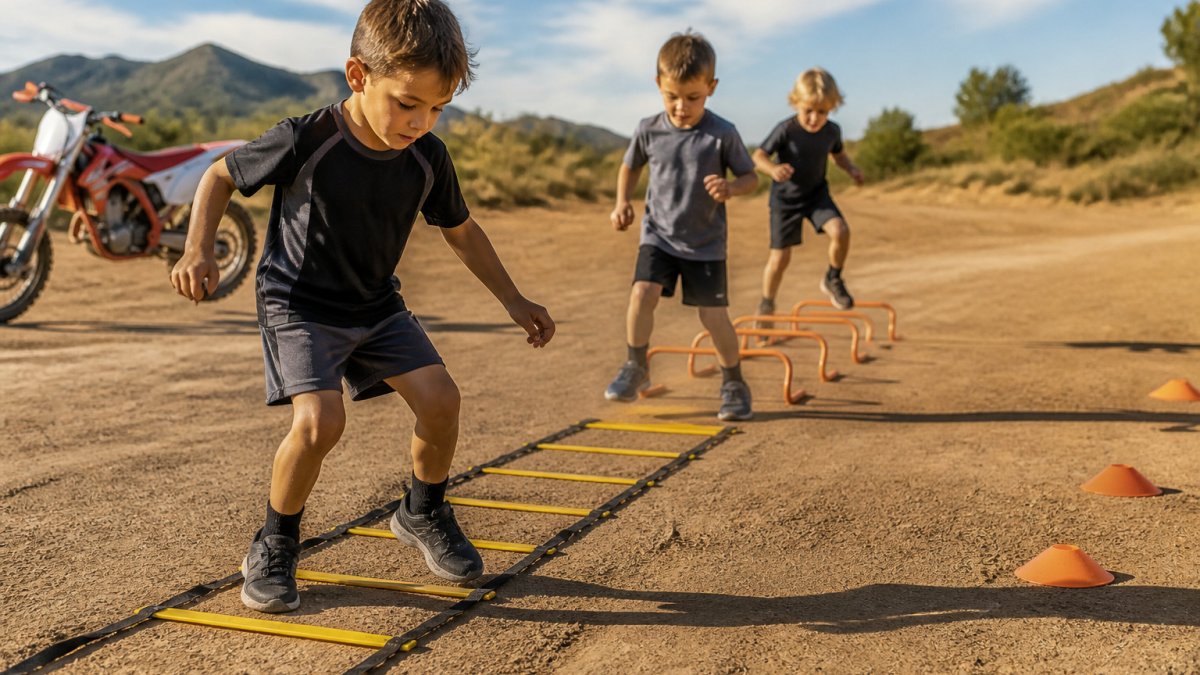
Kids do not need a bike to build motocross skills. These games build agility, footwork, and coordination in the backyard, and they cost nothing. The key is to match the game to the child's age and coordination level, then progress the challenge only when the child is consistently successful.
Ages 3 to 5: Body Awareness and Balance
At this age, the goal is fun and basic control. Keep sessions to 10 to 15 minutes and stop before the child loses interest.
- Animal walks: bear crawls, crab walks, and frog hops build core and shoulder strength while teaching weight shift. Do 3 to 5 steps at a time, then rest.
- Simon Says balance: call out positions like "stand on one foot," "arms out like wings," or "freeze like a statue." This teaches the child to hold a stable position on command, which mirrors holding a line on a bike.
- Hop and freeze: hop in place or in a small pattern, then freeze on a signal. This builds the stop-and-hold control a rider needs when braking.
Ages 6 to 9: Agility, Footwork, and Reaction
Older kids can handle faster movement and simple rules. Sessions of 15 to 20 minutes work well.
- Fast feet: tap a line on the ground with alternating feet as fast as possible for 10 seconds, then rest. This builds the quick footwork a rider uses to shift weight and catch a slide.
- Cone slalom on foot: set up four to six household objects as cones and weave through them at a walk, then a jog. This mirrors the cone slalom drills riders do on a bike and teaches the child to look ahead and plan a line.
- Reaction ball or call-out drill: an adult calls "left," "right," "stop," or "go," and the child responds immediately. This trains the reaction time a rider needs when a bump or another rider appears.
- Balance beam walk: use a line of tape on the floor or a low curb (with an adult spotting). Walking heel-to-toe builds the single-leg stability that keeps a rider steady on the pegs.
Progression Rules That Keep It Safe
Increase difficulty only when the child can complete the current version without losing form. If a child wobbles, slows down, or starts goofing off, that is a sign the challenge is too high or the child is tired. Drop back to an easier version or end the session.
These games also work as a warm-up before riding. Five minutes of animal walks and fast feet prepares the body for the balance and footwork demands of the bike.
Building a Weekly Kids Dirt Bike Fitness Routine
Consistency beats intensity. A simple weekly plan works better than one hard day, and for young children the plan should build slowly over several weeks rather than jumping to a full schedule.
A Four-Week Progression for Ages 6 to 9
Start with three short sessions in week one and add time or a fourth session only if the child finishes each week feeling good.
- Week 1: three sessions of 15 minutes each, one core circuit, one balance session, one off-bike game session. Two rest days between sessions.
- Week 2: same three sessions, but extend each to 20 minutes if the child is comfortable.
- Week 3: add a fourth session, a short ride or a balance-plus-riding day, and keep the other three at 20 minutes.
- Week 4: keep four sessions but make one of them a longer practice day with breaks. Do not add intensity; add variety instead.
For children ages 3 to 5, keep the whole week to two or three 10-to-15-minute play sessions and treat every session as optional. Establishing these lighthearted habits early on creates a sustainable foundation for later years, much like the process of starting a fitness journey requires a gradual shift from simple play toward more structured physical development.
A Sample Week for a Child Ages 6 to 9
- Monday: core circuit, 15 to 20 minutes
- Tuesday: rest or light play
- Wednesday: off-bike games, 20 minutes
- Thursday: rest
- Friday: balance drills plus easy riding, 20 minutes
- Saturday: longer practice day, with breaks every 15 minutes
- Sunday: rest
Youth training examples often suggest repeating a core workout 3 to 4 times a week (Youth Motocross Training). Always build in rest. Muscles grow stronger during recovery, not during the workout alone.
Signs Your Child Needs a Rest Day
Fatigue often shows up before a child says they are tired. Watch for these cues:
- Slower reactions or delayed responses to commands
- Sloppy form on drills that were clean the week before
- Complaints of being tired before the session starts
- Mood changes, tears, or loss of interest in an activity they usually enjoy
- Complaints of pain, especially in the knees, lower back, or shoulders
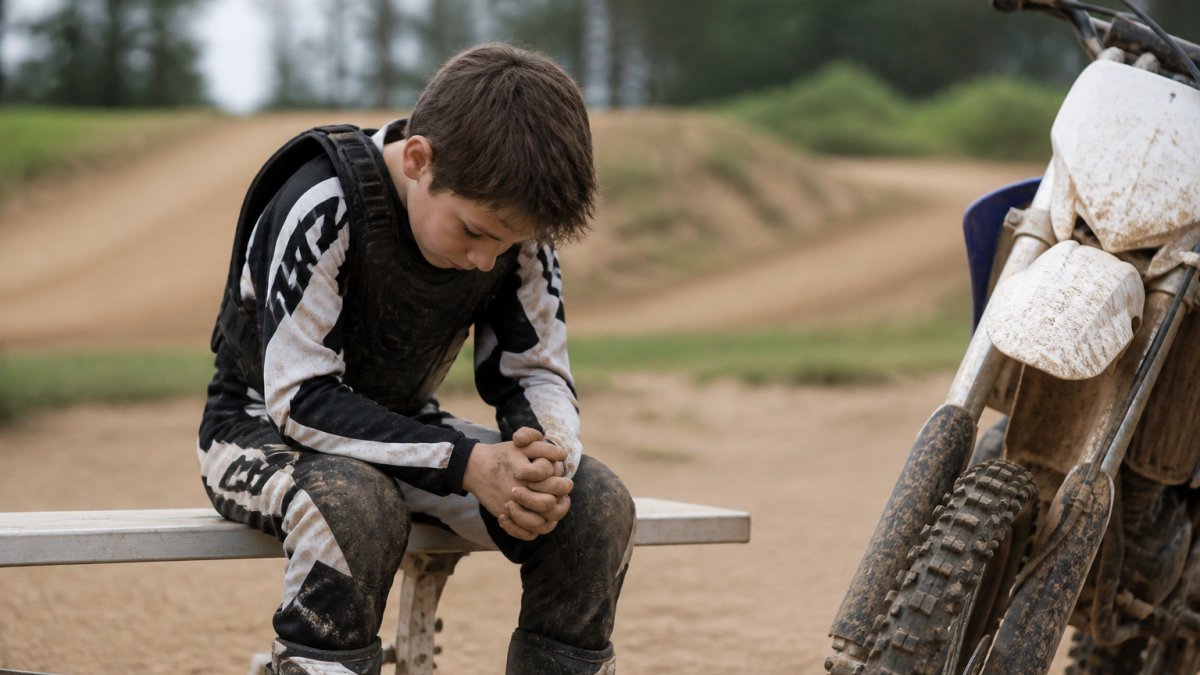
If you see two or more of these, replace the session with a rest day or a light walk. One missed session does not hurt progress; pushing through fatigue is what causes falls and overuse injuries.
Adjusting the Plan for Beginners Without a Bike
If your child does not have a dirt bike yet, replace the riding sessions with balance-bike or bicycle time and keep the core and off-bike game sessions the same. The weekly structure still works; only the equipment changes.
The article lays out a four-week progression for children ages 6 to 9, which is summarised below.
| Week | Sessions | Session length |
|---|---|---|
| Week 1 | Three sessions | 15 minutes each |
| Week 2 | Three sessions | Extend to 20 minutes if comfortable |
| Week 3 | Four sessions | Three at 20 minutes, plus a short ride or balance-plus-riding day |
| Week 4 | Four sessions | One longer practice day with breaks; add variety, not intensity |
Safety, Supervision, and Protective Gear During Training
Supervision is not optional. An adult should watch every session, especially for children under 6.
Protective gear should include: how to choose the right motocross protective gear explains what fits a young rider best.
- A properly fitted helmet
- Goggles
- Chest and shoulder protection
- Gloves
- Boots that support the ankle
- Knee and elbow guards
Check the fit each time your child grows. Loose or worn gear offers less protection. Where a child rides also matters. Choose a closed, designated track and avoid public roads.
Adapting Activities for Beginners Without a Dirt Bike
Not every child has a bike yet. You can still build the foundation.
- Use a balance bike or a bicycle for seated balance practice.
- Practice foot placement by standing on a stable step and moving feet to marked spots.
- Use the off-bike games above to build agility and core strength.
Once a bike is available, move the same skills onto it slowly. Keep the first rides short and supervised.
Planning Your Child's First Fitness Week
Start with three short sessions in week one: a core circuit, a balance session, and an off-bike game session. Keep each under 20 minutes. The Nelmgerian MX Training Book offers a structured routine to follow alongside these sessions.
Track how your child feels. Note energy, mood, and any complaints of pain. Signs of fatigue include slower reactions, sloppy form, and complaints of being tired before starting. If you see these, add a rest day.
Parents who want a structured guide can look at the Nelmgerian MX Training Book, which pairs a training routine with screen-free activities for young riders. For current pricing or to learn more, visit the Nelmgerian MX website.
Frequently Asked Questions
What fitness activities help young kids prepare for motocross?
Bodyweight core work such as planks, bird dogs, and dead bugs builds the trunk control riders use to stay steady on the bike. Balance drills, bridges, and simple stretching round out a basic program. Keep sessions short and playful for children ages 3 to 9, and adjust difficulty based on how your child moves.
How can kids improve balance for dirt bike riding?
Start with single-leg standing, walking heel to toe on a line, and hopping in place. Progress to standing on a folded towel or cushion, which challenges balance more. Coordination drills that ask children to move arms and legs in different patterns also help. Practice these in short bursts so balance work stays fun and does not become a chore for young riders.
How long should a fitness session be for a young child?
For children ages 3 to 9, sessions of 15 to 30 minutes work well, including a short warm-up and cool-down. Total daily movement matters more than one long workout. Stop when your child shows fatigue, loses form, or stops wanting to continue.
Do kids need strength training before riding a dirt bike?
Young children do not need formal strength training with weights. Bodyweight exercises, climbing, running, and play build the strength and coordination needed for riding. Motocross is a high-risk sport even with protective equipment, so focus on skills, supervision, and gear before adding any structured conditioning.
Ready to get your child started? Nelmgerian MX builds books, rider journals, and activities that keep young riders engaged between practice days, all built around the sport they love. Send us a message today to find the right resource for your rider.