 ultimate-guide
What CC Should a 12 Year Old Have? A Parent's Guide
Table of Contents
- Why Engine Size Matters for a 12-Year-Old Rider
- Youth Motocross Bike Sizing Chart: CC by Age and Weight
- Two-Stroke vs Four-Stroke for Kids: Which Is Right?
- How to Start Motocross Racing Kids: A Step-by-Step Path
- Essential Protective Gear and Injury Prevention for Young Riders
- Budget-Friendly Entry Paths and Maintenance for Parents
- Avoiding Burnout: Keeping the Sport Fun for Your 12-Year-Old
- Conclusion: Matching the Bike to the Rider
- Frequently Asked Questions
Last Updated: September 24, 2026
Why Engine Size Matters for a 12-Year-Old Rider
The answer to what CC should a 12 year old have is an 85cc two-stroke or a 125cc four-stroke for most riders, with 65cc workable for smaller or less experienced kids. Displacement determines acceleration, weight, and forgiveness when a young rider makes a mistake.
The honest answer depends less on age than on experience, size, and confidence.
Youth Motocross Bike Sizing Chart: CC by Age and Weight
A youth motocross bike sizing chart should weigh height and experience alongside age, because two 12-year-olds can differ by 30 pounds and three inches of inseam.
| Age | Typical CC Class | Stroke Type | Best For |
|---|---|---|---|
| 6-9 | 50cc | 2-stroke / 4-stroke | First-time riders, low seat height |
| 9-11 | 65cc | 2-stroke | Riders who have mastered throttle control |
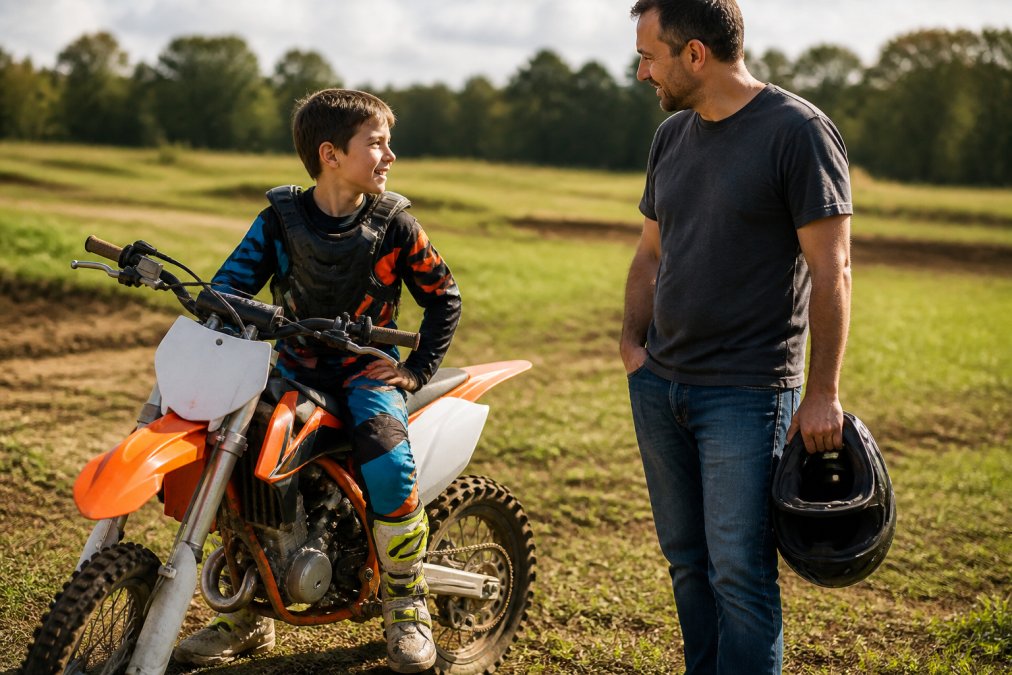
| 11-13 | 85cc | 2-stroke | Most 12-year-olds with prior seat time |
| 12-15 | 125cc | 4-stroke | Taller riders or those moving up gradually |
| 13-16 | 125cc / 250cc | 4-stroke | Competitive youth racing classes |
50cc and 65cc: The Entry-Level Classes
The 50cc class teaches balance and throttle control without intimidation: low seats, light weight, modest speeds. Most kids outgrow them by age nine.
85cc and 125cc: The 12-Year-Old Sweet Spot
The 85cc two-stroke is the standard pick for a 12-year-old with riding experience: manageable powerband, full-size suspension travel, and a seat height that fits most kids this age.
Two-Stroke vs Four-Stroke for Kids: Which Is Right?
Two-strokes deliver a sharp power hit that rewards good throttle control but punishes sloppy inputs. Four-strokes spread power wider, making them easier to ride smoothly.
How to Start Motocross Racing Kids: A Step-by-Step Path
Starting motocross racing with kids follows a predictable sequence; skipping steps leads to injured or burned-out riders.
- Build base skills off-road first. Supervised practice on flat ground teaches balance and braking before any gate drops.
- Enroll in a structured training program. A local motocross training school covers riding posture, cornering, and bike control.
- Get the right protective gear. Helmet, chest protector, boots, and goggles are non-negotiable before racing.
- Obtain a racing license or membership. Most sanctioned series require one, and requirements vary by organization.
- Enter beginner or novice classes. Youth racing classes exist specifically for first-season racers.
- Practice local track etiquette. Learn flag meanings, staging order, and how to ride predictably around others.
- Track progress over the season. Log practice hours, lap times, and skills mastered.
Local Track Etiquette and Supervised Practice
Track etiquette matters more than raw speed for a beginner: hold your line, don't cut across the track, and respect the flaggers.
Essential Protective Gear and Injury Prevention for Young Riders
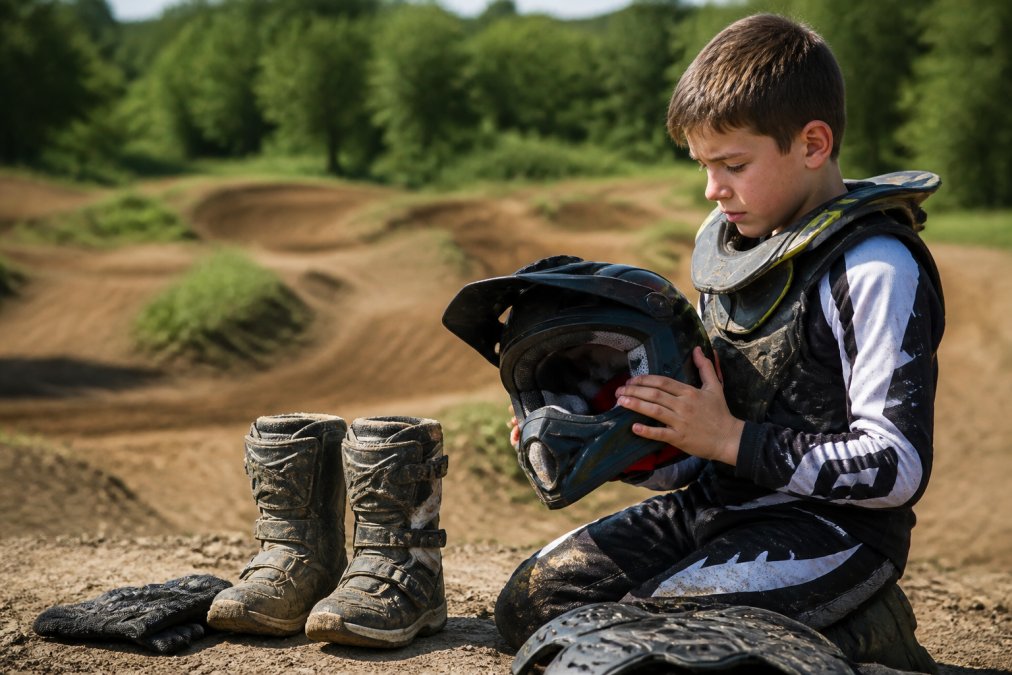
No gear matters more than a properly fitted helmet. It should sit level, cover the forehead to about an inch above the eyebrows, and stay put when you grab the chin bar and roll it forward and back. A helmet that slides or lifts is the wrong size, whatever the label says.
- Helmet: Snell or DOT certified, snug enough that cheek pads press lightly against the face, replaced after any hard impact or every five years of use
- Chest protector: Shields the torso from roost and handlebar strikes, worn over the jersey and under the neck brace if one is used
- Boots: Rigid ankle support and shin protection, sized with about a half-inch of toe room so feet do not slide forward on the pegs
- Goggles: Tear-off compatible, with a spare lens and roll-off system in your gear bag for muddy days
- Gloves and knee guards: Grip and joint protection on every ride, with knee guards sized to stay in place during a fall
- Neck brace: Optional but common in youth racing, designed to limit extreme neck extension in a forward fall
Conditioning That Prevents the Most Common Youth Injuries
Gear handles impact; conditioning handles the strains and overuse injuries that sideline kids quietly. The most common youth complaints are wrist and forearm fatigue, lower back tightness, and knee soreness from bracing against the pegs.
- Arm circles and wrist rolls to loosen the forearms before gripping the bars
- Bodyweight squats and lunges to activate the legs and hips
- Planks and bird-dogs for the core stability that holds riding posture through a full moto
- Standing hamstring and hip-flexor stretches to offset the seated, knees-up riding position
Gear Budget Tiers: Essential vs. Nice-to-Have
Parents often overspend on the wrong items. Split the list into two tiers:
- Essential before the first ride: Helmet, goggles, gloves, boots, chest protector
- Add as the rider progresses: Neck brace, knee braces, elbow guards, hydration pack
Budget-Friendly Entry Paths and Maintenance for Parents
Most families overpay on the first bike and underprepare for everything after it. The smart entry path is a used 85cc two-stroke from a racing family, quality used gear, and a parent willing to learn a few mechanical skills, a combination that cuts first-year costs dramatically.
Nelmgerian MX Training Journal →
Used vs. New: How to Decide
Buy used when the rider is still growing into a class. A 12-year-old on an 85cc will likely move up within 18 to 24 months, so a new bike loses value fast. Buy new only when the rider is at the top of a class, racing competitively, and you'll keep the machine for multiple seasons.
When shopping used, check these items in person:
- Frame and swingarm: Look for cracks, fresh paint hiding repairs, or mismatched bolts
- Wheels: Spin them and check for wobble, which signals a bent rim or worn bearings
- Chain and sprockets: Hooked teeth or a chain that lifts off the rear sprocket mean replacement is due
- Fork seals: Oil streaks down the fork tubes indicate a seal job you will inherit
- Compression: A bike that kicks over too easily may need a top-end rebuild soon
What the First Year Actually Costs
Beyond the purchase price, budget for these recurring items. Prices vary by region and brand, so treat these as ranges:
- Tires: A rear tire on an 85cc wears out in a season of regular riding; fronts last longer
- Chain and sprocket set: Replaced as a pair, typically once a season on a ridden-hard bike
- Air filters: Cleaned after every ride, replaced when the foam breaks down
- Engine oil and coolant: Four-strokes need more frequent oil changes than two-strokes
- Top-end rebuild: Two-strokes need a piston and ring at intervals measured in hours, not miles
- Entry fees and series memberships: Sanctioned series charge per event plus an annual membership
- Safety gear replacement: Helmets and boots wear out and need periodic replacement
The Maintenance Skills a Parent Should Learn
You do not need to be a mechanic. You need to handle the tasks that prevent expensive failures between rides:
- Chain tension and lubrication: Check slack at the midpoint of the chain, adjust at the rear axle, and lube after every wash
- Air filter cleaning: Remove, clean with filter cleaner, oil lightly, and reinstall before every ride in dusty conditions
- Tire pressure: Check cold before each ride; a few PSI changes how the bike handles
- Oil level and changes: Learn the interval for your bike and stick to it
- Bolt check: Walk the bike after each ride and tighten anything that has vibrated loose
- Wash and inspect: Clean the bike after every ride and look for cracks, leaks, and worn parts while you do it
Avoiding Burnout: Keeping the Sport Fun for Your 12-Year-Old
Psychological burnout ends more youth motocross careers than injuries do. Signs show up early: excuses to skip practice, lost enthusiasm at the track, and irritability on race day.
Conclusion: Matching the Bike to the Rider
Choosing a dirt bike for a 12-year-old is a judgment call about readiness, not a lookup table. The 85cc two-stroke and 125cc four-stroke cover most riders this age, but size, experience, and confidence decide the final pick.
Send
Frequently Asked Questions
Is 12 too late to start motocross?
No, 12 is a common age to start. Many riders begin at 12 and progress quickly through the 85cc and 125cc classes. The key is supervised practice, professional training, and consistent seat time. Starting at 12 gives riders enough physical stamina and coordination to handle clutch operation, braking technique, and throttle control, which younger riders often struggle with.
What is the difference between a 65cc, 85cc, and 125cc dirt bike?
These numbers refer to motorcycle displacement. A 65cc bike suits riders roughly 7 to 9, an 85cc fits most 10 to 13 year olds, and a 125cc is typically for teens 14 and up. A 12 year old usually lands on an 85cc two-stroke or a 150cc four-stroke, depending on height, weight, and riding experience.
Should a 12-year-old start on a two-stroke or four-stroke engine?
It depends on the rider's goals. Two-strokes are lighter, cheaper to maintain, and teach clutch control, but power hits harder. Four-strokes deliver smoother, more predictable power, which helps beginner riders build confidence. Many families start a 12 year old on a four-stroke for control, then move to a two-stroke once balance and throttle control are solid. Both work well with proper training.
What safety gear is essential for a 12-year-old motocross rider?
At minimum: a DOT-certified helmet, goggles, chest protector, gloves, motocross boots, and knee and elbow guards. A neck brace adds protection during falls. Replace the helmet after any hard impact, and check that boots and chest protector still fit as your rider grows. Proper gear is not optional in youth racing classes and most tracks require it.