 blog
BuddyMX Alternatives for Home Training
Table of Contents
- Why Parents Choose BuddyMX Alternatives for Home Training
- Motocross Training for Kids: Building Skills Between Rides
- Using a Motocross Training Journal to Track Progress
- Essential Motocross Drills for Beginners at Home
- Designing a Youth Motocross Practice Routine
- Strength Training and Conditioning for Young Riders
- Screen-Free Resources and Learning Tools
- Frequently Asked Questions
Last Updated: October 12, 2026
Why Parents Choose BuddyMX Alternatives for Home Training
Finding the right BuddyMX alternatives home training option means understanding what your young rider needs between practice days and races. At Nelmgerian MX, the best solutions aren't the most expensive or complicated ones. They're the ones that keep kids engaged, build real skills, and fit your family's schedule.
The challenge is simple: your child wants to ride dirt bikes, not sit through another screen-based program or expensive academy membership. Yet skill development doesn't stop when the bike is parked. The gap between race days is where confidence gets built, weak points get fixed, and riders start thinking like athletes.
This guide covers practical alternatives to mainstream coaching platforms: how to structure training at home, track progress that matters, and keep your young rider excited about improvement without expensive subscriptions or travel commitments.
Motocross Training for Kids: Building Skills Between Rides
Effective motocross training for kids focuses on what they can control off the bike. Balance, body awareness, fitness, and mental toughness don't require a track, just consistency and the right framework.
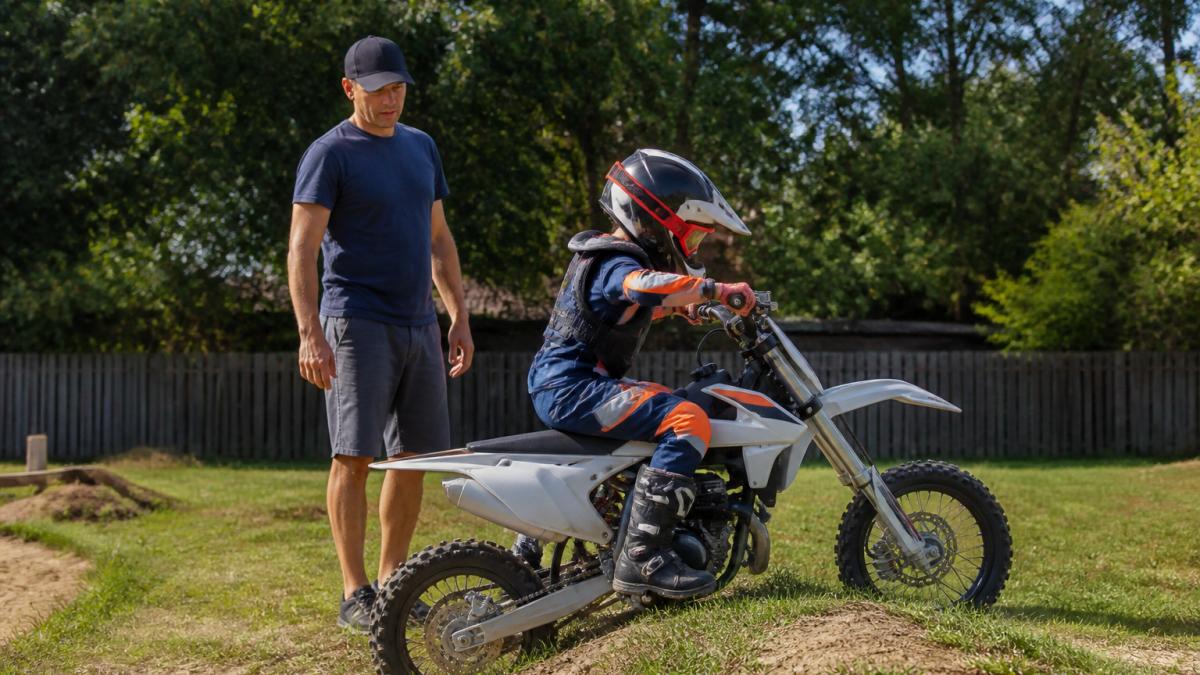
Most young riders spend 90% of their time thinking about going fast. The other 10%, conditioning, technique drills, mental prep, is where real improvement happens. Home training fills that gap.
The best motocross training for kids at home includes three core elements: structured practice routines, measurable progress tracking, and confidence-building activities that need no expensive equipment.
Many parents worry kids will lose interest if training isn't immediately "fun." The opposite is true: kids stay engaged when they see progress.
Using a Motocross Training Journal to Track Progress
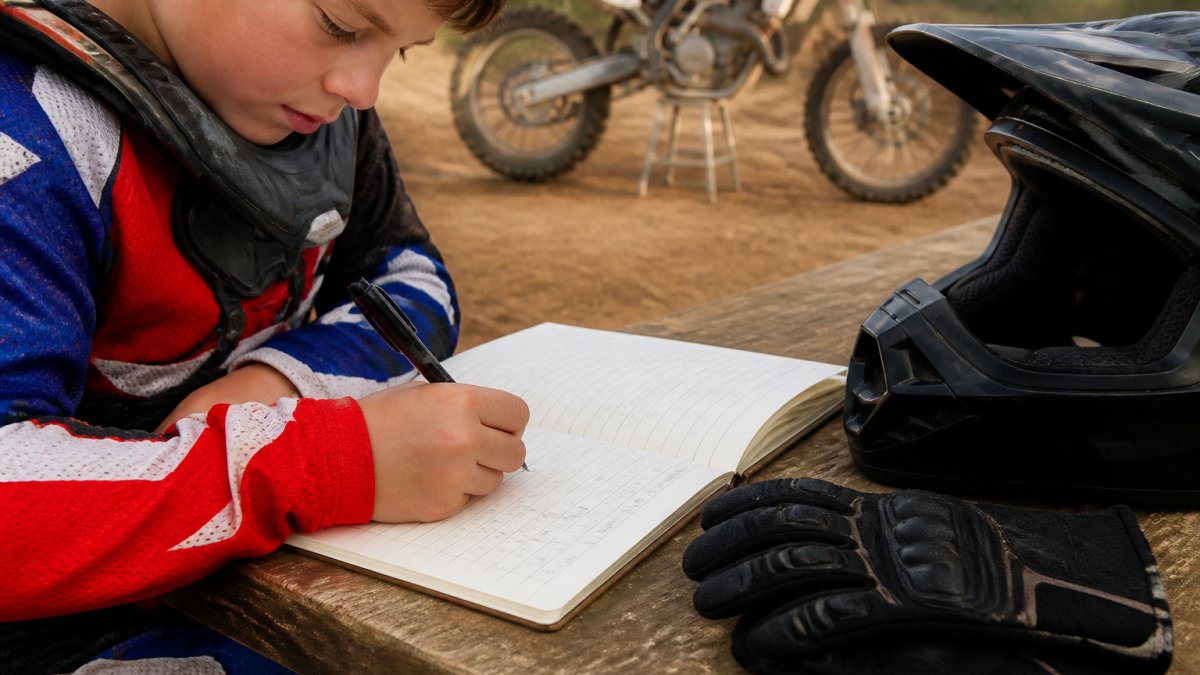
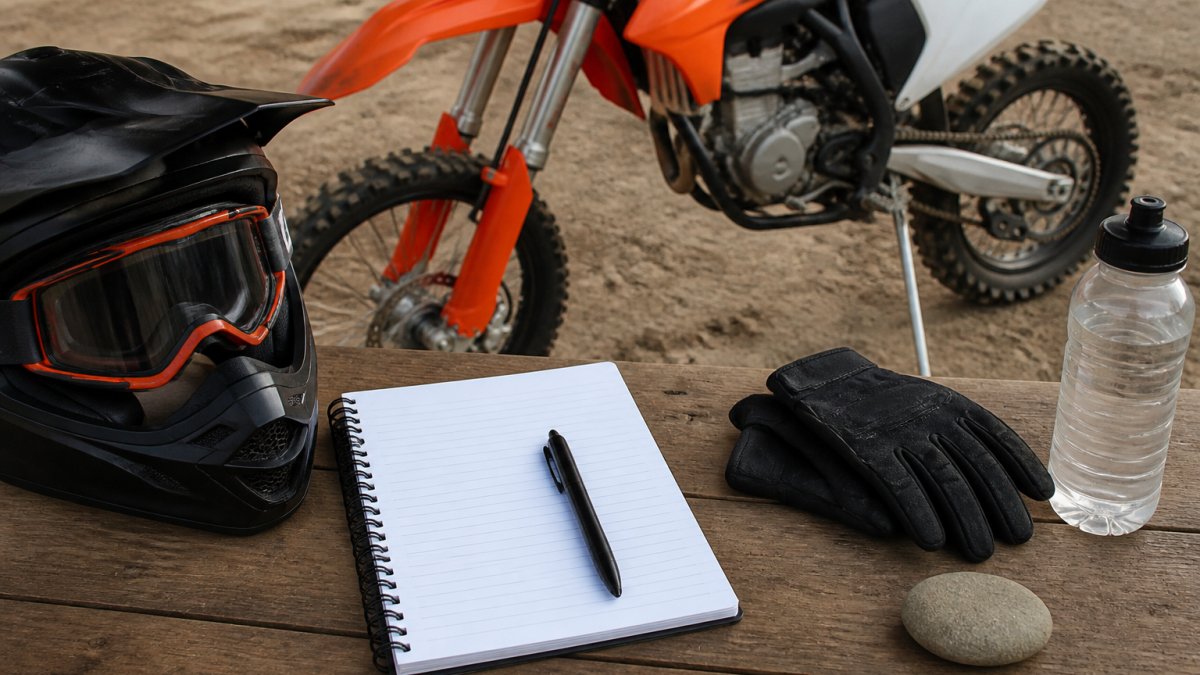
A motocross training journal transforms vague effort into measurable improvement. It's the difference between "I practiced" and "I improved my starts by focusing on throttle control for three weeks."
Nelmgerian MX training journals are designed specifically for young riders: simple, visual tools that let kids record what they did, how they felt, and what got better, not complicated spreadsheets or video analysis platforms.
What makes a training journal work is specificity.
The journal also serves parents: you can see what your child is working on, where the struggles are, and when to push versus back off. Over a season, it becomes proof that effort produces results, proof your young rider can see.
Essential Motocross Drills for Beginners at Home
Motocross drills for beginners at home don't require a track, just intention and repetition. The most effective drills build fundamentals that transfer directly to race performance.
Balance and body positioning drills are foundational. A young rider can practice on a stationary bike, in the yard, or indoors.
Core strength drills matter more than most parents realize. Motocross demands serious core stability.
Mental drills are often overlooked. Visualization, breathing exercises, and positive self-talk can be practiced anywhere. A rider who stays calm under pressure beats one who's physically stronger but mentally scattered.
Reaction drills develop the quick thinking racing demands. Responding to hand signals or verbal cues, and timed gate starts with a parent, build the neural pathways that matter in competition.
Rotate drills so training stays fresh, boredom kills consistency. A routine that changes weekly keeps young riders engaged while building real skills.
Designing a Youth Motocross Practice Routine
A solid youth motocross practice routine balances conditioning, technical work, and mental preparation. It's designed to fit into a family schedule, not consume it.
Most young riders benefit from 3-4 focused sessions per week, each 30-45 minutes, enough to build momentum without burnout. Include one conditioning day, one technique day, one mental/visualization day, and one mixed session.
The routine shifts with the racing calendar: competition season leans toward race-specific prep, off-season toward base fitness and fixing technical weaknesses. A training journal shows which approach works best for your rider.
Consistency matters more than intensity. A rider who trains 30 minutes three times weekly outpaces one doing intense 2-hour sessions once a month. The brain and body adapt to regular stimulus, not occasional heroics.
Parents should structure the routine but let the rider own it.
Strength Training and Conditioning for Young Riders
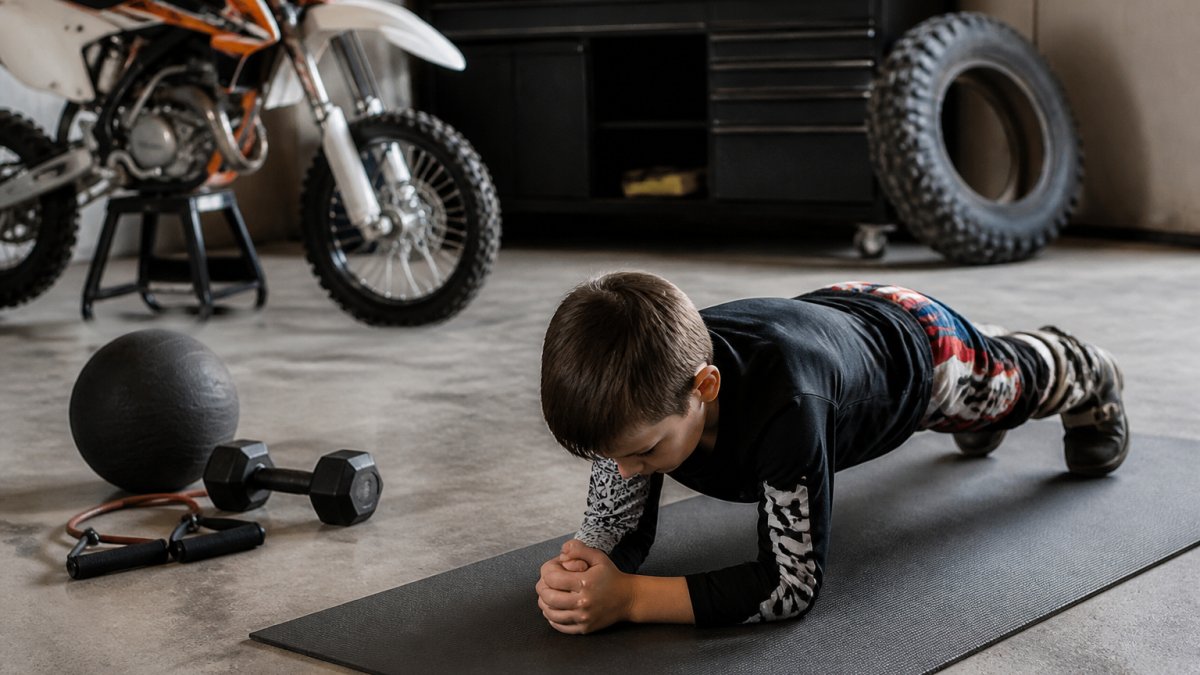
Young riders need conditioning tailored to their age and development. Strength training for motocross isn't about building muscle; it's about endurance, stability, and power. The difference between fading in the second moto and holding form comes down to off-bike work, doable in a garage, driveway, or spare bedroom.
Bodyweight first, then load
Bodyweight exercises form the foundation: push-ups, pull-ups, planks, squats, lunges, and glute bridges build functional strength with no equipment. For riders under about 10, bodyweight work plus play is enough stimulus. Add external load gradually as they get stronger and older.
Resistance bands are the most practical first purchase. A basic set of loop and tube bands runs $15-$40 and covers pulling patterns (rows, face pulls, band pull-aparts) that bodyweight work misses. They store in a drawer and travel to the track in a gear bag. Complementing these strength tools with effective home recovery gear ensures that the physical stress of your training remains manageable and sustainable over the long term.
Equipment that actually earns its space
If you're building a home setup, these are the items most motocross families find worth the footprint:
- Pull-up bar (doorway or wall-mounted): $25-$60. Doorway models need a standard 24-32 inch frame and remove in seconds. Wall-mounted versions need studs and a drill but hold more weight and don't mar trim.
- Adjustable dumbbells: $80-$300 per pair depending on max load. A pair that adjusts from 5 to 25 lb per hand covers a young rider from roughly age 8 through the teen years. Fixed hex dumbbells are cheaper per pound but you'll outgrow them.
- Kettlebells: $30-$80 each for 10-25 lb. One or two is enough for swings, goblet squats, and carries.
- Plyo box or step: $40-$120. A 12-24 inch box handles step-ups, box jumps (once a rider has landing mechanics), and elevated push-ups.
- Jump rope: $8-$20. The single best cheap conditioning tool for motocross.
- Foam roller and lacrosse ball: $15-$35 combined. Mobility and recovery.
- Yoga mat: $20-$40. Protects floors and gives a defined training zone.
A complete starter setup, bands, jump rope, pull-up bar, and one adjustable dumbbell pair, lasts years.
Space and storage reality check
You do not need a gym. A 6 ft x 8 ft clear floor area handles nearly every drill here. A doorway pull-up bar and jump rope need almost no storage; adjustable dumbbells fit under a bed; bands hang on a hook. If space is tight, prioritize: jump rope, bands, pull-up bar, then dumbbells.
Cardiovascular conditioning
Motocross is both aerobic and anaerobic. Riders need a base engine and the ability to recover between hard efforts. Interval training mimics race demands better than steady-state cardio.
A simple progression for a young rider:
- Weeks 1-2: 20 seconds hard, 40 seconds easy, repeated 6-8 times. Jump rope, shuttle runs, or bike sprints.
- Weeks 3-4: 30 seconds hard, 30 seconds easy, 8-10 rounds.
- Weeks 5+: 40 seconds hard, 20 seconds easy, 8-10 rounds, or add a second interval day per week.
Hill repeats and short sprint intervals build the same quality. Keep total conditioning time to 15-25 minutes for younger riders; longer for teens.
Flexibility and mobility
Young riders often neglect stretching, but that's where many soft-tissue injuries start. A 10-minute routine before and after sessions keeps hips, hamstrings, and shoulders moving well. Focus on hip flexors (tight from the bike), hamstrings, calves, and thoracic spine rotation.
Age-appropriate progression
A 5-year-old and a 9-year-old need very different approaches.
- Ages 5-7: Bodyweight only. Focus on movement quality, balance, and play. No added load.
- Ages 8-10: Bodyweight plus light bands and very light dumbbells (5-10 lb). Emphasize technique over weight.
- Ages 11-13: Add moderate loads (10-25 lb), introduce structured interval work, and start tracking progress in a journal.
- Ages 14+: Full strength and conditioning programming with progressive overload, provided technique is solid.
Conditioning should progress gradually. Age-appropriate progression prevents injury and keeps training sustainable.
Screen-Free Resources and Learning Tools
Most searches for BuddyMX alternatives home training start with the same question: what does the app actually do, and what can replace it without another subscription? BuddyMX is primarily a training and coaching platform, so the comparison isn't app-versus-app, it's app-versus-everything-else: journals, printed programs, in-person coaching, and structured practice you run yourself.
What a coaching app typically provides
App-based training platforms generally bundle some combination of:
- Guided workouts or drill libraries
- Video demonstrations
- Progress tracking and streaks
- Feedback or form cues
- Community or leaderboard features
- A recurring subscription
Those features are real and useful, but so are the trade-offs: screen time, monthly cost, dependence on a charged device and internet connection.
What a training journal replaces
A motocross training journal covers structured practice, measurable progress, and accountability. It doesn't replace video feedback.
Here's a direct feature comparison:
| Feature | Typical coaching app | Training journal |
|---|---|---|
| Guided drills | Yes, generic library | Yes, rider-chosen and track-specific |
| Progress tracking | Automatic, app-defined metrics | Handwritten, rider-defined metrics |
| Video feedback | Sometimes | No |
| Screen time | High | None |
| Monthly cost | Recurring subscription | One-time purchase |
| Works offline | Rarely | Always |
| Customization | Limited to app's content | Fully open |
| Accountability | Streaks and notifications | Parent review and rider ownership |
Books and storybooks
Storybooks featuring motocross characters build reading skills while keeping kids connected to the sport. Characters like Ryder, Pepper, and Wheelie from Nelmgerian MX stories show young riders what confidence, perseverance, and sportsmanship look like, lessons that transfer directly to racing.
Activity books and workbooks
Activity and coloring books keep kids engaged during downtime, screen-free ways to stay connected to motocross culture, reinforce learning, and build fine motor skills. They also include younger siblings who aren't riding yet but want to be part of the routine.
When an app still makes sense
There are situations where a coaching app earns its subscription:
- Your rider is working on a specific technical skill that benefits from slow-motion video review.
- You want structured programming you don't have to design yourself.
- Your rider responds well to streaks, badges, or digital accountability.
- You're traveling frequently and need something that fits in a pocket.
If none of those apply, a journal plus a printed routine will usually get you further.
Building the habit
Physical resources build habits that last. A rider who reads motocross stories and fills out a training journal develops a relationship with the sport. The journal also gives parents a concrete artifact to review weekly, turning training into a conversation instead of a nag.
American Motorcyclist Association youth rider resources
Frequently Asked Questions
What makes a motocross training journal effective for young riders?
A motocross training journal helps young riders track progress by recording practice sessions, goals, and skill improvements. Journaling builds accountability and allows parents to see exactly what their child is working on between rides. For beginners, journals create a structured routine and help riders remember drills and techniques they've learned. When paired with feedback from coaches or parents, journals become a tool for measurable progress, children can flip back and see how far they've come, which builds confidence and motivation.
Can young motocross riders improve without a dirt bike at home?
Yes. Home training builds the foundation for better riding. Young motocross riders improve through strength and conditioning, balance exercises, flexibility work, and mental preparation. Calisthenics, resistance bands, and bodyweight training develop the core and leg strength needed for control on the bike. Visualization and studying technique through books and resources reinforce what they learn at the track. Many beginning riders benefit most from off-bike conditioning and confidence-building before they spend more time in the saddle.
How often should a beginner motocross rider practice home drills?
Most young riders benefit from 3-4 home training sessions per week, lasting 20-30 minutes each. This frequency builds strength and technique without overtraining. Consistency matters more than intensity for beginners. A structured youth motocross practice routine that includes warm-up, focused drills, and cool-down keeps young riders engaged and prevents boredom. Parents should pair physical drills with journal entries so children track what they've done and set goals for the next session.
What's the difference between BuddyMX alternatives and a full training academy?
BuddyMX alternatives like motocross training journals and home resources give families control over their training schedule and budget. They're ideal for building foundational skills, confidence, and discipline between track days. Full academies offer in-person coaching and structured progression but require travel. Many families use both: home training journals and drills for consistent practice, and periodic academy sessions for expert feedback. The best approach depends on your child's age, experience level, and access to coaching.