 how-to
7 Motocross Jump Progression Drills for Nervous Riders
Last Updated: October 24, 2026
Quick Summary
A staged motocross jump progression builds confidence in four phases: setup, flat ground, small features, and mental work. You start with bike and site checks, drill standing position and throttle control on flat ground, then move to rollers, tabletops, and doubles only after passing a five-point test.
- Walk the jump and check the landing before any wheel leaves the ground.
- Jump early in the day, on fresh legs, before fatigue dulls throttle control.
- Roll a set of rollers smoothly without sitting or braking before trying a tabletop.
- Use box breathing for three rounds at the base of the jump before every attempt.
- Drop back one step in the progression and re-pass the test after a bad jump.
Table of Contents
- Why Nervous Riders Need a Staged Jump Progression Plan
- Safety Setup and Site Assessment Before Any Jump Drill
- Dirt Bike Jumping Practice Drills That Start on Flat Ground
- Dirt Bike Balance Drills for Airborne Control and Stability
- How to Jump a Dirt Bike Straight With a Consistent Approach Line
- Motocross Mental Training: Fear Management for Nervous Riders
- Objective Criteria for Advancing to Bigger Jumps
- Common Mistakes and How to Recover From Them
- Frequently Asked Questions
Why Nervous Riders Need a Staged Jump Progression Plan
Nervous riders freeze at the base of a jump because their brain reads the lip as a threat, not a target.
The problem with most jump advice is that it starts at the takeoff. That is the last thing a scared rider should think about.
Here is the core argument of this guide: nervous riders do not need more courage. They need a better sequence. Get the order right and the courage shows up on its own.
What does a staged plan actually look like? It moves through four phases:
- Setup: check the bike, the site, and the gear before any jumping
- Flat ground: build body position, throttle control, and balance
- Small features: rollers, then tabletops, then doubles
- Mental work: breathing, visualization, and a decision rule for backing off
Each phase has drills and a clear exit test. You do not move on until the rider passes it.
Safety Setup and Site Assessment Before Any Jump Drill
Before a single wheel leaves the ground, walk the jump and check the landing. That order is not optional. A rider who trusts the landing will commit to the takeoff.
Start with the bike. Tire pressure, brake function, chain tension, and suspension settings matter more for jumping than for any other riding skill.
Then walk the site with the rider, out loud:
- Lip: is the takeoff face smooth and dry, or rutted and loose?
- Landing: is it longer than the jump, with a downslope rather than a flat?
- Run-up: is there a straight approach line with enough room to build speed?
- Exits: if the rider decides not to jump, is there a safe way around the feature?
- Track conditions: wind, recent rain, and how other riders are using the line
The last point matters more than most parents expect. A jump that works in dry conditions can become dangerous after rain.
Dirt Bike Jumping Practice Drills That Start on Flat Ground
Flat ground is where jump technique is actually learned. Every skill that keeps a rider stable in the air can be drilled at walking pace in an open field. These dirt bike jumping practice drills need nothing more than a marked straight line and a few cones.
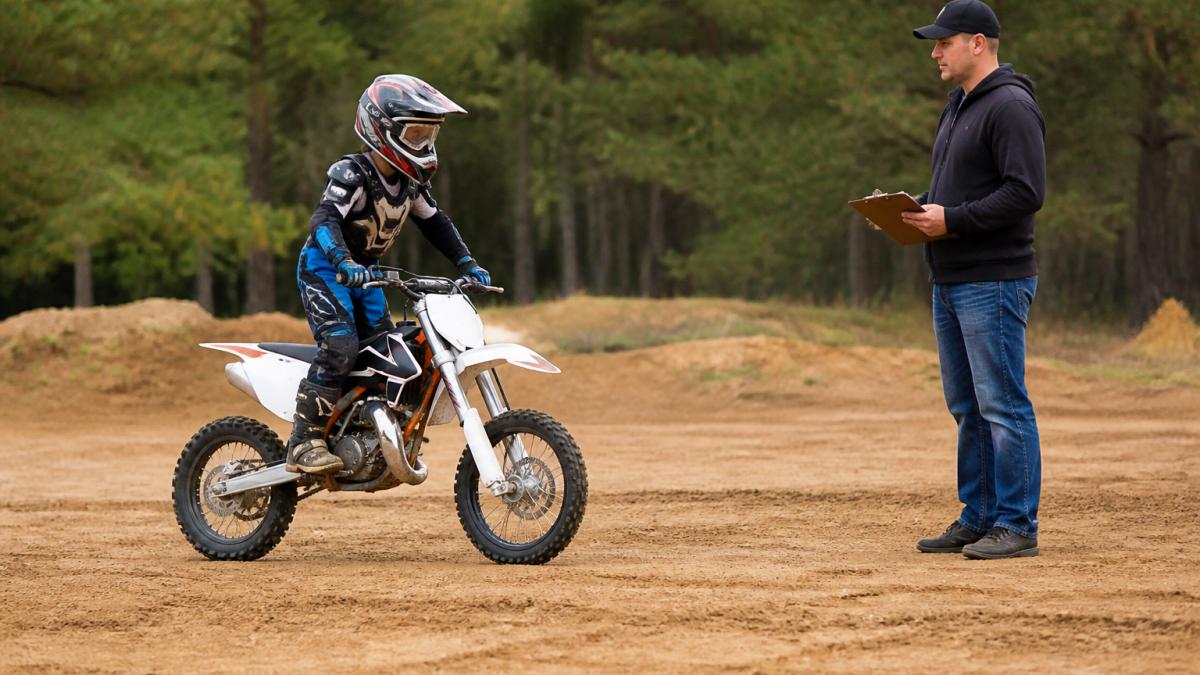
Drill 1: Standing Position and Peg Pressure
Set the bike on a stand or have the rider stand still in gear. Feet on the pegs, knees bent, elbows up and out. The rider should squeeze the bike with the knees and press down through the pegs, not sit on the seat.
Run a slow figure-eight with the rider standing the whole time. Ten minutes, no speed. The goal is simple: the rider finishes the drill without sitting down. That standing position, drilled until it is automatic, is what keeps the bike stable when the wheels leave the ground.
For riders who want more foundational work before jumps, our guide to dirt bike riding drills for beginners covers the flat-ground basics in more depth, and younger or more nervous riders can follow a step-by-step beginner drill guide for kids that pairs well with these jump drills.
Drill 2: Throttle Control and Smooth Acceleration
Mark two cones about 30 feet apart. The rider accelerates from the first cone and holds a steady, smooth throttle until the second. No blipping. No chopping.
Repeat it five times, then shorten the gap. Smooth acceleration on flat ground becomes smooth acceleration up a jump face, and that is the whole skill. Nervous riders tend to chop the throttle at the lip, which drops the front wheel and pitches the rider forward. Drilling steady throttle on flat ground builds the habit before fear can break it.
Drill 3: Rollers as Stepping Stones
Rollers are the bridge between flat ground and real jumps. A roller has a takeoff and a landing without the gap, so the rider learns the body position and the throttle timing with a much smaller consequence.
Have the rider roll the first roller at low speed, standing and centered, five times. Then roll it at a slightly higher speed. Then roll two rollers in a row. Only when the rider can roll a set of rollers smoothly, without sitting or braking on the face, does the rider move to a small tabletop.
Dirt Bike Balance Drills for Airborne Control and Stability
Balance drills build the small corrections that keep a bike straight in the air.
Set up a slow-speed straight line, maybe 50 feet, and have the rider ride it standing, as slowly as possible, without putting a foot down. Do it five times.
Add a small log or a low curb. The rider rolls over it standing, absorbing the bump with the knees and elbows rather than the spine.
The thing nobody tells you about airborne control is that it is mostly decided before takeoff.
How to Jump a Dirt Bike Straight With a Consistent Approach Line
Learning how to jump a dirt bike straight starts with picking one line and repeating it until it is boring.
Pick a line, mark the entry with a cone, and ride it at a set speed.
Most nervous riders drift toward the outside line, which is fine. An outside line usually offers a longer, straighter run-up and a cleaner view of the landing.
Straight tracking comes from the rider's eyes. Look at the landing, not the lip. A rider who stares at the takeoff tends to steer at the takeoff.
Motocross Mental Training: Fear Management for Nervous Riders
Motocross mental training works best when it is specific and short. Fear management for nervous riders is not about pumping yourself up. It is about lowering the stakes until the brain stops treating the jump as a threat.
The protocol we recommend has three parts, done in order:
- Name the fear out loud. "I am scared of casing the landing." Vague fear is bigger than named fear.
- Shrink the step. If the rider is scared of the tabletop, the drill is the roller. If the roller is scary, the drill is flat ground.
- Set a decision rule before the attempt. "If I am not standing and steady at the entry cone, I roll the jump." A pre-made decision removes the panic choice at the lip.
Riders who struggle with fear want concrete exercises to pair with the breathing and visualization work below, and our guide to motocross mental preparation exercises for beginners covers those in detail.
Breathing Drills and Visualization Before Takeoff
Box breathing is the simplest tool. In for four counts, hold for four, out for four, hold for four. Do it at the base of the jump, three rounds, before every attempt.
Visualization comes next. Have the rider close their eyes and walk through the jump in first person: the entry cone, the throttle, the takeoff, the landing, the roll-out. Thirty seconds. Then ride.
This pairing works because it gives the nervous system a script. A rider who has already "ridden" the jump in their head has one less unknown to manage at the lip.
Objective Criteria for Advancing to Bigger Jumps
Progress should be earned, not rushed. We use a simple pass test for each step, and the rider does not move up until every box is checked:
- Five clean repetitions in a row at the current feature size
- Standing position held from entry to landing, no sitting
- Steady throttle through the takeoff, no chopping
- Straight tracking, landing in the same spot each time
- Rider can explain the decision rule and used it at least once
A rider who passes all five on a roller is ready for a small tabletop. A rider who passes all five on a small tabletop is ready for a slightly bigger one.
This is where a written record helps.
When the rider is ready to build a full weekly structure around these drills, our step-by-step motocross training plan for beginners lays out how to sequence practice days, rest, and race preparation.
Common Mistakes and How to Recover From Them
Most jump problems on a nervous rider's bike trace back to one of five mistakes. Here is what each looks like and how to fix it.
| Mistake | What You See | Fix |
|---|---|---|
| Chopping the throttle at the lip | Front wheel drops, rider pitches forward | Re-drill smooth acceleration on flat ground |
| Sitting on the takeoff | Bike pitches nose-high, rider lands off-balance | Standing position drill, five reps before jumping |
| Staring at the lip | Bike steers off line, inconsistent landing | Eyes on the landing, entry cone at the same spot |
| Jumping while tired | Late throttle, sloppy body position | Jump early in the session, stop when form breaks |
| Skipping a step after one good jump | Confidence spike, then a crash or stall | Pass test before every size increase |
The recovery response is the same for all five: drop back one step in the progression and re-pass the test.
Readers who hit repeated problems during practice will find a broader list of common dirt bike riding mistakes and fixes useful alongside this section.
Fear at the base of a jump is not a character flaw, and it is not fixed by a pep talk.
At Nelmgerian MX, we build tools for exactly this kind of patient progress.
Get started with Nelmgerian MX and give your rider the journals and stories that make steady progress feel like an adventure.
Frequently Asked Questions
How can a nervous rider build confidence on jumps?
Start smaller than you think you need to and repeat each step until it feels boring. Roll small jumps before you air them, then move to a slightly larger feature only when your approach line, throttle control, and landing feel consistent three sessions in a row. Pair each riding step with a short mental routine: two slow breaths, a quick visualization of a clean takeoff, and one clear cue like "steady throttle." Confidence grows from repeatable practice, not from forcing a big jump on a bad day.
What drills help improve dirt bike jumping technique?
Build a base with flat-ground drills first. Practice standing position with knees bent and steady leg pressure, then work on throttle control and smooth acceleration in a straight line. Move to dirt bike balance drills on rollers and small features, focusing on straight tracking and consistent body position. Once those feel automatic, take the same cues to a small tabletop or double. Each drill should be repeatable, and you should be able to describe exactly what went right or wrong after every pass.
How should beginners progress from flat ground to small jumps?
Treat progression as a ladder. Start on flat ground with body position and throttle drills, then roll rollers and small jumps without leaving the ground. Next, air a small jump at a controlled speed, focusing on a consistent approach line and a safe landing. Only move up in feature size when you can repeat the smaller jump calmly and land where you planned.
How do you stay calm when approaching a motocross jump?
Calm comes from preparation, not luck. Before the gate drops, use breathing drills and visualization as part of your motocross mental training: picture the approach, the takeoff, and the landing, then pick one cue word. On the bike, commit to your line early and avoid last-second throttle changes, which unsettle the bike. If fear spikes, roll the jump instead of forcing it and return when you feel steady. A rider who knows the next step in the progression has far less to be nervous about.